Catholic saint biography
St. Kizito
St. Kizito was the youngest of the Catholic Uganda martyrs, about 14 when he died at Namugongo on June 3, 1886. A page in the royal court of Buganda, he was baptized by Charles Lwanga shortly before his martyrdom.
- Commemoration:
- June 3
- Patron Saint of:
- children
- Lived:
- c. 1872–1886 — Buganda, present-day Uganda
Celebrated with Charles Lwanga and companions on June 3.
Why dates and liturgical observances can differ
Read the sources for this biography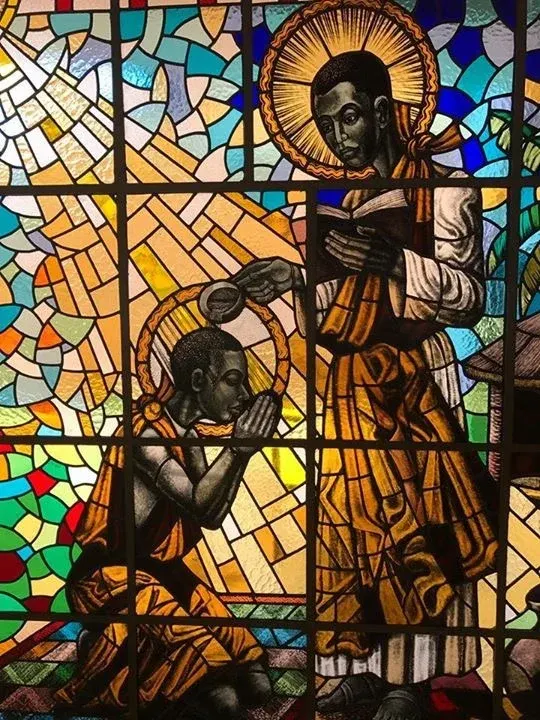
Kizito's story: age, martyrdom and remembrance
Who ordered Kizito's death, and how did he die?
King Mwanga II ordered the execution of Christian subjects who would not renounce their faith. Kizito was burned to death with companions at Namugongo on June 3, 1886. The king's order and the execution are distinct events; the account does not mean the king personally carried out the killing.
How old was Kizito, and who baptized him?
The Kampala account places his birth around 1872 and his age at death at about 14. Charles Lwanga baptized him during the persecution in May 1886. Munyonyo Shrine preserves the memory of that baptism; Namugongo is the place of his martyrdom. Keeping the two places distinct helps make sense of his final days.
When is Saint Kizito's feast day?
Kizito is remembered on June 3 with Saint Charles Lwanga and companions. In the General Roman Calendar this celebration is a memorial. His witness can be honored through prayer and care for vulnerable young people; it is not a reason to encourage children to put themselves in danger.
A prayer for courage and care
God of mercy, help us protect children and stand beside those who are afraid. Through Saint Kizito's intercession, give us courage to do what is right and wisdom to seek help when we need it. Amen.
Original prayer by Saint Discovery; not a quotation from the saint or an official liturgical text.
These answers were compared with the linked sources on using AI assistance.
Biography
Kizito was a young page at the court of King Mwanga II of Buganda. He learned Christianity within the court's small Christian community and received protection and instruction from Charles Lwanga. As persecution intensified in May 1886, Lwanga baptized him shortly before the Christian pages were condemned. He was approximately fourteen years old.
Court service placed young pages close to authority but did not give them independence from it. Christian instruction developed through relationships among members of the household. Lwanga's role as teacher and protector is therefore important: Kizito's final days were part of a community's experience rather than an isolated private act.
Kizito was burned to death with companions at Namugongo on June 3, 1886. The Kampala tradition remembers his composure and encouragement of other prisoners, while identifying him as the youngest of the Catholic Uganda martyrs. His story concerns a child's vulnerability to royal power and his commitment to faith; it should not be embellished with invented last words or treated as a call for children to seek danger.
His remembrance is inseparable from the other Uganda martyrs and from Namugongo, the place associated with their deaths. The available account concentrates on conversion and martyrdom, leaving much of his childhood undocumented. Keeping that limit visible is preferable to inventing hobbies, private thoughts, or a detailed upbringing that the evidence does not supply.
Context & contribution
Baptism remembered through place and stained glass
The Munyonyo shrine's dedicated baptism account identifies Kizito alongside Gyaviira Musoke, Mbaga Tuzinde, and Mugagga Lubowa as catechumens baptized by Charles Lwanga in May 1886. That grouping preserves the names of companions whose instruction and initiation occurred within the same threatened community.
The basilica represents the baptism in stained glass. This gives visitors an entry into Kizito's story before the execution at Namugongo: a young person receiving the faith through the care of another African Christian. The window is a modern act of remembrance, while the event it depicts belongs to the shrine's historical tradition. Keeping those layers distinct helps explain how pilgrimage communicates the martyrs' history.
Explore the sources for this section
AI-assisted source comparison updated 2026-09-26. Editorial approach
From the Saint Discovery blog
Keep exploring your faith
Practical guides to prayer, the saints, and living the Catholic faith.
Why Do Catholics Pray to Saints? Intercession Explained
Why do Catholics pray to saints? Learn how intercession differs from worship, how it relates to Jesus, and a simple way to ask a saint to pray for you.
A next step with your saintRead the article Living the seasonsHow to Celebrate Your Patron Saint's Feast Day at Home
Celebrate your patron saint's feast day with prayer, a short biography, and an act of kindness. A practical plan for families, sponsors, and individuals.
A next step with your saintRead the articleFrom reading to reflection
What will you carry with you?
After reading about St. Kizito, take a moment to consider:
- Study the shrine's baptism scene and identify teacher, learner, and witnesses; explain how focusing on initiation changes a biography centered only on death.
These are reflection prompts from Saint Discovery, not quotations from the saint.
Sources and further reading
Biography source comparison recorded on . This is an AI-assisted comparison, not independent human or ecclesiastical approval.
What the recorded review covers
AI-assisted expansion of the existing source-reviewed biography with comparison to retrieved cited sources; not ecclesiastical approval
A source list helps you check an account; it does not establish that every claim is certain. Follow the biography’s qualifications about historical evidence, traditions and feast calendars.
Suggest a correction to this biography
How we research these pages and handle corrections · Directory corrections log
More lives to explore
Suggestions based on the site’s quiz themes, not a historical relationship or a measure of holiness.