Catholics pray to saints to ask for their intercession: their prayers to God on our behalf. Catholic teaching does not place saints alongside God as rival sources of salvation. It understands them as members of Christ's Church whose love and prayer continue in heaven.
That distinction can be hard to recognize if the language is unfamiliar. Here is what Catholics mean, why Jesus remains central, and how someone new to the practice can begin.
What does “pray to a saint” mean?
In this setting, it means addressing a request for prayer to a saint. The simple phrase “Saint Catherine, pray for us” expresses that intention clearly. The person being asked is a fellow member of the Church; the prayer is directed toward help from God.
The Catechism, paragraphs 954–957, describes the unity of the Church on earth and in heaven. Paragraph 956 specifically teaches the saints' intercession through Christ. Catholics therefore approach the saints as companions in a shared life of faith, not as replacements for the Lord.
Is asking a saint for prayer the same as worship?
No. Catholic teaching distinguishes the honor given to saints from the adoration owed to God. For example, in discussing sacred images, the Catechism, paragraph 2132, distinguishes respectful veneration from divine adoration.
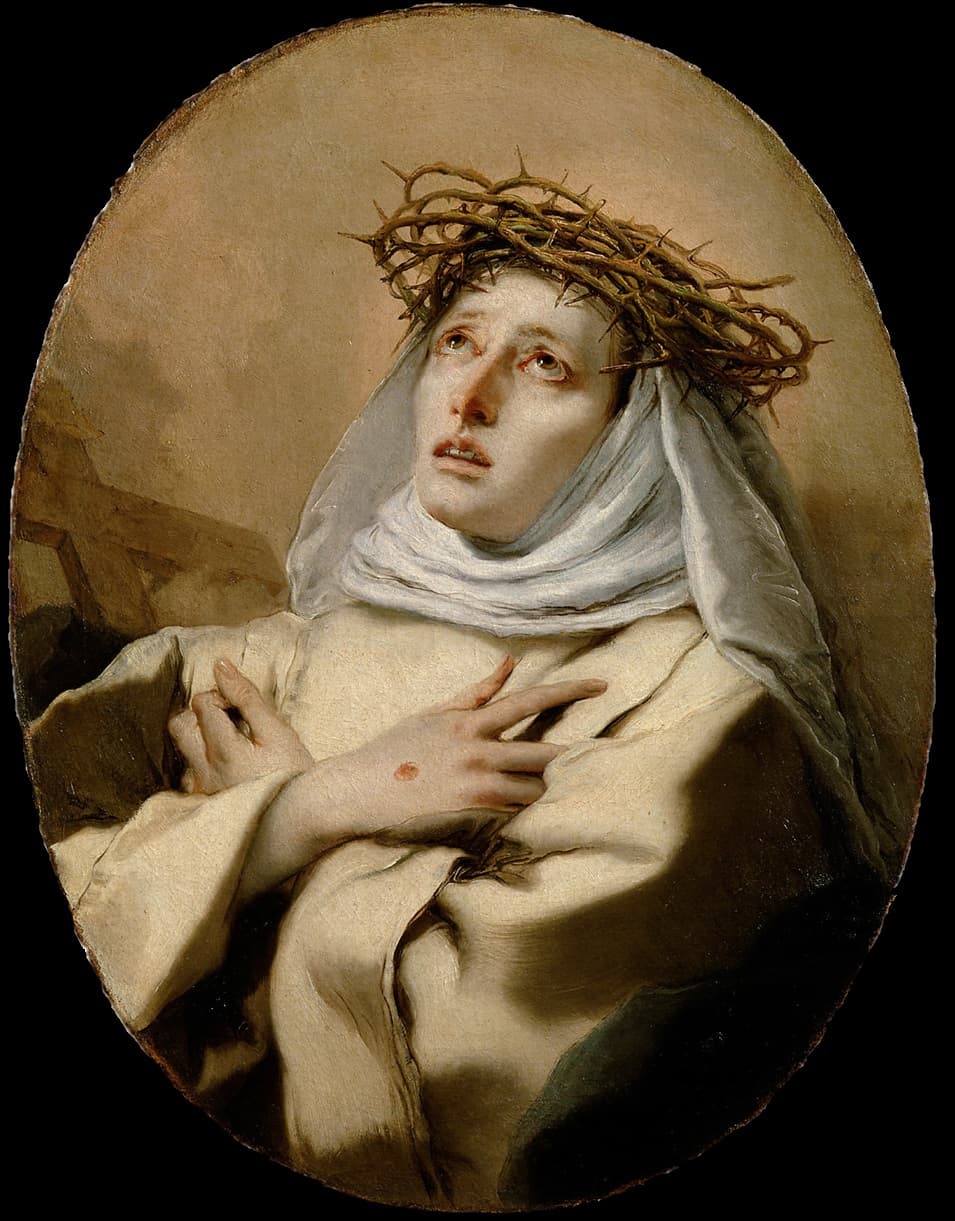
An image can help someone remember a saint and their example; the picture itself is not a god. The painting accompanying this article depicts Saint Catherine of Siena. Learning who she was can give a devotional image context rather than leaving it as an unfamiliar religious object.
The language you choose can make your intention clearer. “Please pray for me” is a useful starting point when you are explaining the practice to a friend or learning it yourself.
What about Jesus being the one mediator?
First Timothy 2:1–6 both urges prayer for others and identifies Jesus Christ as the one mediator between God and humanity. Catholic teaching understands intercessory prayer as depending on Christ, not competing with him.
The Catechism's explanation of intercession, paragraphs 2634–2636, places Christian intercession within Christ's own prayer. Asking another person to pray for you does not create a second savior. Catholics understand the saints' prayer in that same Christ-centered communion.
This does not mean that every Christian tradition accepts invoking saints. It explains how the Catholic practice fits together with Catholic belief in Christ's unique saving role.
Why ask saints instead of praying directly to God?
Catholics do pray directly to God. Asking for a saint's prayers is an additional expression of communion, not a rule that someone must go through a saint before approaching Jesus.
In his general audience of April 7, 2021, Pope Francis described prayer as joining a community that includes believers on earth and the saints in heaven. The emphasis is on shared prayer and mutual concern, not a barrier between a person and God.
You might bring the same concern to God in private prayer, ask a friend to remember you, and ask a saint to intercede. Those requests need not be in competition.
How does Scripture connect heaven with our prayers?
In Revelation 5:8, the heavenly elders hold bowls of incense identified with the prayers of the holy ones. The scene belongs to a vision of worship centered on the Lamb. Catholics read it within the wider teaching on the communion of saints, not as a stand-alone instruction describing every later devotional practice.
That distinction makes a conversation more honest. The passage contributes to the biblical picture of heavenly worship and prayer. The Church's teaching about invoking saints draws on Scripture read within its received faith; a reader should not claim that this verse alone resolves every disagreement between Christian traditions.
Is asking saints for prayer the same as consulting the dead?
Catholic teaching rejects divination and attempts to conjure the dead or use hidden powers to obtain knowledge or control. See Catechism 2115–2117. Asking for intercession has a different purpose: prayer to God within communion in Christ. It does not require a medium, a message from a deceased person, or a prediction of the future.
For example, “Saint Catherine, pray that I act with courage and charity” expresses a request for prayer. Trying to obtain secret information or a guaranteed outcome through an object or ritual changes the nature of the activity. If a practice is presented as a way to force an answer, step back and ask your parish for guidance. The saints are not independent supernatural services assigned to deliver results; their intercession remains dependent on God.
How to ask a saint to pray for you
You do not need to begin with a long devotion or specialized vocabulary. Try these three steps:
Choose a saint whose life you would like to understand. Read a short biography rather than relying only on a name or image.
Name a need honestly: patience with someone, courage for a difficult conversation, or help remaining faithful to a responsibility.
Ask the saint to pray for you, then bring the concern directly to God and consider your next practical step.
Here is an original prayer you can adapt:
Saint ___, please pray for me as I face ___. Lord Jesus, help me respond with faith, wisdom, and love. Guide my choices and help me care for the people around me. Amen.
This is a suggested prayer written for this article, not a historical quotation or an officially prescribed formula.
The Catechism, paragraph 2683, presents saints as witnesses who share in the Church's prayer through their lives, writings, and intercession. Reading about a saint can therefore accompany prayer rather than becoming a separate collection of facts.
A patron saint is a companion, not a guarantee
It is natural to look for a saint connected with your work, family, studies, or a difficulty you are facing. Our patron-saint guides offer starting points and explanations, with links to biographies for deeper reading.
Keep the relationship grounded in faith. A prayer is not a technique for forcing a particular outcome. The Catechism, paragraph 2111, cautions against treating religious practices as though their outward performance alone had magical power.
You can ask sincerely for a particular help while remaining open to God's will. You can also act on the need in front of you: prepare for the conversation, offer the apology, study for the exam, or ask a trusted person for support.
Questions people often ask
Are saints gods?
No. The Catholic understanding described above honors saints as people united to Christ. Adoration belongs to God; a request for a saint's intercession asks for prayer.
Do I have to use a special prayer?
For a simple personal request, “Saint ___, pray for me” expresses the intention. You may also use an established devotion or the original prayer above. Clear, sincere words are a good place to begin.
Can I pray to Jesus directly?
Yes. Direct prayer to God belongs at the heart of Christian life. The saints' intercession is understood within that relationship, not as an alternative to it.
How do I choose a saint to learn about?
Begin with your baptismal or Confirmation patron, a saint from your parish's name, or a biography that interests you. Browse the saint directory and follow the sources. Once you have a starting point, you might mark the relationship with a simple feast-day reflection.
Sources and further reading
Catechism, 954–957: the communion and intercession of saints.
Pope Francis: Praying in Communion with the Saints, April 7, 2021.
Cover artwork: Saint Catherine of Siena, Giovanni Battista Tiepolo, public domain.
