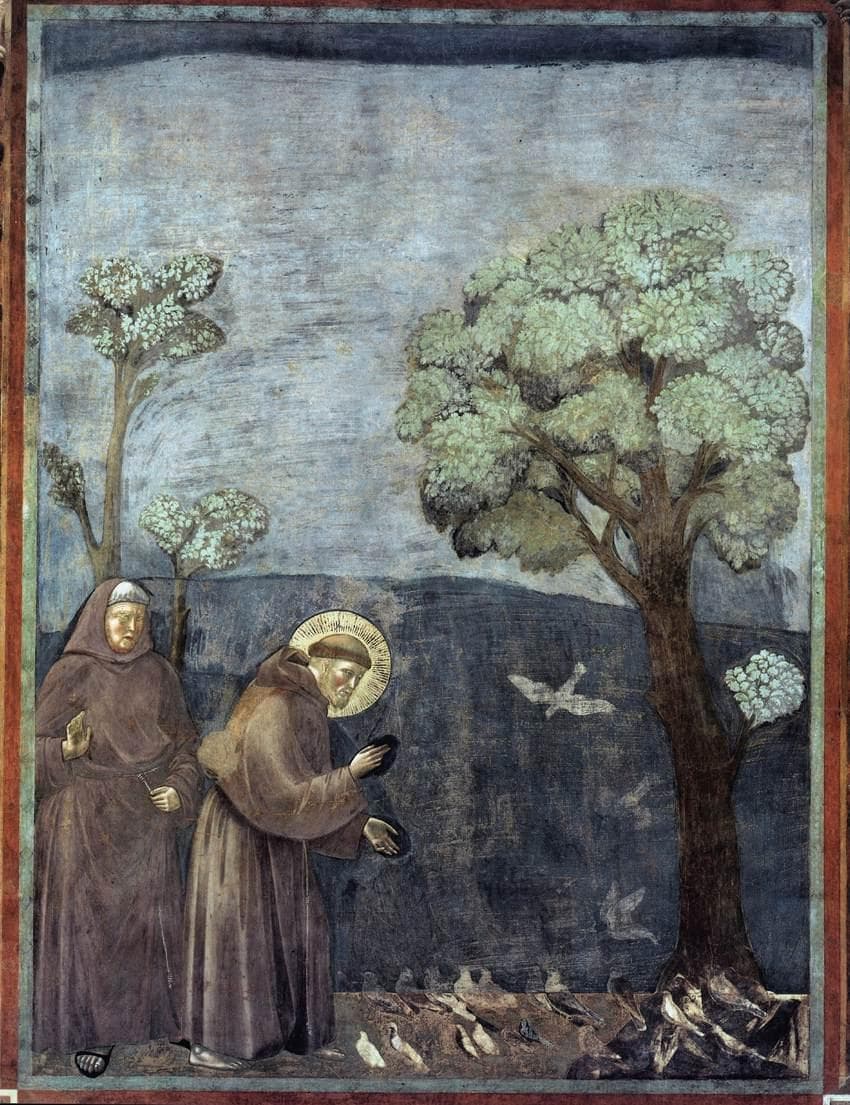
The Canticle of the Creatures is a song of praise that Saint Francis of Assisi began composing in 1225, near the end of his life. It praises God for the sun, moon and stars, wind, water, fire and earth, then for people who forgive and endure hardship, and finally for “Sister Bodily Death.” It is also called the Canticle of Brother Sun. Francis composed it in his own Umbrian dialect, and it is often counted among the earliest poems in Italian with a known author.
October 4 is associated with Saint Francis, and many parishes and families turn to this prayer around that date. The liturgical celebration depends on the year's calendar: in the 2026 United States calendar, October 4 is the Twenty-Seventh Sunday in Ordinary Time. Check your parish or Franciscan community's calendar for its observance. This guide explains where the Canticle came from, what its images mean, and how you can pray with it this week.
When and why did Francis write it?
According to the Franciscan friars, Francis spent about fifty days at San Damiano, near Assisi, in the spring of 1225, a few months after his experience on La Verna. He was seriously ill. After a night troubled by pain, he received an assurance of God’s love and salvation, and he responded with this hymn of praise. The Order of Friars Minor’s centenary page describes that setting and lists the early Franciscan sources that record it, including the Assisi Compilation.
That context matters. The Canticle is not the work of someone admiring a pleasant view on a good day. It comes from a sick man who still found reasons to thank God for light, water and warmth he could barely enjoy.
Why does it call creatures “brother” and “sister”?
Francis addresses Brother Sun, Sister Moon, Brother Wind, Sister Water, Brother Fire and “our Sister Mother Earth.” He is not treating creatures as divine. Every stanza praises God, the Most High, and the creatures belong to that praise because God made them.
Pope Francis drew on this in the encyclical Laudato Si’, whose title comes from the Canticle’s refrain, “Laudato si’, mi’ Signore” (“Praise be to you, my Lord”). In paragraph 10, he calls Francis the patron saint of all who study and work in ecology. In paragraph 11, he explains that Francis spoke to creatures as brothers and sisters and refused to treat the world as a mere object to be used and controlled.
The family language invites humility. A brother or sister is not a possession. Calling water “Sister Water” is a way of receiving it as a gift that you share with others and for which you owe thanks.
The biblical pattern behind this prayer
Read Psalm 148 beside the Canticle. The psalm summons the heavens, sun, moon, creatures, and people to praise the Lord. Francis's prayer belongs within that biblical pattern of creation praising its Creator. Its family language gives the pattern a distinctive warmth without dissolving the difference between God and what God makes.
Another illuminating companion is Daniel 3:52–90, where the three companions in the furnace call upon the natural world to bless God. Praise is voiced in a setting of danger, not only after everything becomes comfortable. Reading that passage beside the account of Francis's illness helps prevent a sentimental reading of the Canticle.
For a short study exercise, notice one shared image and one difference in emphasis. Then ask whom the praise addresses. The answer is God: the sun and water are fellow creatures within the praise, not replacements for its divine recipient.
“Through,” “for,” or “by”: what does the refrain mean?
Each verse praises God “per” a creature. The old Italian word can be translated as “through,” “for,” or “by,” and translators make different choices. Franciscan Media’s history of the Canticle reads it mainly as “through,” so that creatures become channels of praise.
You do not need to settle the question to pray the Canticle. The meanings fit together: we praise God for the gift of the sun, the sun’s brightness reflects something of its Maker, and all creation gives glory to God simply by being what God made it to be.
The stanzas Francis added later
The Canticle grew in stages. Francis first composed the praise of God and the creatures. Later he added lines praising those who forgive for love of God and who bear illness and trial in peace. He wrote them during a bitter dispute between the bishop and the mayor, or podestà, of Assisi. Francis’s brothers sang the song before both men, and the early sources report that the two were reconciled. See the Franciscan Media overview of the Canticle for this account.
Near his death, Francis added the final stanza, which praises God for “Sister Bodily Death,” whom no living person can escape. Franciscan Media’s history notes that Thomas of Celano, his first biographer, describes Francis welcoming death with trust. The same stanza warns against dying in mortal sin and calls blessed those whom death finds doing God’s will. Francis’s calm is not denial. It rests on the hope of eternal life with God.
These added verses make the prayer more than a nature poem. Forgiveness, patience and a holy death are also part of what Francis praises God for.
Does caring for creation distract from caring for people?
Pope Francis joins these responsibilities rather than asking us to choose between them. Laudato Si’ 48–49 describes the particular burdens environmental harm places on people who are poor. A prayer of gratitude for water therefore invites attention both to wasting it and to neighbors who lack safe access to it.
A family or parish group could connect the prayer with one concrete question: when we replace supplies, organize a meal, or clean a shared space, who benefits and who bears the inconvenience? For example, reduce avoidable food waste while checking what a local food ministry actually accepts. This is a contemporary application of the prayer, not an activity Francis prescribed.
The Canticle's movement toward forgiveness also keeps ecology from becoming an excuse to neglect difficult human relationships. Let care for the earth accompany patience, fair treatment, and reconciliation in the same household.
How to pray with the Canticle this week
You can find reliable translations through Franciscan publishers, your parish or a hymnal. Many parishes also sing “All Creatures of Our God and King,” a later hymn inspired by the Canticle. Here is a simple five-day way to use it before October 4.
Day 1, light: Pray the verses about the sun, moon and stars in the morning or evening. Name one person who has brought light to a hard season in your life and thank God for them.
Day 2, water and fire: Before a meal, a shower or lighting a candle, stop and thank God for the gift. Ask how you might use it with care, or share it with someone who lacks it.
Day 3, earth: Spend ten minutes outside, or look at a plant or a window view. Francis praises the earth for sustaining us with fruit, flowers and herbs. Consider one small habit that reduces waste in your home.
Day 4, pardon: Read the verse about those who forgive. Is there a person you need to forgive, or someone you need to ask for forgiveness? Bring that name to prayer, even if you are not ready to do more yet.
Day 5, Sister Death: Read the final stanza slowly. Pray for someone who is ill or has died, and ask for the trust that Francis showed.
If praying with a written text is new to you, our beginner’s guide to lectio divina offers a gentle method for reading slowly and responding to God. For a wider introduction, see What Is Prayer? A Catholic Guide for Beginners.
An original closing prayer
This short prayer was written for Saint Discovery and is not part of the Canticle:
Most High and good Lord, thank you for the gifts I often overlook: light, water, food and the people who make my days brighter. Teach me to receive your creation with humility, to forgive as I have been forgiven, and to trust you in sickness and at the hour of death. Saint Francis, pray for us. Amen.
Learn more about Saint Francis
To learn more about his conversion, his love of poverty and the Franciscan family he founded, read our biography of Saint Francis of Assisi. If you are planning a celebration on October 4, our guide to celebrating a patron saint’s feast day at home offers simple ideas for families. Check the USCCB liturgical calendar or your parish for the day’s observance.
Considering Francis as a Confirmation saint? Our Confirmation saint guide can help you think through that choice.
Artwork: Sermon to the Birds, fresco in the Upper Basilica of San Francesco, Assisi, about 1297–1299, formerly attributed to Giotto. Public domain, via Wikimedia Commons.
