Catholic saint biography
St. Francis of Assisi
Saint Francis of Assisi founded the Order of Friars Minor. Born in Assisi in late 1181 or early 1182, he turned from ambitions of wealth and military honor toward a life shaped by the Gospel, poverty and fraternity.
- Commemoration:
- October 4
- Patron Saint of:
- Italy
- Lived:
- 1181/1182–1226 — Assisi, Italy
October 4; observance has higher rank in Franciscan communities and appropriate local calendars.
Why dates and liturgical observances can differ
Read the sources for this biography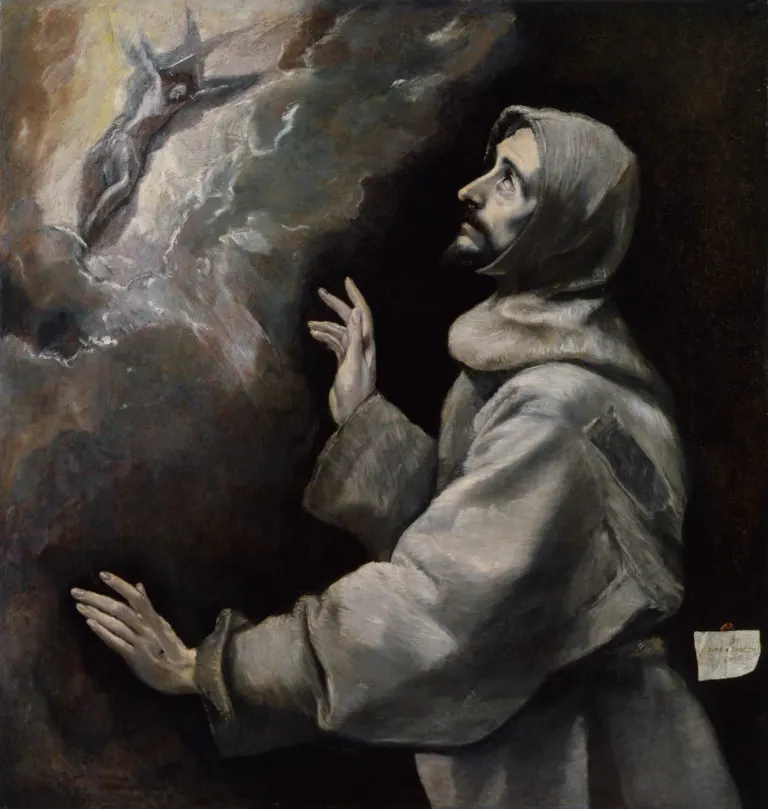
Francis of Assisi: birth, death and feast dates
When and where was Saint Francis of Assisi born?
Benedict XVI places his birth in Assisi at the end of 1181 or the beginning of 1182. That uncertainty is why reliable biographies give both years. October 4 is his feast day, not an established birthday.
Why do accounts mention both October 3 and October 4?
Francis died on the evening of October 3, 1226, at the Portiuncula. His annual liturgical commemoration is October 4. The Franciscan remembrance of his passing, called the Transitus, concerns his death; it does not establish a second birthday or a different Francis.
When was Francis canonized?
Pope Gregory IX canonized him in 1228, two years after his death. Learning his dates is a starting point; his own Canticle and the story of his conversion help explain the faith behind his enduring influence.
These answers were compared with the linked sources on using AI assistance.
Biography
Francis of Assisi founded the Order of Friars Minor and helped inspire a wider Franciscan family committed to poverty, fraternity, and the Gospel. His life began in a prosperous merchant household around 1181 or 1182.
As a young man he sought military distinction. Captivity and illness contributed to a gradual change of direction. Encounters with people suffering from leprosy and his prayer at San Damiano became central episodes in the accounts of his conversion. Repairing a small church developed into a much broader understanding of religious renewal.
He publicly renounced dependence on his father's wealth and attracted companions who wished to share his way of life. The brothers sought papal recognition, and their rule received definitive approval in 1223. Clare of Assisi adopted a related vocation, while lay followers also found ways to participate in Franciscan ideals.
Francis met Sultan al-Malik al-Kamil during the crusading conflict, an encounter that remains important to his legacy of religious dialogue. At Greccio he helped arrange a Christmas celebration centered on the poverty of Christ's birth. His Canticle of the Creatures linked praise of God with the created world.
The brothers' rapid growth required more than enthusiasm. A movement built around personal poverty also needed a shared rule and a relationship with the wider Church. Francis's obedience to ecclesiastical authority belonged alongside his criticism of wealth; his renewal was pursued from within the Christian community rather than by founding a separate church.
Illness marked his final years, and accounts of the stigmata express his intense identification with Christ's Passion. He died in 1226 and was canonized two years later. His enduring influence cannot be reduced to a love of animals: service to excluded people, worship, poverty, and the difficult life of a growing fraternity were fundamental to his vocation. That combination helps explain the breadth of his influence across different vocations.
Context & contribution
Delegation within a growing fraternity
On returning to Italy, Francis entrusted administration to Pietro Cattani, while Cardinal Ugolino served as protector of the growing order. These named roles make the organizational challenge clearer: a fraternity spreading beyond its original companions could no longer depend solely on the founder's immediate presence.
The Portiuncula remained a spiritual center even as responsibilities were distributed. This combination of a shared place of memory, delegated administration, and a written rule helped sustain a movement larger than one household of brothers. It also reveals a less familiar aspect of Francis's poverty: accepting that the community's work would require the service and judgment of others.
Explore the sources for this section
AI-assisted source comparison updated 2026-09-26. Editorial approach
Read, discuss, apply
Follow the changing meaning of rebuilding
Read the account of San Damiano in Benedict XVI's audience, then continue to Francis's relationship with his companions and the Church. Notice how repairing a building becomes a way of discussing renewal in a community.
Read Benedict XVI on Francis and renewal ↗
Try this with the text
Make a small diagram with three headings: building, community, personal response. Under the first two, record what the audience actually says; under the third, propose one modest responsibility you could take on in your parish or neighborhood. Mark that last item as your application, not an instruction Francis gave.
An original study activity from Saint Discovery, for personal reading, a class, or a Confirmation group.
Find printable reflection resources →From the Saint Discovery blog
Keep exploring your faith
Practical guides to prayer, the saints, and living the Catholic faith.
The Canticle of the Creatures: St. Francis’s Song of Praise Explained
What is St. Francis’s Canticle of the Creatures? Learn when he wrote it, why he says Brother Sun and Sister Death, and how to pray it this week.
Connected to this saintRead the article Everyday faithCan Lay People Become Franciscans? The Secular Order Explained
Can married and single Catholics become Franciscans? Learn about the Secular Franciscan Order, its profession, formation stages, and visiting a fraternity.
Connected to this saintRead the articleFrom reading to reflection
What will you carry with you?
After reading about St. Francis of Assisi, take a moment to consider:
- Which part of this account changes your picture of Francis beyond familiar animal imagery?
- What would serving a community require of you besides pointing out what is wrong?
- Name one possession, commitment, or habit you could simplify to make room for that responsibility.
- Identify what Francis retained and what he delegated as the fraternity grew. Discuss how relinquishing control differs from abandoning responsibility.
These are reflection prompts from Saint Discovery, not quotations from the saint.
Frequently Asked Questions
- Did Francis seek renewal apart from the Church?
- Benedict XVI presents Francis's renewal as taking place within the Church. He describes Francis seeking the pope's approval for his community and links his Gospel commitment with the Eucharist and communion with the Church.
Sources and further reading
Benedict XVI's 2010 audience is a modern Catholic interpretation of Francis's life. It draws on earlier Franciscan accounts and writings; it is not an eyewitness record. Its treatment of reported visions should be read as religious tradition, with the pope's interpretation distinguished from the events described.
Biography source comparison recorded on . This is an AI-assisted comparison, not independent human or ecclesiastical approval.
What the recorded review covers
AI-assisted expansion checked against cited sources; historical traditions distinguished from documented evidence; not ecclesiastical approval
A source list helps you check an account; it does not establish that every claim is certain. Follow the biography’s qualifications about historical evidence, traditions and feast calendars.
Suggest a correction to this biography
How we research these pages and handle corrections · Directory corrections log
More lives to explore
Suggestions based on the site’s quiz themes, not a historical relationship or a measure of holiness.