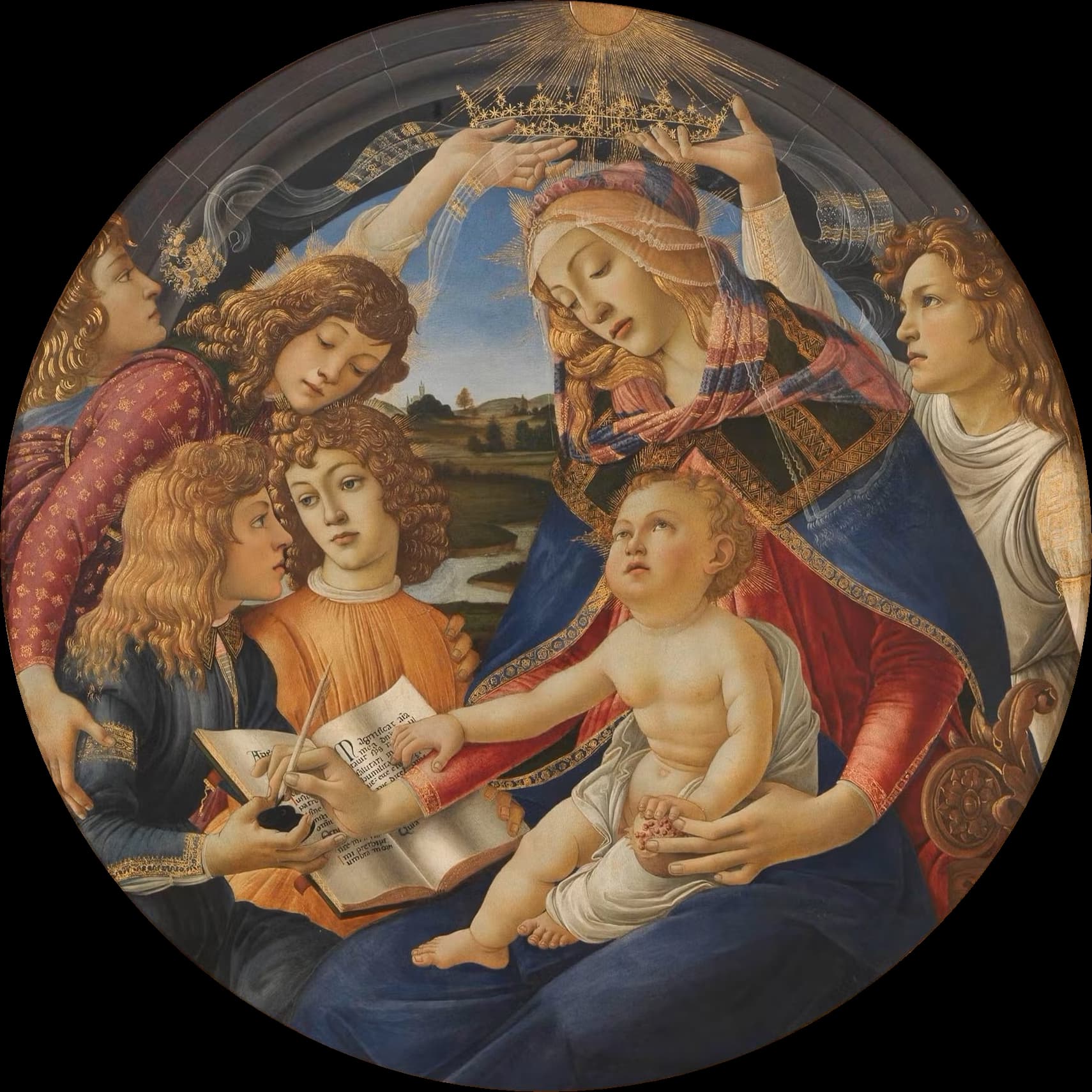
The Magnificat is Mary's song of praise in Luke 1:46–55. It gives thanks for God's goodness to her and celebrates his mercy toward the lowly, the hungry, and his people Israel. Catholics pray it as the Gospel canticle at Evening Prayer, also called Vespers.
You can also read it slowly in personal prayer. Its movement from gratitude to concern for others makes it a helpful companion when the day has been joyful, demanding, or difficult to understand.
Where does the Magnificat come from?
In Luke's account, Mary visits Elizabeth after the announcement that she will bear Jesus. Elizabeth welcomes her, and Mary responds with praise directed to God. The name Magnificat comes from the first word of the canticle in Latin.
You can read the complete canticle in Luke 1:46–55, in the Holy See's New American Bible. Read the whole passage before choosing a line to reflect on. The explanations below are paraphrases, not quotations from the Bible.
This is a biblical prayer, not a later prayer written by a saint. Our Saint Luke biography introduces the evangelist associated with the Gospel that preserves it. Luke presents the canticle as Mary's response; that is different from claiming we possess an independent transcript of the visit.
What does Mary's song mean?
The prayer begins with Mary's gratitude for what God has done for her. It then widens toward God's action in the world and his faithfulness to Israel. In his February 15, 2006 catechesis on the Magnificat, Benedict XVI describes this movement from Mary's personal thanksgiving toward the voice of the believing community.
That gives us a useful way to listen. Start by noticing the gifts Mary names, then pay attention to whom the prayer brings into view. The hungry and those without status are not an interruption of her praise. They belong within it.
The Catechism, paragraph 2619, calls the canticle a song both of Mary and of the Church, emphasizing thanksgiving and hope in God's promises. Praying it invites us to join that praise rather than merely admire Mary's eloquence from a distance.
A practical question follows: when I give thanks, whose needs do I overlook? You might remember someone who cooked, cleaned, listened, or helped quietly today. Naming that person's contribution can make gratitude more attentive and less centered on achievement.
Why does it speak so strongly about power and wealth?
The middle of the canticle describes a reversal of familiar human expectations: pride and privilege do not have the last word. Benedict XVI's reflection on verses 51–55 stresses God's care for the lowly and the humility that opens a person to grace.
This is not a promise that reciting a prayer will immediately solve a financial problem or remove an unjust situation. It can, however, challenge what we admire and what we ignore.
For an original reflection exercise, consider the difference between recognizing need and keeping it at a comfortable distance. Could you support a food pantry, check on a person who feels forgotten, or share credit fairly at work? Choose a response that fits a real need and your actual responsibilities.
If you are the person in need, you do not have to pretend otherwise to pray. You can bring hunger, insecurity, and disappointment honestly. Thanksgiving need not erase a request for help.
Why is the Magnificat prayed in the evening?
In the same catechesis, Benedict XVI identifies the Magnificat as a canticle belonging to every celebration of Vespers. Its recurring place gives the Church a familiar language of praise as each day passes.
Our beginner's guide to the Liturgy of the Hours explains the wider pattern. The Magnificat is one part of Evening Prayer; reading it on its own is not the whole liturgical office.
If you join a parish celebration, follow the booklet and those leading the prayer. You do not need to know a melody beforehand. If you are beginning at home, ask your parish for help finding the appropriate prayer book rather than trying to reconstruct the office from scattered quotations.
A simple way to pray with it tonight
The following is an original personal reflection exercise, not a replacement for the order of Evening Prayer.
First, read Luke 1:46–55 without stopping to analyze every sentence. Read it again more slowly. Notice a word or idea that draws your attention: mercy, gratitude, hunger, humility, or God's faithfulness.
Next, bring one event from the day into conversation with that theme. If gratitude stands out, name a gift and someone through whom it came. If humility catches your attention, consider where you resisted listening. If the hungry remain on your mind, remember a specific person or community.
Then speak to God in your own words. You may give thanks, ask forgiveness, or ask for help. Leave a little silence before deciding what to do next. You do not need to manufacture a strong feeling.
Finally, choose one small response you can carry into tomorrow. Keep it specific enough to remember: a message, a practical offer of help, an apology, or a moment set aside for prayer. This is a suggested practice, not a guarantee of a particular spiritual experience.
What does the cover painting show?
Sandro Botticelli's Madonna of the Magnificat, about 1483, depicts Mary writing with the Christ Child on her lap and angels around them. The Uffizi's catalogue explains the painting's relationship to the canticle. This is a later devotional interpretation, not a scene Luke describes Mary performing during her visit to Elizabeth.
The cover uses a reproduction without the decorative frame, identified as public domain on its Wikimedia Commons file page. Let the image prompt a return to the Gospel text: what do you notice when Mary's praise becomes a prayer you actually take time to read?
