A daily Catholic prayer routine can begin with three small pauses: offer your day to God in the morning, turn to him during an ordinary break, and look back with gratitude before sleep. Choose moments you can return to, and give yourself a simple way to begin again when the day changes.
If you are balancing work, school, caregiving, or a crowded household, the plan below is a starting point you can adapt. It is an original practical suggestion, not an official prayer rule or a substitute for the Church's sacramental life.
Begin with a rhythm you can actually keep
The Catechism, paragraphs 2697–2698, connects continual prayer with intentional times of prayer. It names daily rhythms such as morning and evening prayer and prayer around meals, while placing Sunday worship centered on the Eucharist within the wider rhythm of Christian life.
You do not have to adopt every practice at once. Choose one dependable moment: after getting dressed, before opening your work laptop, or after putting your phone down for the evening. Put your prayer book or Bible where you will use it. If a reminder helps, give it a gentle, specific label such as “Pause and pray.”
For the first few days, try one pause. Add another when the first fits naturally. The suggested times below are flexible; they are not a measure of your faithfulness.
Morning: offer the day in two minutes
Before turning to the next task, make the Sign of the Cross. Name one thing you are grateful for and one responsibility you expect to face. Ask God for the grace to meet it with love.
Here is an original morning prayer written for this guide:
Lord Jesus, I offer you this day: the work I understand, the interruptions I do not expect, and the people I will meet. Help me listen, act honestly, and love generously. Guide me in the next thing I need to do. Amen.
Keep the intention concrete. “Help me listen during today's meeting” gives you something to remember when the conversation begins. “Help me care patiently for my family” can return to mind when a small task becomes frustrating.
If you already know a morning offering or another prayer you love, use it. There is no need to replace a helpful practice simply because you found a new routine online.
Midday: let an ordinary break become a prayer
Choose a natural transition: before lunch, after a class, or between two tasks. Pause briefly and ask, “What am I carrying right now?” You might notice gratitude, impatience, concern for someone, or a decision that needs attention.
Bring that situation to God in a sentence. Then name one person to pray for, including someone you find difficult if you are able. Before moving on, consider whether the prayer suggests a practical response: listening more carefully, checking on a neighbor, or correcting an unkind remark.
In his February 10, 2021 audience on prayer in daily life, Pope Francis describes conversation with God continuing through work and everyday events. He also connects prayer with greater care for others. Ordinary responsibilities can become occasions for prayer rather than being treated only as obstacles to it.
When you have a longer break, read a short Scripture passage. You can find the day's readings through the USCCB Bible and daily readings page. Read slowly, notice one phrase, and bring a question or response to God. You do not need to finish a long reading plan during every pause.
Evening: review the day without making a scorecard
Spend a few quiet minutes remembering the day as it was. These three original prompts can help:
What am I grateful for, including something I nearly overlooked?
Where do I need forgiveness or an opportunity to make something right?
What concern do I need to entrust to God tonight?
Be specific without trying to review every minute. You might give thanks for a conversation, acknowledge that you spoke sharply, and decide to apologize tomorrow. Close with the Our Father or a brief prayer in your own words.
If writing helps, keep one or two lines in a notebook. If writing becomes another burden, leave it out. The purpose of this suggested pause is to bring the day into prayer, not to produce a perfect journal entry.
A lesson from Saint Francis de Sales
Saint Francis de Sales is a helpful companion when you are trying to connect devotion with daily duties. In Totum amoris est, Pope Francis highlights his teaching that devotion belongs in different walks of life and should be adapted to a person's responsibilities. It is expressed in active charity, not merely in an impressive collection of religious practices.
Let that perspective shape the routine you choose. A parent settling a child, a student preparing for class, and someone starting a night shift may need different times and settings. Ask which small practice helps you attend to God and care more faithfully for the people entrusted to you.
To learn about another witness to faith, visit Saint of the Day. Choose one part of the biography to consider rather than adding a large reading assignment to every morning.
What to do when the routine breaks
If you forget a pause, begin at the next reasonable opportunity. Do not turn one missed moment into a reason to abandon the entire plan. If mornings repeatedly become chaotic, move the prayer to a more workable point in your day.
When your mind wanders to something you must remember, jot down a word if that helps and return to the prayer. When a person needs your attention, respond to the need and return when you can. A flexible plan gives you a place to resume.
At the end of a week, ask one practical question: “What helped me pray, and what made beginning unnecessarily difficult?” Change one thing. You might shorten a reading, silence a notification, or choose a different time.
Adapt the routine to an irregular day
The following examples are original adaptations of the routine, not additional obligations. For night-shift work, attach the offering to waking, the midday pause to a meal break, and the review to preparing for sleep. The point is a sequence you can recognize, not making a night worker imitate someone else's clock.
For a caregiver whose quiet moments are interrupted, keep a short prayer available on paper and choose one reliable transition, such as finishing a meal. If an urgent need interrupts, attend to the person and resume when practical. For a student, begin with one intention before study and return to it when closing the books. In each example, identify the cue first and then choose a prayer short enough to remember.
Try the adaptation for a week before adding another devotion. Notice whether it helps you turn toward God and your responsibilities. If the plan becomes an elaborate system that you spend more time managing than praying, simplify it.
What if the routine feels dry or distracted?
The Catechism discusses distraction and dryness as difficulties encountered in prayer. It encourages a return of the heart to God, rather than treating distraction as a puzzle to pursue indefinitely. See paragraphs 2729–2731. A day without a strong feeling is not, by that fact alone, proof that your prayer was worthless.
A modest response is to finish the short prayer you chose, acknowledge the distraction, and avoid adding repeated restarts as a penalty. If you are uncertain about a persistent spiritual difficulty, discuss it with a trusted priest or spiritual director. This routine is a place to begin; it is not a way to diagnose your spiritual condition from the number of minutes you managed.
Questions about daily Catholic prayer
How many minutes should I pray each day?
The two-minute morning pause and brief midday and evening pauses here are suggestions, not Church requirements. Begin with a manageable commitment and seek guidance from your parish or a spiritual director if you want help developing a fuller prayer life.
Can I include a patron saint?
Yes. You can ask a saint to pray for you while bringing your needs directly to God. Our guide to why Catholics pray to saints explains intercession and offers a simple way to begin.
What is the easiest first step today?
Choose one moment already in your routine. At that moment, thank God for one thing, name one need, and ask for help with the next faithful action. Return tomorrow, adapting the practice as you learn.
Sources and further reading
Catechism of the Catholic Church, 2697–2699: the life of prayer.
Pope Francis, Totum amoris est, December 28, 2022, especially the section on true devotion.
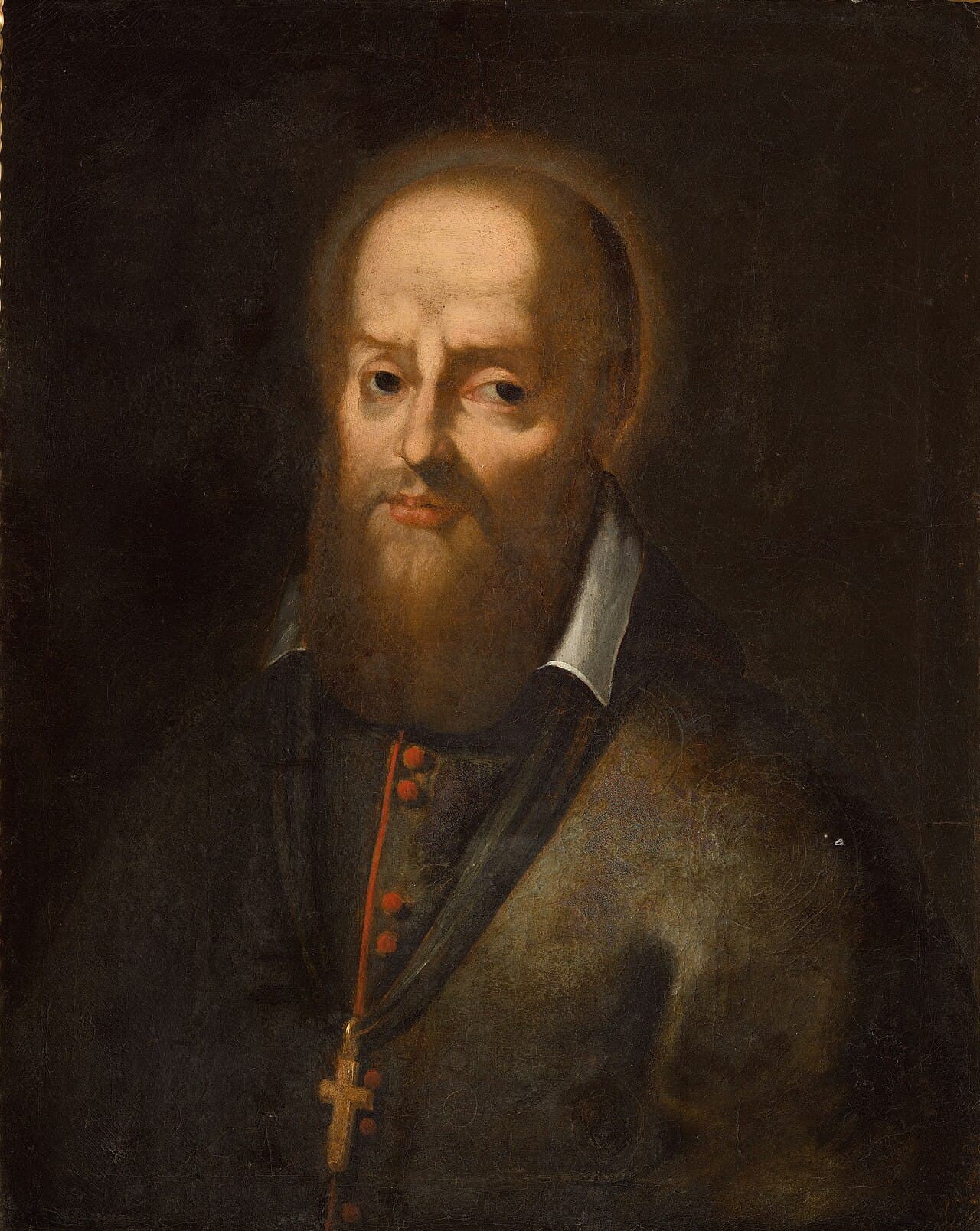
Cover image and license details: portrait of Saint Francis de Sales at Château de Bussy-Rabutin. Photograph by Benjamin Gavaudo for the Centre des monuments nationaux, 2019; Licence Ouverte 1.0. The Wikimedia Commons version is cropped.
