To return to Confession after years away, find a parish confession time or arrange an appointment, examine your conscience, and tell the priest that you need help getting started. Confess honestly, express sorrow and a sincere intention to change, receive absolution, and complete your penance. You can ask for guidance throughout.
Perhaps you remember the confessional but have forgotten the prayers. Perhaps one painful chapter of your life makes the whole conversation feel impossible. The U.S. bishops explicitly welcome people who have been away and offer help with hesitation and uncertainty in their pastoral exhortation on Reconciliation. Your first practical task is to make room for that conversation.
Arrange a time that gives you room to begin
Check a Catholic parish's current schedule. If you expect a longer confession or have questions about returning to the Church, contact the parish office and ask for an appointment with a priest. You could explain, in your own words: I have been away for several years and would appreciate help returning to Confession. The office does not need a list of your sins.
An appointment can make it easier to discuss questions without watching a queue grow behind you. If the regular scheduled time works better, use it. Ask beforehand about access needs or whether a screen is available if that would help you feel comfortable.
If you have never been Catholic or are unsure about your baptism and sacramental preparation, explain that first. A priest can help identify the appropriate next step. This guide is for Catholics returning to the sacrament they have previously received.
Examine your conscience without writing your entire life story
Find a quiet place and ask God for honesty. Review your choices since your last good confession, including thoughts, words, actions, and responsibilities you neglected. The Washington and Arlington dioceses' short guide to Reconciliation includes an examination of conscience based on the commandments.
Use its questions to notice concrete behavior. Instead of stopping at a vague judgment such as being a difficult person, identify what actually happened: lying to protect your reputation, treating someone cruelly, or failing to meet a responsibility you could have fulfilled. Concentrate on your own choices. A confession is easily sidetracked when it becomes an account of everyone else's mistakes.
A few brief notes can help you remember. Write what you need to say rather than a detailed narrative of every incident. If you become stuck on whether something was sinful, make that a question for the priest. You do not have to solve every uncertainty before approaching him.
Be specific about serious sins and honest about what you remember
The United States Catholic Catechism for Adults explains that mortal sins must be confessed in kind and number. That means identifying the sin and how often it occurred. It also strongly recommends confessing venial sins.
Years of absence can make exact recall difficult. Say so plainly. Give what you genuinely remember; when you cannot remember a count, explain the pattern or period involved and ask the priest for help. Avoid inventing precision to make your confession sound more complete.
The Diocese of Dallas's Confession FAQ specifically addresses returning after many years and acknowledges the limits of memory over a long absence. Honest preparation does not require reconstructing every day of those years.
Tell the priest you need help with the order
At the beginning, say approximately how long it has been since your last confession and explain that you need guidance. Here is an original example of ordinary opening words: Father, it has been about fifteen years since my last confession. I am nervous and have forgotten the order. Would you help me?
The diocesan guide outlines the usual sequence: a greeting and Sign of the Cross, confession of sins, the priest's counsel and assigned penance, an Act of Contrition, and absolution. Ask him to lead you through anything unfamiliar.
Listen carefully to the penance. If you do not understand it or cannot carry it out, tell the priest before leaving so he can clarify or address the difficulty. There is no benefit in nodding politely while remaining confused.
What if I have forgotten the Act of Contrition?
Ask for help or bring a printed copy. The Dallas FAQ explains that you may also express sorrow and a firm purpose of amendment in your own words. You are expressing repentance, rather than proving that you remember a prayer from childhood.
The Catechism, paragraph 1451, describes contrition as sorrow for sin with a resolution to turn away from it. A sincere intention to change is different from predicting that you will never struggle again. Consider one concrete change you are willing to begin.
Can the priest tell anyone what I confess?
No. The Catechism, paragraph 1467, teaches that the sacramental seal requires absolute secrecy concerning confessed sins and admits no exceptions. The priest is also forbidden to use knowledge gained through confession about a penitent's life.
What if I remember a serious sin afterward?
The Dallas FAQ distinguishes an honestly forgotten mortal sin from a deliberately concealed one. Genuine forgetfulness does not invalidate an otherwise valid confession. Mention the remembered mortal sin at your next confession. If you deliberately concealed something serious, tell the priest and ask him to guide you in making a good confession.
Let your return continue after absolution
Complete your penance and consider what repairing harm requires. The Catechism explains in paragraphs 1459–1460 that forgiveness does not remove every consequence of wrongdoing. Repair may include returning stolen property or correcting a damaged reputation. Ask the priest about a complicated situation rather than assuming one apology settles it.
For someone conscious of mortal sin, the ordinary requirement is sacramental absolution before receiving Holy Communion; the Catechism addresses this in paragraph 1457. Ask the priest about any uncertainty concerning your circumstances and returning to Communion.
Choose a manageable next action: check the next Sunday Mass time, set aside a few minutes for daily prayer, or arrange follow-up guidance. Our Padre Pio and Confession article offers a saint's example for continuing this practice, while our seven sacraments guide explains Reconciliation's place in Catholic life.
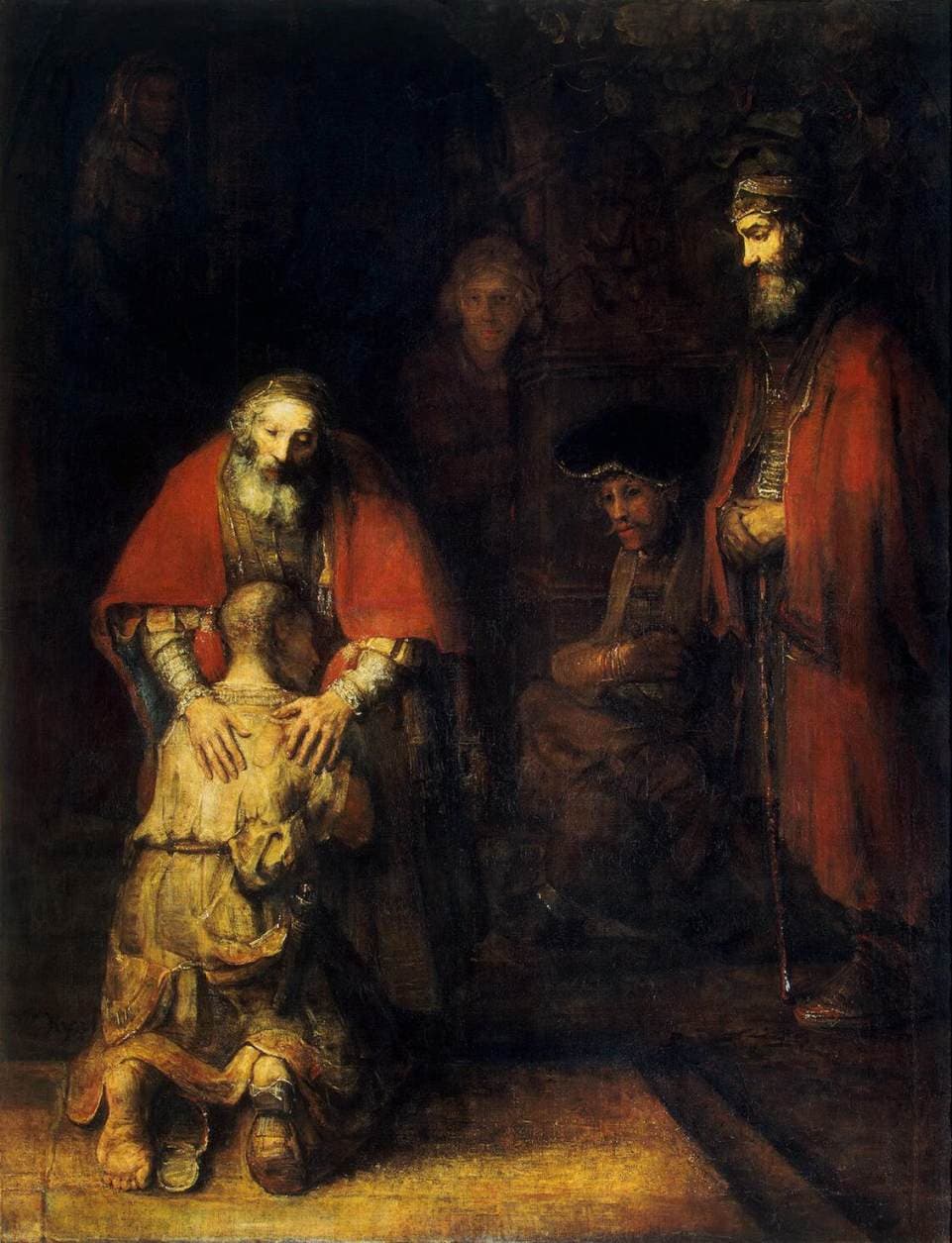
The returning son in Luke 15:11–32, available in the NABRE, acknowledges his wrongdoing and is welcomed by his father. That passage can give you something to pray with while you prepare. Today, your next step may be as simple as finding a parish phone number and making the call.
Cover artwork: Rembrandt, The Return of the Prodigal Son, circa 1668, Hermitage Museum. Public-domain reproduction from the Web Gallery of Art, via Wikimedia Commons.
