Catholic saint biography
St. Thérèse of Lisieux
- Commemoration:
- October 1
- Patron Saint of:
- Missions
- Lived:
- 1873–1897 — Alençon and Lisieux, France
Why dates and liturgical observances can differ
Read the sources for this biography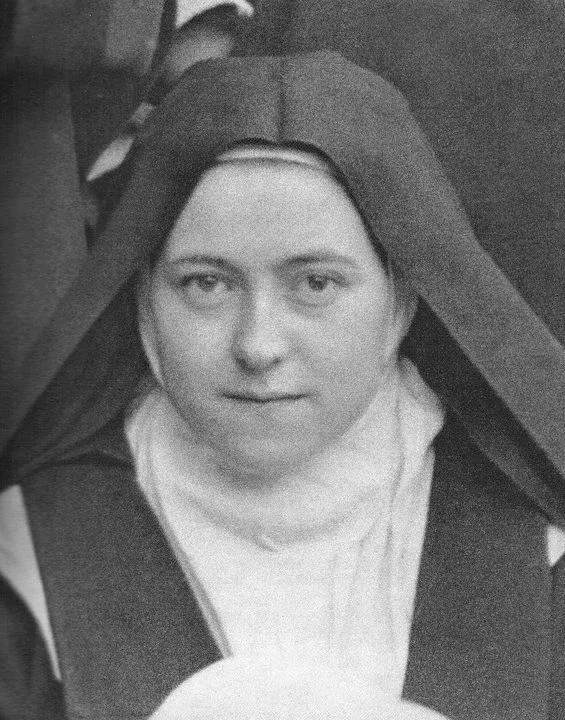
Biography
Thérèse of Lisieux (1873–1897) was a French Carmelite whose teaching centers on confidence in God’s merciful love. Her short life was largely spent within a family and a religious community, yet her writings reached readers far beyond them. Her spiritual childhood, often called the little way, concerns how to love when personal strength feels small.
Born Thérèse Martin in Alençon, she lost her mother, Zélie, at four. Her family then moved to Lisieux. During a pilgrimage to Rome in 1887, she asked Leo XIII for permission to enter Carmel while still young. She entered in April 1888 at fifteen and made her religious profession in 1890. Her years in Carmel included community duties, assistance with novices, prayer for missionaries, and correspondence. Illness and a severe trial of faith marked her final period. She died on September 30, 1897, aged twenty-four.
The little way is not a promise that faith removes difficulty. In C’est la confiance, Pope Francis explains her emphasis on receiving God’s grace rather than relying on a record of impressive achievements. Her image of being raised in Jesus’ arms expresses that dependence. Confidence and daily love belong together: she does not propose indifference to one’s responsibilities. Her final struggle with faith also complicates sentimental pictures of her life. Trust could remain a choice when consolation was absent.
The texts collected as Story of a Soul arose from requests made within her community. They belong to a wider body of writing that includes letters, poems, prayers, and religious plays. In declaring her a Doctor of the Church in 1997, John Paul II drew attention to this teaching and its roots in Scripture. Her insight was not the result of extensive academic study. Her reading of the Gospel, life of prayer, and reflection on love gave her a way to speak about Christian holiness that others could understand.
Her missionary concern did not depend on traveling abroad. She prayed and corresponded with missionaries while remaining in Carmel. The Church named her a patron of missions, alongside Francis Xavier, in 1927. For readers discerning how to serve, her life raises a useful question: what support can be offered from the responsibilities and relationships one already has? Her example makes hidden service worth considering without requiring everyone to adopt her vocation or circumstances.
Context & contribution
A teacher within her own community
Thérèse’s influence began before the publication of her writings. The Vatican biography records her guidance of novices, placing the little way within the daily formation of other sisters. Her teaching was tested in relationships with particular people before readers around the world encountered it in a book.
Her autobiographical manuscripts also belong to distinct moments and recipients, while the sayings collected near her death were recorded by others. Keeping those forms separate helps readers ask who is speaking and in what circumstances. It protects a personal and sometimes difficult spiritual testimony from being reduced to detached slogans.
Explore the sources for this section
AI-assisted source comparison updated 2026-09-26. Editorial approach
Read, discuss, apply
Read the little way without reducing it to a slogan
Begin with paragraphs 14–24 of C’est la confiance, linked below. Then read a passage from Story of a Soul with that explanation in mind. Look for the relationship between receiving mercy and responding with love.
Read Francis’s explanation of the little way ↗
Try this with the text
For personal or group study, describe one ordinary situation: a shared chore, an unwelcome interruption, or a conversation with someone you find difficult. Write a concrete loving response that does not depend on being noticed. Keep this as an exercise in applying the reading, not a quotation or rule attributed to Thérèse.
An original study activity from Saint Discovery, for personal reading, a class, or a Confirmation group.
Find printable reflection resources →From the Saint Discovery blog
Keep exploring your faith
Practical guides to prayer, the saints, and living the Catholic faith.
Saint Thérèse’s Little Way: How to Practice It in Daily Life
What is Saint Thérèse’s little way? Discover its Catholic meaning and five practical ways to grow in trust and love through ordinary daily life.
Connected to this saintRead the article Meet the saintsWhy Is St. Thérèse the Patron Saint of Missions?
Why is St. Thérèse patron saint of missions? Discover her support for missionaries and practical ways to participate in the Church's mission from home.
Connected to this saintRead the articleFrom reading to reflection
What will you carry with you?
After reading about St. Thérèse of Lisieux, take a moment to consider:
- When do you measure your worth by visible achievements? How might receiving love change that habit?
- What useful, unnoticed act could you do for someone with whom you share daily life?
- Who serves others in a setting you cannot reach? Consider one realistic way to support that person.
- When reading a saying attributed to Thérèse, check whether it comes from her manuscript, a letter, or someone else’s recollection.
These are reflection prompts from Saint Discovery, not quotations from the saint.
Frequently Asked Questions
- Does Thérèse’s little way mean making no effort?
- No. Her emphasis is on trusting God’s grace rather than depending on personal achievement. That confidence supports love in daily life; it does not excuse neglecting other people or one’s responsibilities.
Sources and further reading
- Vatican: Life of Thérèse of Lisieux ↗
- Francis: C’est la confiance, 2023 ↗
- John Paul II: Divini amoris scientia, 1997 ↗
Biography source comparison recorded on . This is an AI-assisted comparison, not independent human or ecclesiastical approval.
What the recorded review covers
AI-assisted comparison with the cited primary Catholic sources; expanded with historical context and source-reading guidance. Not a human theological review or ecclesiastical approval.
A source list helps you check an account; it does not establish that every claim is certain. Follow the biography’s qualifications about historical evidence, traditions and feast calendars.
Suggest a correction to this biography
How we research these pages and handle corrections · Directory corrections log
More lives to explore
Suggestions based on the site’s quiz themes, not a historical relationship or a measure of holiness.