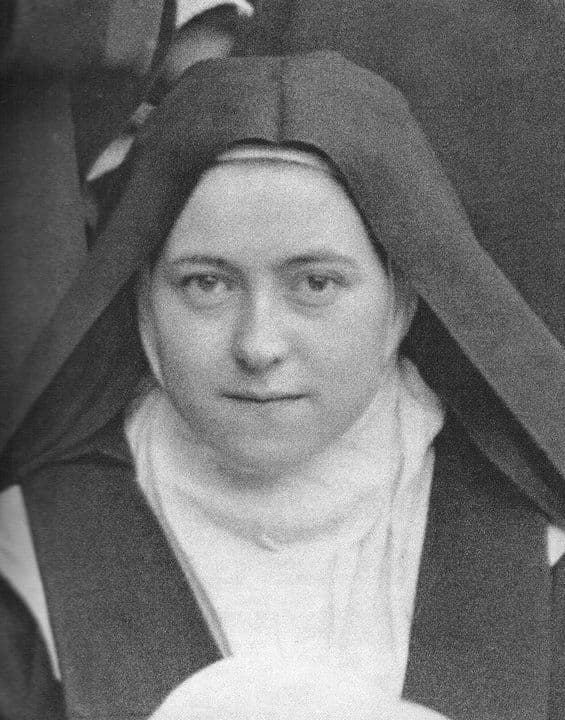
Saint Thérèse’s little way is a path to holiness through trust in God’s mercy and love expressed in ordinary life. It begins with dependence on Jesus, rather than confidence that we can make ourselves holy through impressive achievements. Pope Francis describes this spiritual childhood as a way open to people of every age and situation in C’est la confiance, paragraphs 14–18.
What might that look like during a crowded school day, an exhausting shift, or another evening of unfinished chores? Start with the person and responsibility already in front of you. Here is a practical introduction, with suggestions you can adapt to your circumstances.
Who was Saint Thérèse of Lisieux?
Thérèse Martin was born in France in 1873, entered the Carmel of Lisieux at fifteen, and died in 1897 at twenty-four. Within her community’s daily responsibilities, she developed the little way of spiritual childhood and taught it to the novices in her care. Her autobiographical manuscripts describe this spiritual life. These details come from the Vatican’s official biography of Saint Thérèse.
You can explore her background further in our Saint Thérèse of Lisieux biography. This guide focuses on putting her teaching into practice.
What does the little way actually mean?
Spiritual childhood means trusting God with our weakness and receiving his help. It does not require pretending that adulthood’s responsibilities are simple. In his explanation of Thérèse’s teaching, Pope Francis emphasizes the priority of grace: God acts first, and our efforts depend on his gift. Trust gives us room to respond generously without treating holiness as something we manufacture. See C’est la confiance, paragraphs 16–18.
Nor is the little way permission to do the minimum. When declaring Thérèse a Doctor of the Church in 1997, Saint John Paul II described a path accessible to everyone that remains demanding. He connected trust in divine mercy with serious commitment and highlighted her discovery of love at the heart of the Church’s life. See his homily, sections 4–5.
One helpful question, then, is: What would a more loving response require of me here? Sometimes the answer will be a small kindness. Sometimes it will mean the difficult work of keeping a promise, telling the truth, or changing an established habit.
Why the little way reaches beyond small courtesies
Thérèse's concern was wider than getting along pleasantly in her convent. In his 2011 audience on her life, Benedict XVI recalls her prayer, at fourteen, for a condemned criminal who appeared unrepentant. Later she prayed for priests and sustained relationships with missionary brothers. Her hidden life was directed toward other people's salvation.
That history changes the meaning of “little.” An action can be outwardly small while its intention reaches beyond your immediate comfort. Remembering someone who is isolated, praying for a person you find difficult, or doing careful work that others depend on can express an expansive charity. You do not need to imagine that your effort controls another person's choices or guarantees an outcome.
Try pairing one ordinary act with one named intention: prepare a meal attentively while praying for a household under strain, then contact them if practical help would be welcome. The intention should deepen attention to people, not turn the task into a bargain with God.
Five ways to practice the little way today
The following exercises are practical suggestions inspired by this teaching, not quotations from Thérèse or a required devotional formula. Choose one before trying all five.
1. Begin with one actual responsibility
Pick something that already belongs to your day: helping a child with homework, completing an assignment honestly, or preparing a meal. Before beginning, ask Jesus for help to do it with care. Give that task your attention for a manageable period. You do not need to invent extra work to have something worthwhile to offer.
For a student, this might mean putting away the phone during a group project. For a caregiver, it might mean listening without immediately deciding what the other person should say next.
2. Offer one kindness without arranging recognition
Put away something someone else left behind, thank a colleague whose work is easily overlooked, or make space for a quieter person to speak. Let the action be useful to its recipient. Avoid turning it into a test of whether others notice how considerate you have become.
Keep it realistic. A small, sustainable act of service is a better starting point than an ambitious promise you cannot keep.
3. Choose a gentler response in an ordinary irritation
Notice the moment when you are tempted to make a cutting remark. Pause long enough to choose words that address the problem without humiliating the person. You might say that you need a few minutes before continuing a conversation.
Kindness can include a clear boundary or an honest disagreement. The aim of this exercise is to change how you respond, while still addressing what needs attention.
4. Repair a failure instead of dwelling on it
If you lose your temper, acknowledge what you did and apologize specifically. Consider whether you need to correct an unfair statement, finish neglected work, or give someone time to respond. Then take the next reasonable step.
Try replacing a vague resolution to become a completely different person with a concrete one: Tomorrow, I will let my child finish speaking before answering. A specific repair gives your intention somewhere to go.
5. End the day with a brief review
Recall one moment when you received kindness and one when you could have responded better. Thank God, ask forgiveness, and entrust tomorrow to him. Keep the review brief enough that you can return to it without dread.
If you need help making room for this, our daily prayer routine for busy Catholics offers a simple place to begin. This reflection can fit into an existing prayer time.
Can I follow the little way when prayer feels dry?
Yes. Thérèse herself experienced a severe trial of faith, so her teaching should not be confused with feeling peaceful or spiritually successful all the time. Pope Francis discusses this darkness in C’est la confiance, paragraph 25.
On a difficult day, choose an honest, brief prayer and one manageable action. You can also speak with a trusted priest or spiritual companion about what you are experiencing.
Read her own account, not only quotations about her
Story of a Soul brings together three autobiographical manuscripts, written for different recipients. Divini Amoris Scientia 6 distinguishes them: Manuscript A recounts her early life and entrance into Carmel, B considers her vocation, and C returns to community life, charity, and her trial of faith. Knowing this prevents you from reading every passage as a rule addressed directly to every Christian.
Choose an edition that identifies the manuscripts and explains their setting. After a short passage, note what happened, what Thérèse understood through it, and what might apply differently in your circumstances. A vowed Carmelite and a parent have different responsibilities; imitating her love does not require copying every feature of her daily life.
If an online quotation has no identifiable work or letter attached, leave it unshared until you can trace it. A well-sourced paragraph from her own writing will usually teach more than a collection of attractive sayings.
Begin before her October 1 memorial
The Church celebrates Saint Thérèse’s memorial on October 1, as shown in the USCCB calendar. For the coming week, choose one setting where you want to practice patient love. Write down a small action, try it, and reflect on what helped or got in the way.
If you are considering Thérèse as a Confirmation patron, bring that experience to a conversation with your sponsor. Our Confirmation saint selection guide can help you connect a saint’s example with the Christian life you hope to grow into.
An original prayer for practicing the little way
Jesus, meet me in the responsibilities of this day. Help me receive your mercy, notice the people beside me, and respond with patient love. When I fail, give me courage to make amends and begin again. Saint Thérèse, pray for me as I learn to trust Jesus in ordinary things. Amen.
Artwork: Photograph of Thérèse of Lisieux by Céline Martin, April 15, 1895, detail. Public domain in the United States. Image and licensing information on Wikimedia Commons.
