Catholic saint biography
St. Moses the Ethiopian
- Commemoration:
- August 28
- Lived:
- Fourth to early fifth century — Egypt; traditionally of Ethiopian origin
Eastern commemoration; Julian August 28 corresponds to civil September 10.
Why dates and liturgical observances can differ
Read the sources for this biography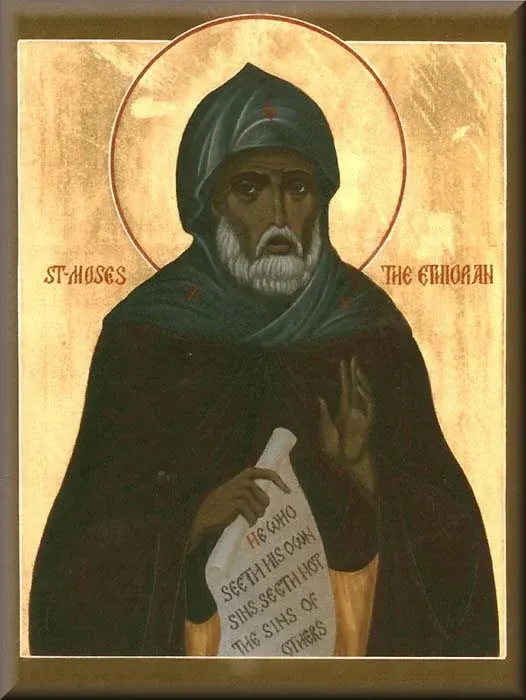
Biography
Moses the Ethiopian, often called Moses the Black, is remembered among the monks of the Egyptian desert. The monastic tradition describes an earlier life of violence and robbery followed by conversion and admission to a community at Scetis. His story emphasizes the possibility of radical change through repentance.
The tradition does not portray conversion as the immediate disappearance of every struggle. Moses repeatedly seeks advice and learns discipline within a community. His physical strength, once associated with intimidation, is redirected toward restraint and service, a contrast that gives the desert stories much of their force.
Accounts of his later life portray a patient spiritual elder who resisted judging others and struggled honestly with his own failings. He is traditionally said to have died during an attack on the monastery. These narratives and sayings were preserved for spiritual instruction rather than as a modern chronological biography. His August 28 commemoration remains important in Eastern Christian tradition.
Sayings about refusing to condemn another monk make self-knowledge central to his reputation as an elder. They belong to a teaching tradition intended to form readers, not to provide a complete transcript of his life. His remembered death during an attack gives the story a final setting of violence, distinct from the violence he had once practiced.
Context & contribution
Carrying water for elders in the desert
One episode in the desert tradition describes Moses going from cell to cell at night, carrying water for other monks, especially elders living far from the well. In an arid setting, this was concrete assistance with a task made difficult by age and distance. The story redirects attention from his former violence to a use of strength that eased another person's daily burden.
The surrounding narrative also keeps Abba Isidore's guidance in view. Moses seeks counsel rather than judging the success of his struggle entirely for himself. These remembered relationships make his ascetic life communal, even when he occupies a solitary cell. The episodes are monastic teaching traditions, and their practical meaning can be considered without treating every extraordinary detail as independently established history.
Explore the sources for this section
AI-assisted source comparison updated 2026-09-26. Editorial approach
From the Saint Discovery blog
Keep exploring your faith
Practical guides to prayer, the saints, and living the Catholic faith.
How to Make a Spiritual Communion When You Cannot Receive
Learn how to make a spiritual communion, with a short original prayer and clear guidance on Mass, Confession, and times when you cannot receive.
Explore mercy and reconciliationRead the article Prayer & reflectionHow to Pray the Jesus Prayer: A Catholic Beginner's Guide
Learn the Jesus Prayer, its Eastern Christian roots and biblical meaning, with a simple Catholic practice focused on Christ and mercy.
Explore mercy and reconciliationRead the articleFrom reading to reflection
What will you carry with you?
After reading about St. Moses the Ethiopian, take a moment to consider:
- Draw the relationship between the well, the distant cells, and the elders' needs; explain how the water-carrying episode changes the meaning of strength in Moses's story.
These are reflection prompts from Saint Discovery, not quotations from the saint.
Sources and further reading
Biography source comparison recorded on . This is an AI-assisted comparison, not independent human or ecclesiastical approval.
What the recorded review covers
AI-assisted expansion of the existing source-reviewed biography with comparison to retrieved cited sources; not ecclesiastical approval
A source list helps you check an account; it does not establish that every claim is certain. Follow the biography’s qualifications about historical evidence, traditions and feast calendars.
Suggest a correction to this biography
How we research these pages and handle corrections · Directory corrections log
More lives to explore
Suggestions based on the site’s quiz themes, not a historical relationship or a measure of holiness.