Catholic saint biography
St. Cyprian of Carthage
- Commemoration:
- September 16
- Lived:
- Birth uncertain; died 258 — Carthage, present-day Tunisia
Roman memorial with Cornelius; his execution was September 14.
Why dates and liturgical observances can differ
Read the sources for this biography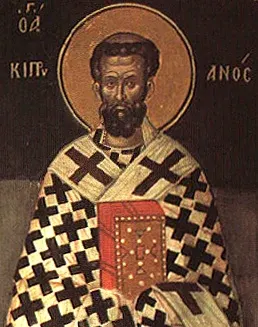
Biography
Cyprian became a Christian as an adult and was soon elected bishop of Carthage. His leadership was tested by persecution and disagreement over how Christians who had abandoned the faith might return. He sought a path that required repentance while resisting both easy readmission and permanent exclusion.
Before his conversion, Cyprian belonged to the educated and prosperous society of Roman Carthage. His account of baptism describes a decisive reorientation of adult life. His episcopate then confronted persecution under Decius and the difficult question of Christians who had denied the faith under pressure.
He opposed both treating that failure as insignificant and excluding repentant believers without hope of reconciliation. Epidemic disease also tested the community’s obligations to suffering neighbors. His letters and treatises therefore emerge from concrete pastoral crises, as well as from reflection on the unity of the Church.
During an epidemic he encouraged Christians to care for suffering neighbors, including non-Christians. His writings discuss prayer, church unity, and pastoral responsibility, while his dispute with Pope Stephen over baptism shows the tensions within early Christianity. Exiled and later condemned under Valerian, he was executed in 258. The Roman calendar commemorates him with Pope Cornelius on September 16.
Context & contribution
Why the Our Father remains plural
Cyprian's treatise on the Lord's Prayer explains that its plural language matters. Even someone praying privately asks for our bread and our forgiveness, speaking as a member of a people rather than an isolated individual. The wording makes communal belonging part of an ordinary act of devotion.
He also discusses bodily composure and the volume of the voice in common worship, connecting inward attention with consideration for others. His emphasis falls on prayer arising from the heart rather than impressive sound. These instructions bring his concern for church unity into a daily practice: a community is formed not only by formal decisions but by how its members address God and share space.
Explore the sources for this section
AI-assisted source comparison updated 2026-09-26. Editorial approach
From the Saint Discovery blog
Keep exploring your faith
Practical guides to prayer, the saints, and living the Catholic faith.
How to Make a Spiritual Communion When You Cannot Receive
Learn how to make a spiritual communion, with a short original prayer and clear guidance on Mass, Confession, and times when you cannot receive.
Explore mercy and reconciliationRead the article Prayer & reflectionHow to Pray the Jesus Prayer: A Catholic Beginner's Guide
Learn the Jesus Prayer, its Eastern Christian roots and biblical meaning, with a simple Catholic practice focused on Christ and mercy.
Explore mercy and reconciliationRead the articleFrom reading to reflection
What will you carry with you?
After reading about St. Cyprian of Carthage, take a moment to consider:
- Underline every plural pronoun in the Lord's Prayer and discuss one obligation toward other people that Cyprian's reading brings into view.
These are reflection prompts from Saint Discovery, not quotations from the saint.
Sources and further reading
Biography source comparison recorded on . This is an AI-assisted comparison, not independent human or ecclesiastical approval.
What the recorded review covers
AI-assisted expansion checked against retrieved historical and institutional sources; traditions distinguished from documented history; not ecclesiastical approval
A source list helps you check an account; it does not establish that every claim is certain. Follow the biography’s qualifications about historical evidence, traditions and feast calendars.
Suggest a correction to this biography
How we research these pages and handle corrections · Directory corrections log
More lives to explore
Suggestions based on the site’s quiz themes, not a historical relationship or a measure of holiness.