Catholic saint biography
St. Teresa Benedicta of the Cross (Edith Stein)
- Commemoration:
- August 9
- Patron Saint of:
- Europe
- Lived:
- 1891–1942 — Breslau, then Germany, now Wrocław, Poland
Why dates and liturgical observances can differ
Read the sources for this biography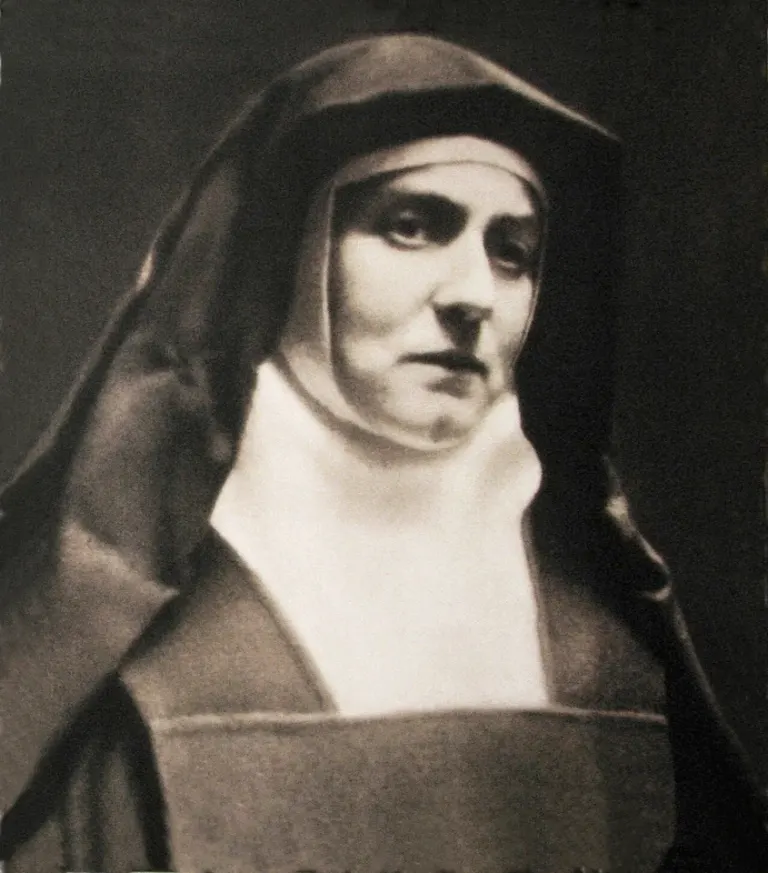
Biography
Edith Stein was a Jewish-born philosopher who became a Catholic and a Discalced Carmelite. Known in religious life as Teresa Benedicta of the Cross, she was murdered at Auschwitz in 1942 during the Holocaust.
Born in Breslau in 1891, she pursued university study and became associated with Edmund Husserl's phenomenology, a philosophical approach concerned with human experience. Her intellectual work included the problem of empathy. During the First World War she also served as a nurse, encountering suffering outside the university.
Her religious searching eventually led to Catholic baptism in 1922. Before entering Carmel, she taught, translated, and wrote about education, philosophy, and women's participation in professional and religious life. Her vocation did not erase the Jewish family relationships that remained important to her.
Her autobiographical writing also preserved the texture of her Jewish upbringing. Life in a Jewish Family was intended to counter dehumanizing prejudice by making family relationships and ordinary experience visible. That project matters alongside her philosophical and religious works: she did not leave only abstract arguments, but a record of people threatened by racial hatred.
Nazi restrictions curtailed her public work. After entering the Cologne Carmel, she transferred to Echt in the Netherlands for safety. She and her sister Rosa were arrested in August 1942 and deported to Auschwitz. The commonly accepted date of her death is August 9. Reading Teresa of Avila's autobiography had been an important step in her conversion, and entering the order Teresa reformed gave that influence a lasting institutional form. Her transfer to the Netherlands could not protect her once Nazi occupation extended the danger across the border.
Canonized in 1998 and named a co-patron of Europe in 1999, Stein is remembered as both a serious intellectual and a victim of antisemitic persecution. Her Christian identity and the Nazi policy of persecuting people of Jewish ancestry must both remain visible in telling her story.
Context & contribution
Empathy and the reasons for European patronage
In Spes Aedificandi, John Paul II connects Stein's philosophical work on empathy with the task of attending carefully to another person's experience. His account treats her intellectual search as an important part of her vocation, rather than a preliminary stage discarded when she became a religious sister.
The same document explains her European patronage through respect for persons across ethnic, cultural, and religious differences. It explicitly situates her death within the Nazi extermination of Jews and links remembrance with opposition to violations of human rights. This gives the title co-patron a concrete ethical and historical meaning beyond an honorary designation.
Explore the sources for this section
AI-assisted source comparison updated 2026-09-26. Editorial approach
From the Saint Discovery blog
Keep exploring your faith
Practical guides to prayer, the saints, and living the Catholic faith.
Why Do Catholics Pray to Saints? Intercession Explained
Why do Catholics pray to saints? Learn how intercession differs from worship, how it relates to Jesus, and a simple way to ask a saint to pray for you.
A next step with your saintRead the article Living the seasonsHow to Celebrate Your Patron Saint's Feast Day at Home
Celebrate your patron saint's feast day with prayer, a short biography, and an act of kindness. A practical plan for families, sponsors, and individuals.
A next step with your saintRead the articleFrom reading to reflection
What will you carry with you?
After reading about St. Teresa Benedicta of the Cross (Edith Stein), take a moment to consider:
- Read sections 8–9 of Spes Aedificandi and distinguish Stein's own intellectual work from the pope's later interpretation of its public significance.
These are reflection prompts from Saint Discovery, not quotations from the saint.
Sources and further reading
Biography source comparison recorded on . This is an AI-assisted comparison, not independent human or ecclesiastical approval.
What the recorded review covers
AI-assisted expansion checked against cited sources; historical traditions distinguished from documented evidence; not ecclesiastical approval
A source list helps you check an account; it does not establish that every claim is certain. Follow the biography’s qualifications about historical evidence, traditions and feast calendars.
Suggest a correction to this biography
How we research these pages and handle corrections · Directory corrections log
More lives to explore
Suggestions based on the site’s quiz themes, not a historical relationship or a measure of holiness.