Catholic saint biography
St. Maximilian Maria Kolbe
- Commemoration:
- August 14
- Lived:
- 1894–1941 — Poland
Why dates and liturgical observances can differ
Read the sources for this biography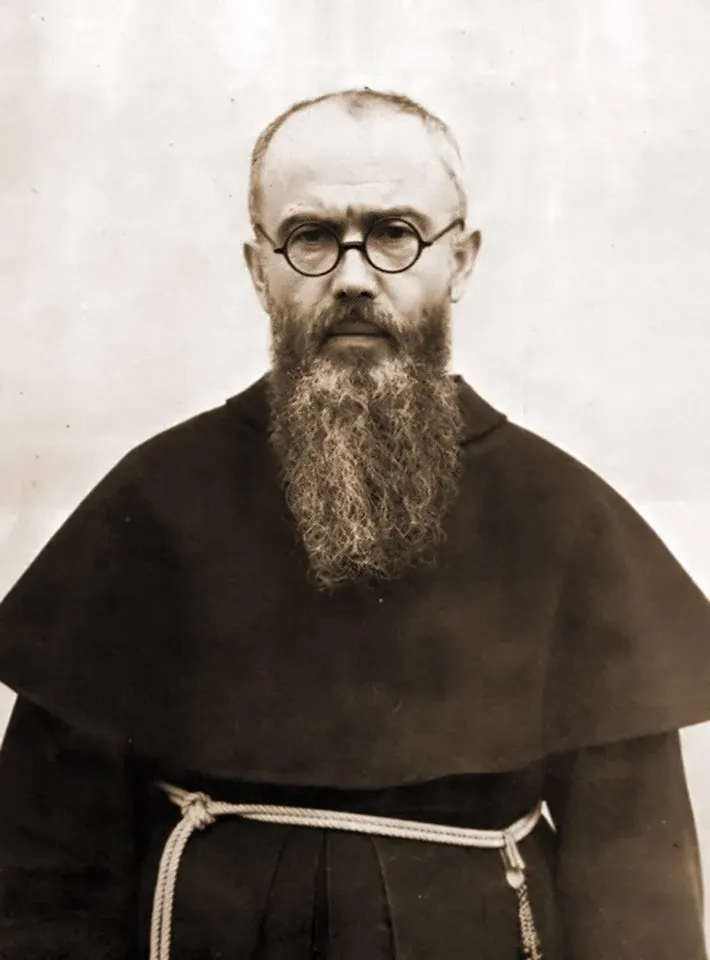
Biography
Maximilian Kolbe was a Polish Conventual Franciscan priest who developed a publishing apostolate and worked as a missionary in Japan. His spirituality centered on devotion to Mary and the use of contemporary media for evangelization. He returned to Poland before the Second World War.
Born Raimund Kolbe in 1894, he entered Franciscan formation as a teenager and took Maximilian as his religious name. Study in Rome preceded ordination in 1918. His publishing projects were practical undertakings involving presses, distribution, and the work of a large religious community, not only private spiritual writing.
The Nazis imprisoned him at Auschwitz. When another prisoner was selected to die in reprisal for an escape, Kolbe volunteered to take his place. He survived prolonged starvation and was killed by lethal injection on August 14, 1941. His canonization recognized this final act of charity as martyrdom. His feast falls on the anniversary of his death.
Niepokalanów, established outside Warsaw in 1927, became the main center of that activity. His mission in Japan extended the same combination of community life and religious communication into another setting. The final act at Auschwitz should be understood within this longer life while remaining distinct from ordinary ministry: it occurred under the coercion of a murderous prison system.
The Auschwitz-Birkenau State Museum identifies the man he replaced as Franciszek Gajowniczek, who survived the war. The selection followed an escape from the camp in late July 1941. Ten prisoners were condemned in retaliation, and Kolbe stepped forward to offer himself instead of the selected man. His offer was accepted, and he was taken with the others to the starvation cells in Block 11.
These details locate his death within the camp's system of collective punishment. His prisoner number was 16670, and he had arrived at Auschwitz in May 1941. After surviving the starvation ordeal, he was killed by injection on August 14. The museum's account preserves the identities, place, and sequence of the event, allowing remembrance of his sacrifice to remain connected to the historical reality of the victims imprisoned there.
Context & contribution
The monastery's wartime workshops and shelter
The Auschwitz-Birkenau Museum's account describes changes at Niepokalanów after Kolbe and other friars returned from their first wartime detention in December 1939. Workshops, including bicycle repair and mechanical services, became available to neighboring villagers. The community adapted practical resources already on its grounds to the disruptions affecting the surrounding population.
The monastery also accommodated displaced people brought from territory incorporated into Nazi Germany, including a substantial group of Jewish refugees. These activities belong to the period before Kolbe's final arrest and reveal a further dimension of his institution's wartime role. The museum situates his imprisonment within this history of occupation, forced movement, and service to people whose ordinary livelihoods and homes had been disrupted.
Explore the sources for this section
AI-assisted source comparison updated 2026-09-26. Editorial approach
From the Saint Discovery blog
Keep exploring your faith
Practical guides to prayer, the saints, and living the Catholic faith.
Why Is St. Thérèse the Patron Saint of Missions?
Why is St. Thérèse patron saint of missions? Discover her support for missionaries and practical ways to participate in the Church's mission from home.
Sharing the faithRead the article Everyday faithWhat Is Evangelization? A Catholic Guide to Sharing the Faith
What is evangelization? Learn the Catholic meaning, the new evangelization, and practical ways to share your faith with respect, confidence, and love.
Sharing the faithRead the articleFrom reading to reflection
What will you carry with you?
After reading about St. Maximilian Maria Kolbe, take a moment to consider:
- List the workshop and shelter resources at Niepokalanów and discuss how a publishing monastery could adapt them when occupation displaced the surrounding population.
These are reflection prompts from Saint Discovery, not quotations from the saint.
Sources and further reading
- www.vaticannews.va: Maximilian Maria Kolbe ↗
- www.vaticannews.va: Maximilian Maria Kolbe ↗
- Auschwitz-Birkenau State Museum: The sacrifice and death of Father Maximilian Kolbe ↗
Biography source comparison recorded on . This is an AI-assisted comparison, not independent human or ecclesiastical approval.
What the recorded review covers
AI-assisted expansion of the existing source-reviewed biography with comparison to retrieved cited sources; not ecclesiastical approval
A source list helps you check an account; it does not establish that every claim is certain. Follow the biography’s qualifications about historical evidence, traditions and feast calendars.
Suggest a correction to this biography
How we research these pages and handle corrections · Directory corrections log
More lives to explore
Suggestions based on the site’s quiz themes, not a historical relationship or a measure of holiness.