Catholic saint biography
St. Maurus
- Commemoration:
- January 15
- Lived:
- Sixth century — Italy
Traditional Benedictine commemoration.
Why dates and liturgical observances can differ
Read the sources for this biography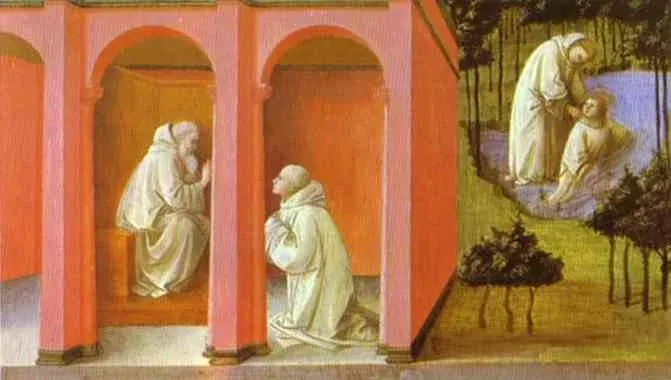
Biography
Maurus appears in Gregory the Great's Dialogues as a young disciple of Benedict at Subiaco. The narrative presents him as an example of obedience and readiness to serve. Its most famous scene describes his rescue of the boy Placidus from the water after Benedict sends him to help.
The rescue of Placidus makes prompt action in response to an abbot's command the center of the remembered episode. Gregory's purpose is to portray the formation of Benedict's disciples. It is a monastic teaching narrative, not a modern account written to establish the mechanics of an extraordinary event.
A later tradition makes Maurus the founder of a monastery at Glanfeuil in France, but the connection depends on a much later life and is historically disputed. His biography should therefore distinguish Gregory's account from the expanded French foundation story. Benedictine devotion has long honored him, and January 15 remains his traditional commemoration.
The later French association gave communities another way to connect themselves with Benedictine beginnings. Because that story appears much later, it must be evaluated separately. Maurus's place in Benedictine remembrance does not require treating every foundation attributed to him as a personally documented journey.
Context & contribution
A namesake congregation devoted to scholarship
Maurus's name acquired a major institutional afterlife in seventeenth-century France. The Congregation of Saint-Maur, formed in 1618 and approved in 1621, united reformed Benedictine houses under a common organization. Naming it for Maurus helped avoid giving one participating monastery precedence over its rivals.
The Maurists became particularly influential through historical and textual scholarship. Their communal organization supported large undertakings whose publication could extend across generations of researchers. This legacy belongs to monks living roughly a millennium after Benedict's disciple; it should not be confused with evidence for Maurus's own disputed journey to France. It does, however, explain why his name appears so often in the history of learned Benedictine publishing.
Explore the sources for this section
AI-assisted source comparison updated 2026-09-26. Editorial approach
From the Saint Discovery blog
Keep exploring your faith
Practical guides to prayer, the saints, and living the Catholic faith.
Why Do Catholics Pray to Saints? Intercession Explained
Why do Catholics pray to saints? Learn how intercession differs from worship, how it relates to Jesus, and a simple way to ask a saint to pray for you.
A next step with your saintRead the article Living the seasonsHow to Celebrate Your Patron Saint's Feast Day at Home
Celebrate your patron saint's feast day with prayer, a short biography, and an act of kindness. A practical plan for families, sponsors, and individuals.
A next step with your saintRead the articleFrom reading to reflection
What will you carry with you?
After reading about St. Maurus, take a moment to consider:
- Distinguish the sixth-century Maurus from the seventeenth-century Maurists, then discuss why a shared patron's name could help unite rival monasteries.
These are reflection prompts from Saint Discovery, not quotations from the saint.
Sources and further reading
Biography source comparison recorded on . This is an AI-assisted comparison, not independent human or ecclesiastical approval.
What the recorded review covers
AI-assisted expansion of the existing source-reviewed biography with comparison to retrieved cited sources; not ecclesiastical approval
A source list helps you check an account; it does not establish that every claim is certain. Follow the biography’s qualifications about historical evidence, traditions and feast calendars.
Suggest a correction to this biography
How we research these pages and handle corrections · Directory corrections log
More lives to explore
Suggestions based on the site’s quiz themes, not a historical relationship or a measure of holiness.