Catholic saint biography
St. John Neumann
- Commemoration:
- January 5
- Lived:
- 1811–1860 — Prachatice, Bohemia, now Czech Republic
U.S. memorial and traditional death-date commemoration.
Why dates and liturgical observances can differ
Read the sources for this biography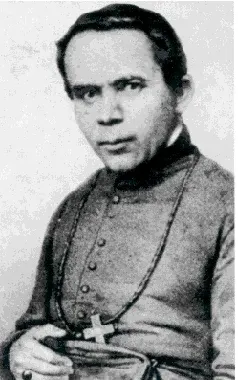
Biography
John Nepomucene Neumann left Bohemia for the United States after completing theological studies. Ordained in New York in 1836, he served dispersed communities and later entered the Redemptorists. His gift for languages helped him minister to immigrants whose circumstances often included poverty and social hostility.
His first American assignments were in western New York, where scattered settlements required extensive travel. He did not arrive with a secure appointment or comfortable resources. Becoming a Redemptorist gave his missionary work the support of a religious community whose preaching and parish ministry suited the needs he had encountered.
As bishop of Philadelphia from 1852, he expanded Catholic schooling, visited parishes, and supported the needs of immigrant congregations. He also wrote catechetical works and encouraged Eucharistic devotion. He died suddenly in Philadelphia in 1860 at forty-eight. Paul VI canonized him in 1977. He is distinct from the English cardinal John Henry Newman, whose similar surname sometimes causes confusion.
Education was a practical response to an immigrant Church that needed institutions as well as individual encouragement. Schools and catechetical teaching helped families transmit their faith in unfamiliar surroundings. His pastoral importance therefore extends beyond founding buildings: he worked to give newcomers sustained access to instruction, worship, and the sacraments.
Context & contribution
A parish network for an immigrant city
Paul VI's canonization homily singles out Neumann's establishment of Philadelphia's first Italian parish, dedicated to Mary Magdalene de' Pazzi. This supplies a concrete example of his immigrant ministry: newcomers needed communities in which language and familiar religious customs could support participation in a larger diocesan church.
The same homily connects his promotion of Forty Hours Eucharistic devotion with building communities of faith and service. Alongside his repeatedly published catechism, this shows three complementary instruments of pastoral work: a stable parish, accessible instruction, and shared worship. His institutional achievement depended on coordinating these ordinary practices rather than treating school construction as an isolated project.
Explore the sources for this section
AI-assisted source comparison updated 2026-09-26. Editorial approach
From the Saint Discovery blog
Keep exploring your faith
Practical guides to prayer, the saints, and living the Catholic faith.
Why Do Catholics Pray to Saints? Intercession Explained
Why do Catholics pray to saints? Learn how intercession differs from worship, how it relates to Jesus, and a simple way to ask a saint to pray for you.
A next step with your saintRead the article Living the seasonsHow to Celebrate Your Patron Saint's Feast Day at Home
Celebrate your patron saint's feast day with prayer, a short biography, and an act of kindness. A practical plan for families, sponsors, and individuals.
A next step with your saintRead the articleFrom reading to reflection
What will you carry with you?
After reading about St. John Neumann, take a moment to consider:
- Design a three-part welcome plan for an immigrant parish community using language access, instruction, and shared worship; identify the Neumann precedent behind each part.
These are reflection prompts from Saint Discovery, not quotations from the saint.
Sources and further reading
Biography source comparison recorded on . This is an AI-assisted comparison, not independent human or ecclesiastical approval.
What the recorded review covers
AI-assisted expansion of the existing source-reviewed biography with comparison to retrieved cited sources; not ecclesiastical approval
A source list helps you check an account; it does not establish that every claim is certain. Follow the biography’s qualifications about historical evidence, traditions and feast calendars.
Suggest a correction to this biography
How we research these pages and handle corrections · Directory corrections log
More lives to explore
Suggestions based on the site’s quiz themes, not a historical relationship or a measure of holiness.