Catholic saint biography
St. Lorenzo Ruiz
- Commemoration:
- September 28
- Lived:
- About 1594–1637 — Manila, Philippines
With the martyrs of Japan.
Why dates and liturgical observances can differ
Read the sources for this biography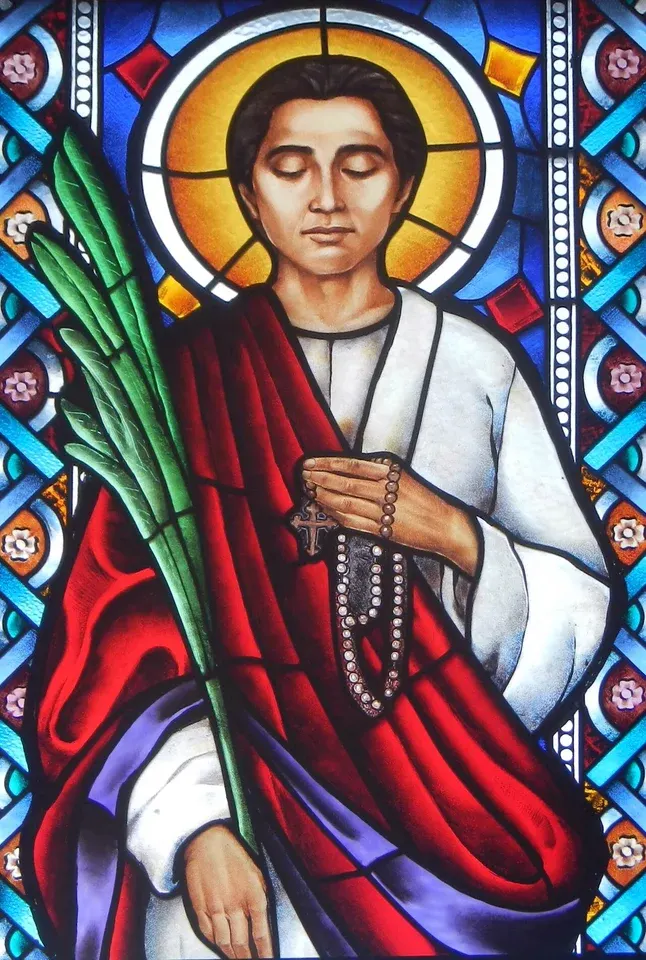
Biography
Lorenzo Ruiz was a married layman from Binondo in Manila, where he served a Dominican parish. His father was Chinese and his mother Filipino. In 1636 he sailed with Dominican missionaries to Japan, where Christianity was being violently suppressed. Arrest followed, and the group was eventually taken to Nagasaki.
He was educated in the Dominican parish environment and earned a living copying documents. His marriage and children are central to his identity as a lay saint. His departure followed an accusation connected with a homicide; the surviving account does not permit a confident reconstruction of the incident.
Ruiz refused to abandon his faith under torture and died in 1637. His story belongs to a persecution that claimed Japanese Christians as well as foreign missionaries. John Paul II beatified him in Manila in 1981 and canonized him with fifteen companions in 1987. He is recognized as the first Filipino canonized by the Catholic Church.
His journey therefore began under circumstances different from those of missionaries who had deliberately prepared for Japan. Once arrested, however, he faced the same demand to renounce Christianity. Remembering the Japanese members of the group prevents his better-known Filipino identity from overshadowing the wider community that suffered alongside him.
Context & contribution
The companions behind the collective canonization
The Vatican News account names Antonio González, Guillaume Courtet, and Miguel de Aozaraza among the Dominicans with whom Lorenzo sailed. It also names the Japanese priest Vicente Shiwozuka de la Cruz and a Japanese lay companion, Lázaro. Their presence makes the journey a story of an international Christian group rather than a solitary Filipino venture.
Lorenzo's occupational skill as a copyist places him outside the clerical roles of several companions. The group therefore brought together different origins and ways of serving the Church before imprisonment subjected them to a common demand. Studying their identities helps preserve the collective character of the martyrs' remembrance without filling the gaps in Lorenzo's departure story with confident speculation.
Explore the sources for this section
AI-assisted source comparison updated 2026-09-26. Editorial approach
From the Saint Discovery blog
Keep exploring your faith
Practical guides to prayer, the saints, and living the Catholic faith.
Why Is St. Thérèse the Patron Saint of Missions?
Why is St. Thérèse patron saint of missions? Discover her support for missionaries and practical ways to participate in the Church's mission from home.
Sharing the faithRead the article Everyday faithWhat Is Evangelization? A Catholic Guide to Sharing the Faith
What is evangelization? Learn the Catholic meaning, the new evangelization, and practical ways to share your faith with respect, confidence, and love.
Sharing the faithRead the articleFrom reading to reflection
What will you carry with you?
After reading about St. Lorenzo Ruiz, take a moment to consider:
- Make a table of the named travelers by origin and lay or clerical role; explain what the group reveals that a biography of Lorenzo alone leaves out.
These are reflection prompts from Saint Discovery, not quotations from the saint.
Sources and further reading
Biography source comparison recorded on . This is an AI-assisted comparison, not independent human or ecclesiastical approval.
What the recorded review covers
AI-assisted expansion of the existing source-reviewed biography with comparison to retrieved cited sources; not ecclesiastical approval
A source list helps you check an account; it does not establish that every claim is certain. Follow the biography’s qualifications about historical evidence, traditions and feast calendars.
Suggest a correction to this biography
How we research these pages and handle corrections · Directory corrections log
More lives to explore
Suggestions based on the site’s quiz themes, not a historical relationship or a measure of holiness.