Catholic saint biography
St. Landry of Paris
- Commemoration:
- June 10
- Lived:
- Seventh century; died c. 656 — Frankish Gaul; associated with Paris
Optional memorial in the Diocese of Paris on June 10.
Why dates and liturgical observances can differ
Read the sources for this biography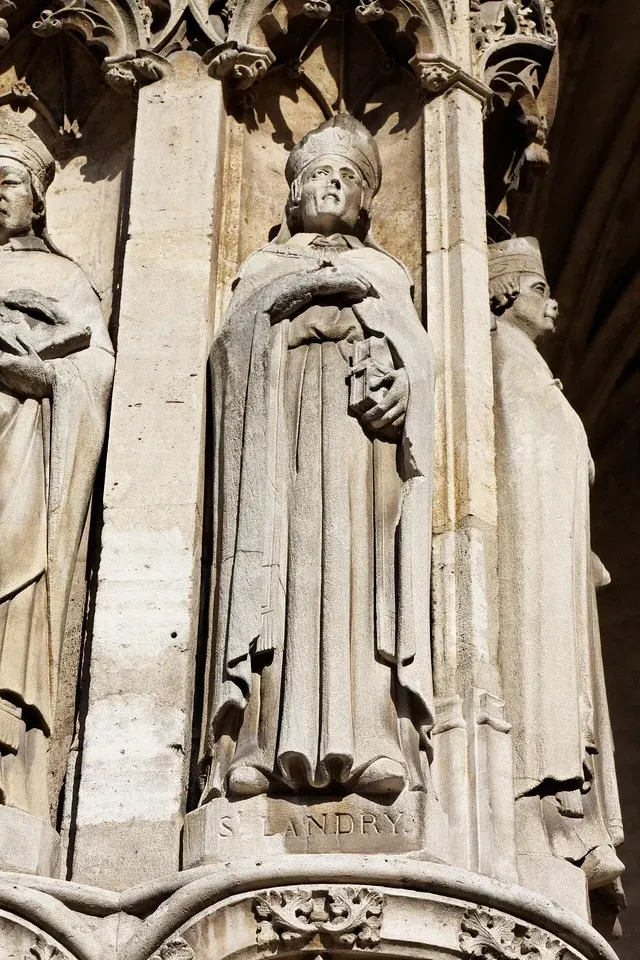
Biography
Landry was bishop of Paris in the middle of the seventh century. The diocesan tradition remembers an administrator whose concern for the poor became especially visible during famine. He is said to have sold furnishings and church vessels to provide food, putting immediate human need ahead of the preservation of valuable objects.
The famine story is remembered because it presents a clear choice about the use of church property. Precious objects were to serve people rather than become an end in themselves. As an account transmitted through local tradition, it explains his reputation for charity without supplying an exact financial record of the relief effort.
Paris also associates him with the beginnings of the Hôtel-Dieu, where care for sick and destitute people could be offered beyond the bishop's household. The precise details of this foundation remain partly traditional, while a document bearing his signature survives from 654. His burial and later veneration at Saint-Germain-l'Auxerrois made him an enduring local figure of episcopal charity and organized care.
His Parisian cult remained attached to identifiable places. At Saint-Germain-l'Auxerrois, imagery of a book and a hand placed near the heart joins learning with concern for the poor. The signed document anchors him in seventh-century history even where the later hospital foundation narrative cannot be established in every detail.
Context & contribution
A saint's memory in the changing city
The Paris diocesan account locates a former chapel of Saint Landry on the rue des Ursins, near the older banks of the Seine. It was sold during the Revolution and demolished in 1828. A nearby port also bore his name, connecting his remembrance with the working geography of the city.
These places belong to the history of Landry's cult rather than evidence for every event in his lifetime. Their disappearance nevertheless leaves a trace worth studying: a saint's public presence can survive through street names, archival descriptions, sculpture, and the memory of demolished buildings. His Parisian legacy is therefore both charitable and topographical.
Explore the sources for this section
AI-assisted source comparison updated 2026-09-26. Editorial approach
From the Saint Discovery blog
Keep exploring your faith
Practical guides to prayer, the saints, and living the Catholic faith.
Why Do Catholics Pray to Saints? Intercession Explained
Why do Catholics pray to saints? Learn how intercession differs from worship, how it relates to Jesus, and a simple way to ask a saint to pray for you.
A next step with your saintRead the article Living the seasonsHow to Celebrate Your Patron Saint's Feast Day at Home
Celebrate your patron saint's feast day with prayer, a short biography, and an act of kindness. A practical plan for families, sponsors, and individuals.
A next step with your saintRead the articleFrom reading to reflection
What will you carry with you?
After reading about St. Landry of Paris, take a moment to consider:
- Locate the rue des Ursins and Saint-Germain-l'Auxerrois on a Paris map; distinguish surviving monuments from places known through records of Landry's cult.
These are reflection prompts from Saint Discovery, not quotations from the saint.
Sources and further reading
Biography source comparison recorded on . This is an AI-assisted comparison, not independent human or ecclesiastical approval.
What the recorded review covers
AI-assisted expansion of the existing source-reviewed biography with comparison to retrieved cited sources; not ecclesiastical approval
A source list helps you check an account; it does not establish that every claim is certain. Follow the biography’s qualifications about historical evidence, traditions and feast calendars.
Suggest a correction to this biography
How we research these pages and handle corrections · Directory corrections log
More lives to explore
Suggestions based on the site’s quiz themes, not a historical relationship or a measure of holiness.