Catholic saint biography
St. Carlo Acutis
- Commemoration:
- October 12
- Lived:
- 1991–2006 — London, England; raised in Milan, Italy
Why dates and liturgical observances can differ
Read the sources for this biography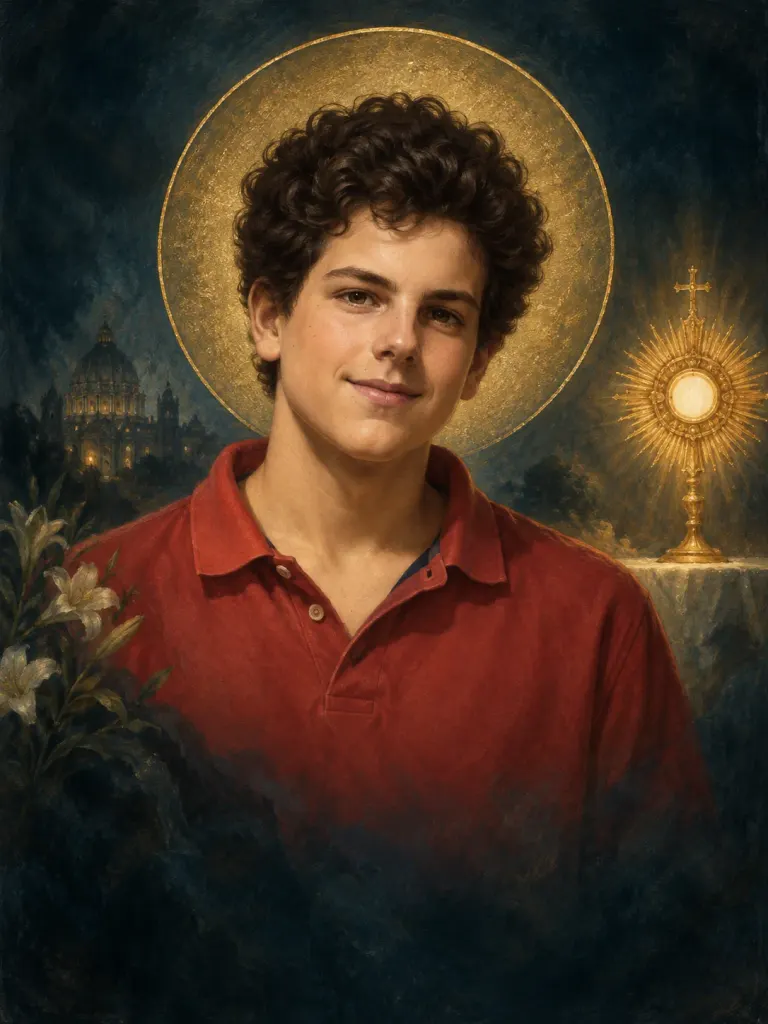
Biography
Carlo Acutis was born in London to Italian parents and grew up in Milan. His ordinary school life included an intense interest in computers and a sustained Catholic practice centered on the Eucharist. He used his technical interests to help assemble an exhibition about reported Eucharistic miracles, while people who knew him also recalled his concern for those excluded or in need.
Carlo’s interests were not limited to computers. The foundation preserving his memory describes soccer, music, games, help with classmates’ schoolwork, and volunteering for people in need. These details matter because they place his religious commitments within ordinary friendships and activities rather than outside teenage life.
His digital projects were one expression of a broader desire to share his faith. The exhibition’s accounts of miracles should be distinguished from a claim that technical skill itself established holiness. The testimony about his daily relationships and service forms another essential part of his remembered life.
He developed acute leukemia and died on October 12, 2006, aged fifteen. His burial in Assisi reflected his attachment to Francis of Assisi. Beatified in 2020, he was canonized by Pope Leo XIV on September 7, 2025. Calling him only Blessed is therefore outdated. His liturgical commemoration is October 12, the anniversary of his death.
Context & contribution
A place in the Church's teaching about digital life
Pope Francis used Carlo's example in paragraphs 104–106 of Christus Vivit, his 2019 exhortation addressed to young people. The setting matters: Carlo appears in a discussion of creativity, consumerism, distraction, and the pressure to conform. His significance is not simply that a religious teenager knew how to use a computer.
Francis presents him as someone whose abilities could communicate faith and beauty without being surrendered to the pursuit of novelty. This reception of Carlo's life gives readers a concrete text for thinking about technology's purpose. The question is what a person creates and whom it serves. An online project can become a contribution to others, while technical fluency by itself says little about the quality of a person's attention or relationships.
Explore the sources for this section
AI-assisted source comparison updated 2026-09-26. Editorial approach
From the Saint Discovery blog
Keep exploring your faith
Practical guides to prayer, the saints, and living the Catholic faith.
Saint Ignatius of Antioch and the Eucharist: A Reading Guide
Explore what Saint Ignatius of Antioch wrote about the Eucharist, with key passages, historical context, and a simple reading plan.
Explore Eucharistic faithRead the article Prayer & reflectionWhat Is Eucharistic Adoration? A Guide to Your First Visit
Learn what Eucharistic adoration is, how it differs from exposition and a holy hour, and what to do during your first visit.
Explore Eucharistic faithRead the articleFrom reading to reflection
What will you carry with you?
After reading about St. Carlo Acutis, take a moment to consider:
- Read Christus Vivit 104–106 and redesign one small digital habit so that it helps you create or serve rather than merely follow the next prompt to consume.
These are reflection prompts from Saint Discovery, not quotations from the saint.
Sources and further reading
- Holy See: Canonization booklet, September 7, 2025 ↗
- Vatican News: Carlo Acutis beatification ↗
- Carlo Acutis Foundation: The Saint ↗
Biography source comparison recorded on . This is an AI-assisted comparison, not independent human or ecclesiastical approval.
What the recorded review covers
AI-assisted expansion checked against retrieved historical and institutional sources; traditions distinguished from documented history; not ecclesiastical approval
A source list helps you check an account; it does not establish that every claim is certain. Follow the biography’s qualifications about historical evidence, traditions and feast calendars.
Suggest a correction to this biography
How we research these pages and handle corrections · Directory corrections log
More lives to explore
Suggestions based on the site’s quiz themes, not a historical relationship or a measure of holiness.