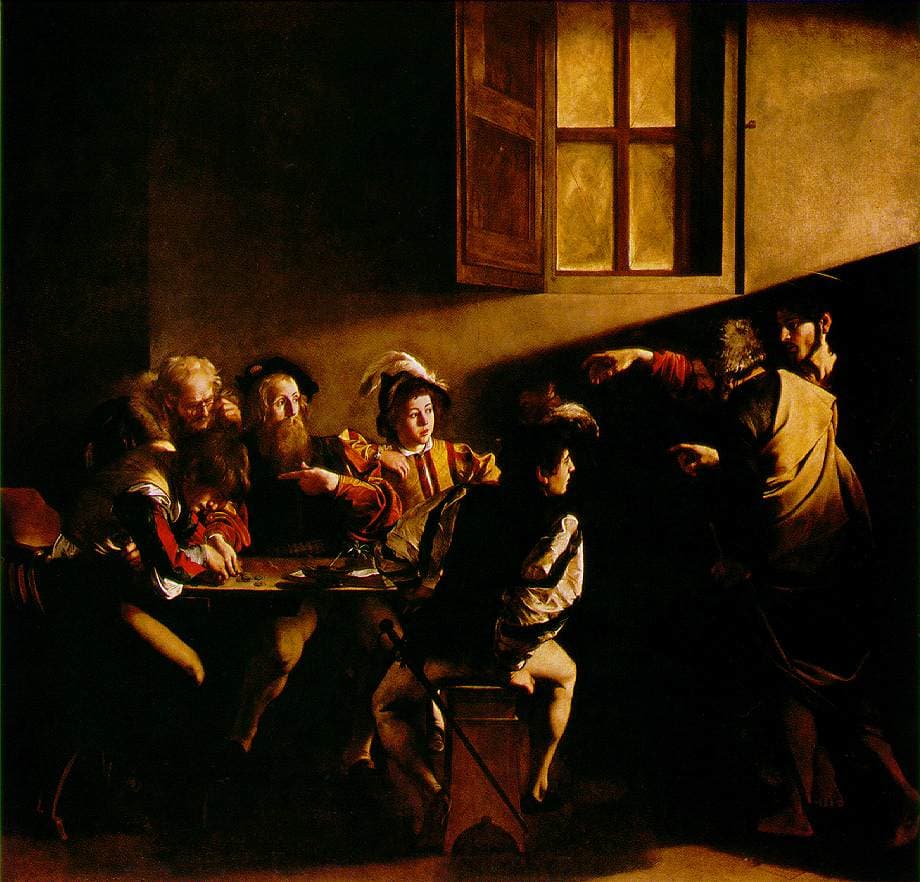
Jesus called Matthew to show that his mercy reaches people others dismiss as sinners, and that receiving mercy can begin a different way of life. In Matthew 9:9–13, the invitation leads to discipleship and a meal with people whose company draws criticism. Jesus answers by explaining his mission to sinners. Read the Gospel passage.
For anyone who wonders whether a past mistake has become a permanent identity, Matthew is a compelling saint to meet. His story gives us a concrete scene to pray with: a working day, an unexpected invitation, and a response.
What happens when Jesus calls Matthew?
Matthew is sitting at a customs post when Jesus says, “Follow me” (Matthew 9:9, NABRE). He gets up and follows. The account then describes Jesus sharing a table with tax collectors and sinners. When the Pharisees object, Jesus compares those who need him to sick people who need a physician, and points them toward mercy. Read the full scene in Matthew 9:9–13.
Notice how little the passage tells us about Matthew's private thoughts. It does not give us a diary of his feelings, a detailed account of earlier conversations, or a list of his financial dealings. We can reflect imaginatively on the scene while keeping those imagined details separate from what Scripture actually says.
Why was calling a tax collector surprising?
In his audience on Saint Matthew, Pope Benedict XVI explains that tax collectors carried a public reputation for sin and were associated with an unwelcome governing authority and the possibility of unjust demands. Against that background, Jesus' choice challenged assumptions about who could belong among his close followers. Benedict also emphasizes that Matthew's response involved leaving behind what was incompatible with following Christ. Benedict XVI, August 30, 2006.
That historical setting should not become an excuse to condemn everyone who works with taxes or money today. The useful question for a modern reader concerns integrity: where does my work invite honesty, and where am I tempted to put advantage ahead of another person's good?
Why does Jesus quote Hosea about mercy and sacrifice?
Jesus' reply draws on Hosea 6:6. In Hosea 6:4–6, the prophet challenges a loyalty that disappears quickly and contrasts knowledge of God with offerings that cannot substitute for faithfulness. The contrast helps explain why religious observance and the treatment of people cannot be separated. The USCCB's note on Matthew 9:13 identifies this prophetic quotation in Jesus' response.
The scene is therefore more demanding than “be nice and ignore wrongdoing.” Jesus approaches sinners as a physician approaches those who need healing, and Matthew's response begins a changed life. Nor is it a reason to dismiss worship as unnecessary. For personal examination, ask whether your religious habits make you more willing to seek another person's good, or whether you use those habits to avoid seeing that person's need. This question applies to the reader before it becomes a judgment about someone else.
Read the accounts without blending every detail
Compare Matthew 9:9–13 with Luke 5:27–32. Matthew uses the name Matthew; Luke uses Levi and explicitly describes his leaving everything and hosting a large banquet. Both bring the call into a dispute over Jesus sharing meals with tax collectors and sinners. Reading them side by side lets you see what each account emphasizes without pretending every sentence appears in both.
There is another tax collector to keep distinct: Zacchaeus in Luke 19:1–10. He is the man who climbs a tree and speaks about giving to the poor and repaying those he has defrauded. Those details should not be inserted into Matthew's biography. Read together, the stories invite reflection on mercy, wealth, and conversion, but each has its own setting and action. If you teach this passage to children, asking “Which details belong to which person?” is a useful way to practice careful Scripture reading.
Does mercy mean our choices do not matter?
Catholic teaching connects forgiveness with conversion. The Catechism describes the sacrament of Penance as reconciliation with God and the Church, and recognizes the continuing need for conversion among the baptized. Receiving mercy belongs to a renewed relationship with God. Catechism of the Catholic Church, paragraphs 1446–1448.
Here is one way to bring that teaching into an ordinary week. Name a specific action you regret, without turning it into a verdict on your entire life. Then identify a response: tell the truth, return what you owe, apologize without demanding forgiveness, or ask for guidance about a situation you have avoided. For a Catholic preparing for Confession, this reflection can help make the conversation concrete.
If you have been away from the sacraments, contact a parish and ask for help preparing. You can say simply that it has been a long time and you are unsure where to start. If you are exploring Catholicism, our guide to why becoming Catholic takes time explains the different paths of adult preparation.
Are Matthew and Levi the same person?
Catholic tradition commonly identifies Matthew with Levi. Benedict XVI notes that Matthew's Gospel names the man at the tax office Matthew, while the parallel accounts in Mark and Luke use Levi. It is helpful to distinguish the names used by the Gospel texts from the traditional identification of the person. Read Benedict's explanation.
When reading a saint's life, small distinctions like this matter. Scripture, historical evidence, and later tradition do not always answer the same questions. You can explore our Saint Matthew biography alongside the Gospel account, noting which details belong to each source.
When is Saint Matthew's feast day?
Saint Matthew, Apostle and Evangelist, is celebrated on September 21 in the Roman calendar. In 2026, the feast falls on Monday, and the Gospel assigned in the U.S. readings is Matthew 9:9–13, the account of his call. USCCB readings for September 21, 2026.
As the feast approaches, try giving the passage ten quiet minutes. Read it once to understand the action and again to notice a question it raises. You might discuss that question with your family, sponsor, or a friend. Our guide to celebrating a patron saint's feast day offers additional ideas if you want to mark the day at home.
Three questions for praying with Matthew's call
These are original reflection prompts, not quotations from Saint Matthew or a prescribed devotion. Choose one rather than rushing through all three.
What label have I allowed to define someone?
Think of a person you usually describe by a failure, a difficult conversation, or a reputation. Without minimizing harm or abandoning needed boundaries, consider whether your description leaves room for that person to change. Pray for their good, especially if reconciliation is not currently possible.
What honest step have I been postponing?
Choose something small enough to name clearly. It might be correcting an inaccurate expense, admitting that you need help, or making an appointment for a conversation. Write down the next action and a realistic time to take it. Avoid promising a complete personal transformation by tomorrow.
Who could help me keep going?
Identify someone trustworthy who can listen without encouraging excuses: a priest, sponsor, mentor, or mature friend. Ask for a conversation about the step you want to take. A private resolution can benefit from patient, practical support.
Could Matthew be your Confirmation saint?
If his story draws you toward honesty, courage, and openness to God's mercy, Matthew is worth learning about as you discern a Confirmation saint. Read about him, pray, and discuss your choice with your sponsor or catechist. Our Confirmation saint selection guide can help you turn an initial interest into a thoughtful choice.
You do not have to reproduce another person's life to learn from it. Begin with one question from Matthew's call and one action you can take today. Let your interest in the saint become a reason to return to the Gospel and keep listening.
Cover artwork: Caravaggio, The Calling of Saint Matthew, 1599–1600. Public-domain reproduction from Wikimedia Commons. The painting is an artistic interpretation of the Gospel scene.
