Catholic saint biography
St. Roque González
- Commemoration:
- November 16
- Lived:
- 1576–1628 — Asunción, Paraguay
November 16 in the Jesuit calendar with Alonso Rodriguez and Juan del Castillo; Roque died on November 15.
Why dates and liturgical observances can differ
Read the sources for this biography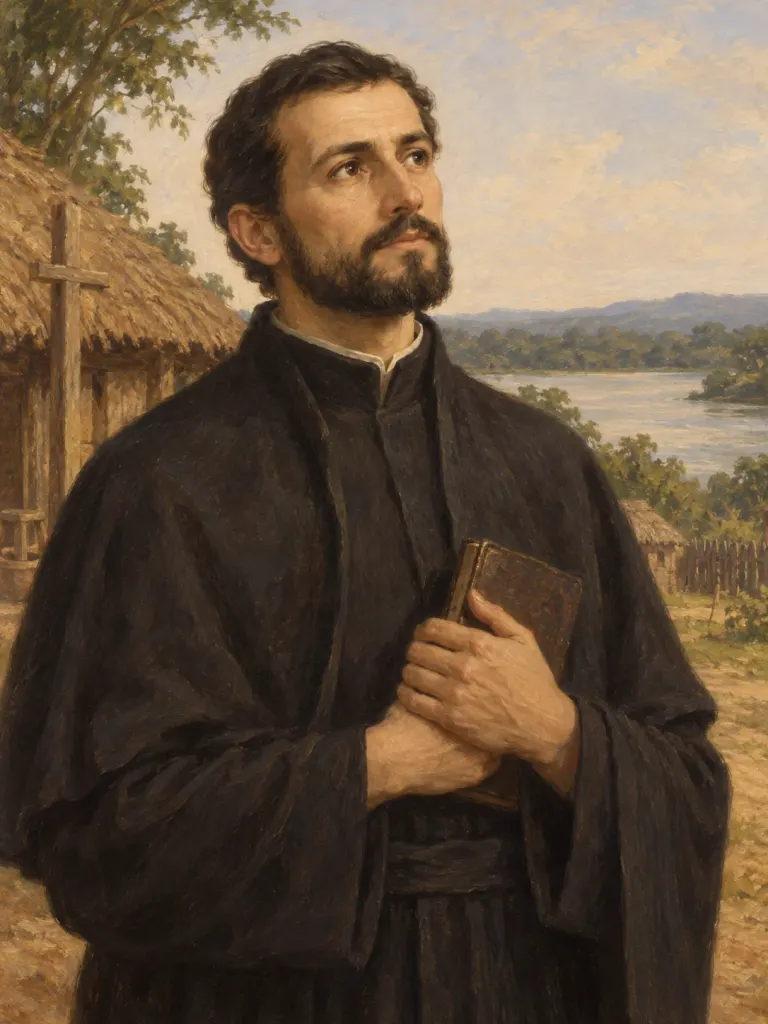
Biography
Roque González was a Jesuit missionary born in Asunción who worked among Guaraní communities in South America. His ministry included learning and teaching the Guaraní language and helping establish the settlements known as reductions. These communities combined religious instruction with organized communal life within a difficult colonial setting.
Born in 1576, González belonged to the region in which he later served. His ability to teach Guaraní to other missionaries made language a shared resource for the mission. Understanding local forms of speech and social life was essential to his approach.
The reductions were not merely isolated preaching stations. They organized a continuing communal life while attempting to shield residents from exploitation. Their history also belongs to colonial power relationships; the Jesuit account expresses the order's understanding of its mission and does not replace Indigenous perspectives on that encounter.
The Jesuit account emphasizes his efforts to understand local customs and defend communities from exploitation. He was killed on November 15, 1628, and is remembered with fellow Jesuit martyrs Alonso Rodríguez and Juan del Castillo. Their story connects the history of mission with questions of language, cultural encounter, and the protection of indigenous people.
Context & contribution
Teaching a language to fellow missionaries
The Society of Jesus’s account emphasizes not only González’s knowledge of Guaraní but his ability to teach it to other missionaries. Language learning therefore contributed to the mission’s continuity. Communication could become a shared capacity rather than depending entirely on one gifted speaker.
The same account presents the reductions as protection from exploitation and an effort to take local culture seriously. It is the order’s interpretation of its own history, and should be read with that standpoint in view. Honoring González’s work does not require overlooking the complex relationship between missionary settlements, Indigenous agency, and colonial power.
Explore the sources for this section
AI-assisted source comparison updated 2026-09-26. Editorial approach
From the Saint Discovery blog
Keep exploring your faith
Practical guides to prayer, the saints, and living the Catholic faith.
Why Is St. Thérèse the Patron Saint of Missions?
Why is St. Thérèse patron saint of missions? Discover her support for missionaries and practical ways to participate in the Church's mission from home.
Sharing the faithRead the article Everyday faithWhat Is Evangelization? A Catholic Guide to Sharing the Faith
What is evangelization? Learn the Catholic meaning, the new evangelization, and practical ways to share your faith with respect, confidence, and love.
Sharing the faithRead the articleFrom reading to reflection
What will you carry with you?
After reading about St. Roque González, take a moment to consider:
- Why does teaching colleagues a local language matter differently from being able to speak it yourself?
These are reflection prompts from Saint Discovery, not quotations from the saint.
Sources and further reading
Biography source comparison recorded on . This is an AI-assisted comparison, not independent human or ecclesiastical approval.
What the recorded review covers
AI-assisted expansion using the linked historical and ecclesiastical sources; devotional traditions distinguished from documented history.
A source list helps you check an account; it does not establish that every claim is certain. Follow the biography’s qualifications about historical evidence, traditions and feast calendars.
Suggest a correction to this biography
How we research these pages and handle corrections · Directory corrections log
More lives to explore
Suggestions based on the site’s quiz themes, not a historical relationship or a measure of holiness.