Catholic saint biography
St. Rabanus Maurus
- Commemoration:
- February 4
- Lived:
- c. 780–856 — Mainz, Germany
February 4 in local German calendars; his designation as saint or blessed varies locally.
Why dates and liturgical observances can differ
Read the sources for this biography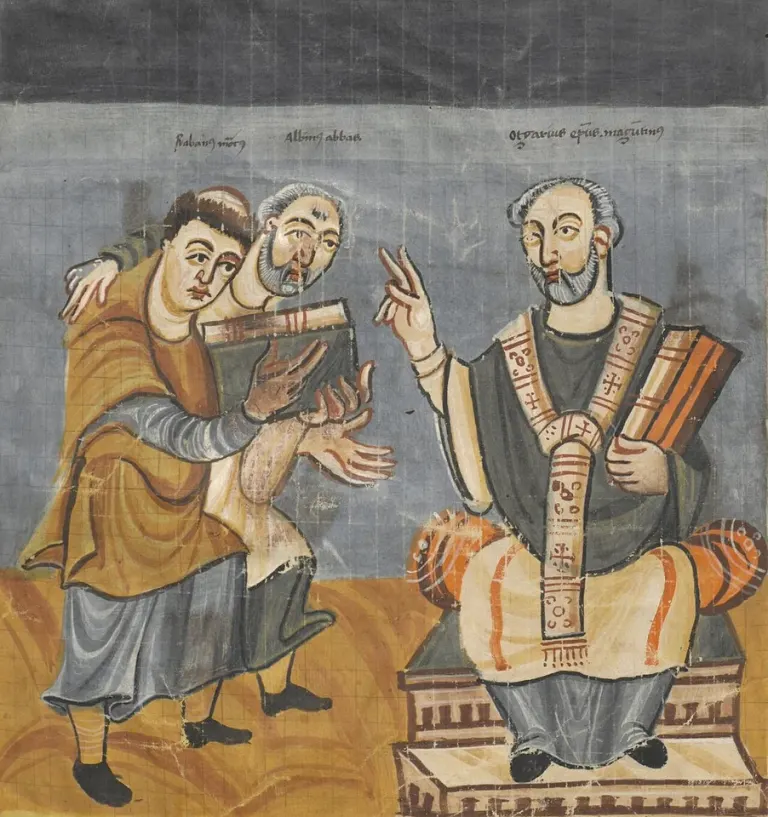
Biography
Rabanus Maurus was a Benedictine scholar, abbot of Fulda, and archbishop of Mainz. His extensive writings helped preserve biblical interpretation and the teaching of earlier Christian authors during the Carolingian period. He combined responsibilities in education and church leadership with sustained study.
Born at Mainz around 780, Rabanus entered monastic life while young. His nickname Maurus recalled Benedict's disciple Maurus, placing his own formation within a familiar Benedictine model. Monastic education gave him the languages and habits of study underlying his later work.
His influence extended to rulers and clergy who sought advice. Rather than abandoning scholarship when he assumed public office, he drew on Scripture and earlier Christian writers to answer pastoral questions. His career illustrates how medieval monasteries served as centers of intellectual transmission as well as worship.
His works included commentaries, poetry, and instruction about worship. A work on the Holy Cross integrated writing and visual design to invite contemplation. The hymn Veni Creator Spiritus is traditionally associated with him, although its authorship is not certain. Venerated locally as a saint or blessed, he is remembered for connecting learning with prayer and pastoral responsibility.
Context & contribution
Theology written to be seen as well as read
Rabanus’s De laudibus Sanctae Crucis combines poetry with pictorial arrangement. Benedict XVI points to the manuscript’s use of the shape of the cross within its writing. The work invites readers to consider how a page’s visual form can participate in its theological meaning.
This is a more particular achievement than simply describing Rabanus as a prolific scholar. He transmitted inherited learning while experimenting with how it could be encountered. His example also complicates a modern division between serious intellectual work and art: in this manuscript, attention to both belongs to the act of contemplation.
Explore the sources for this section
AI-assisted source comparison updated 2026-09-26. Editorial approach
From the Saint Discovery blog
Keep exploring your faith
Practical guides to prayer, the saints, and living the Catholic faith.
Why Is Saint Luke's Symbol an Ox? Meaning and Biblical Roots
Discover why Saint Luke's symbol is a winged ox, its biblical roots, and how the image connects his Gospel with priesthood and sacrifice.
Go deeper into ScriptureRead the article Prayer & reflectionHow to Pray the Jesus Prayer: A Catholic Beginner's Guide
Learn the Jesus Prayer, its Eastern Christian roots and biblical meaning, with a simple Catholic practice focused on Christ and mercy.
Go deeper into ScriptureRead the articleFrom reading to reflection
What will you carry with you?
After reading about St. Rabanus Maurus, take a moment to consider:
- How does encountering an arranged manuscript page differ from reading the same words in a plain paragraph?
These are reflection prompts from Saint Discovery, not quotations from the saint.
Sources and further reading
Biography source comparison recorded on . This is an AI-assisted comparison, not independent human or ecclesiastical approval.
What the recorded review covers
AI-assisted expansion using the linked historical and ecclesiastical sources; devotional traditions distinguished from documented history.
A source list helps you check an account; it does not establish that every claim is certain. Follow the biography’s qualifications about historical evidence, traditions and feast calendars.
Suggest a correction to this biography
How we research these pages and handle corrections · Directory corrections log
More lives to explore
Suggestions based on the site’s quiz themes, not a historical relationship or a measure of holiness.