Catholic saint biography
St. Justin Martyr
- Commemoration:
- June 1
- Lived:
- c. 100–c. 165 — Flavia Neapolis, Samaria
Roman memorial on June 1.
Why dates and liturgical observances can differ
Read the sources for this biography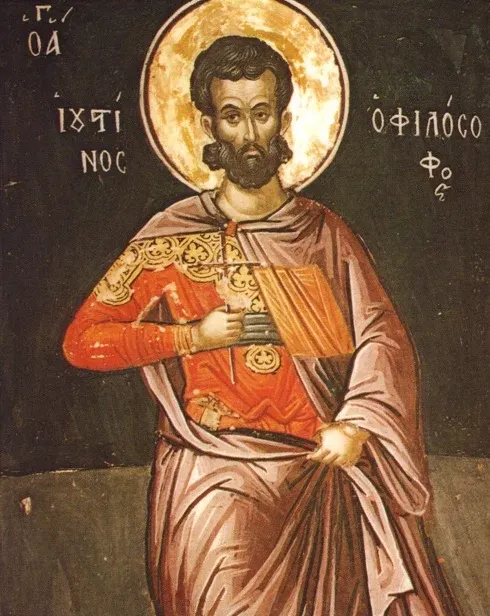
Biography
Justin was a philosopher from Samaria who investigated several Greek schools before embracing Christianity. He continued to present himself as a philosopher and taught in Rome, explaining Christian belief to an educated public. His surviving Apologies and Dialogue with Trypho defend Christians against accusations and interpret their faith in conversation, and sometimes sharp disagreement, with Greek thought and Judaism.
His conversion account presents an encounter that redirected his philosophical search toward the prophets and Christ. At Rome he taught without abandoning the language of reason and inquiry. Calling himself a philosopher expressed his conviction that Christian faith answered the search for truth rather than ending it.
Justin understood Christ as the divine Logos and recognized partial insights into truth beyond the Christian community. His writings also preserve valuable early descriptions of baptism and the Eucharistic assembly. He was executed in Rome around 165 under Marcus Aurelius. His importance rests both in his witness under persecution and in his effort to express faith through reasoned argument.
The Apologies address outsiders' accusations as well as explaining Christian practice. Their descriptions of worship are especially useful because they come from the second century, relatively close to Christianity's beginnings. The Dialogue is an argumentative literary work, however, and should not be read as a neutral transcript of every view held by Jewish contemporaries.
Context & contribution
A free school and a reasoned defense
Justin taught Christianity in a school at Rome without charging pupils, according to Benedict XVI's account. The school gives institutional form to his conviction that Christian faith could be examined as a way of truth and virtuous living. His philosophical language was therefore used in teaching relationships as well as in written defenses.
His positive engagement with philosophy did not mean equal acceptance of every religious practice. He sharply criticized pagan myths while finding openings in reasoned philosophical inquiry. This distinction explains both the reach and the polemical limits of his approach: he looked for shared rational questions without pretending that the competing answers were interchangeable.
Explore the sources for this section
AI-assisted source comparison updated 2026-09-26. Editorial approach
From the Saint Discovery blog
Keep exploring your faith
Practical guides to prayer, the saints, and living the Catholic faith.
Why Do Catholics Pray to Saints? Intercession Explained
Why do Catholics pray to saints? Learn how intercession differs from worship, how it relates to Jesus, and a simple way to ask a saint to pray for you.
A next step with your saintRead the article Living the seasonsHow to Celebrate Your Patron Saint's Feast Day at Home
Celebrate your patron saint's feast day with prayer, a short biography, and an act of kindness. A practical plan for families, sponsors, and individuals.
A next step with your saintRead the articleFrom reading to reflection
What will you carry with you?
After reading about St. Justin Martyr, take a moment to consider:
- Outline a question Justin could discuss with a Greek philosopher, then distinguish the shared reasoning from the religious conclusion on which they might disagree.
These are reflection prompts from Saint Discovery, not quotations from the saint.
Sources and further reading
Biography source comparison recorded on . This is an AI-assisted comparison, not independent human or ecclesiastical approval.
What the recorded review covers
AI-assisted expansion of the existing source-reviewed biography with comparison to retrieved cited sources; not ecclesiastical approval
A source list helps you check an account; it does not establish that every claim is certain. Follow the biography’s qualifications about historical evidence, traditions and feast calendars.
Suggest a correction to this biography
How we research these pages and handle corrections · Directory corrections log
More lives to explore
Suggestions based on the site’s quiz themes, not a historical relationship or a measure of holiness.