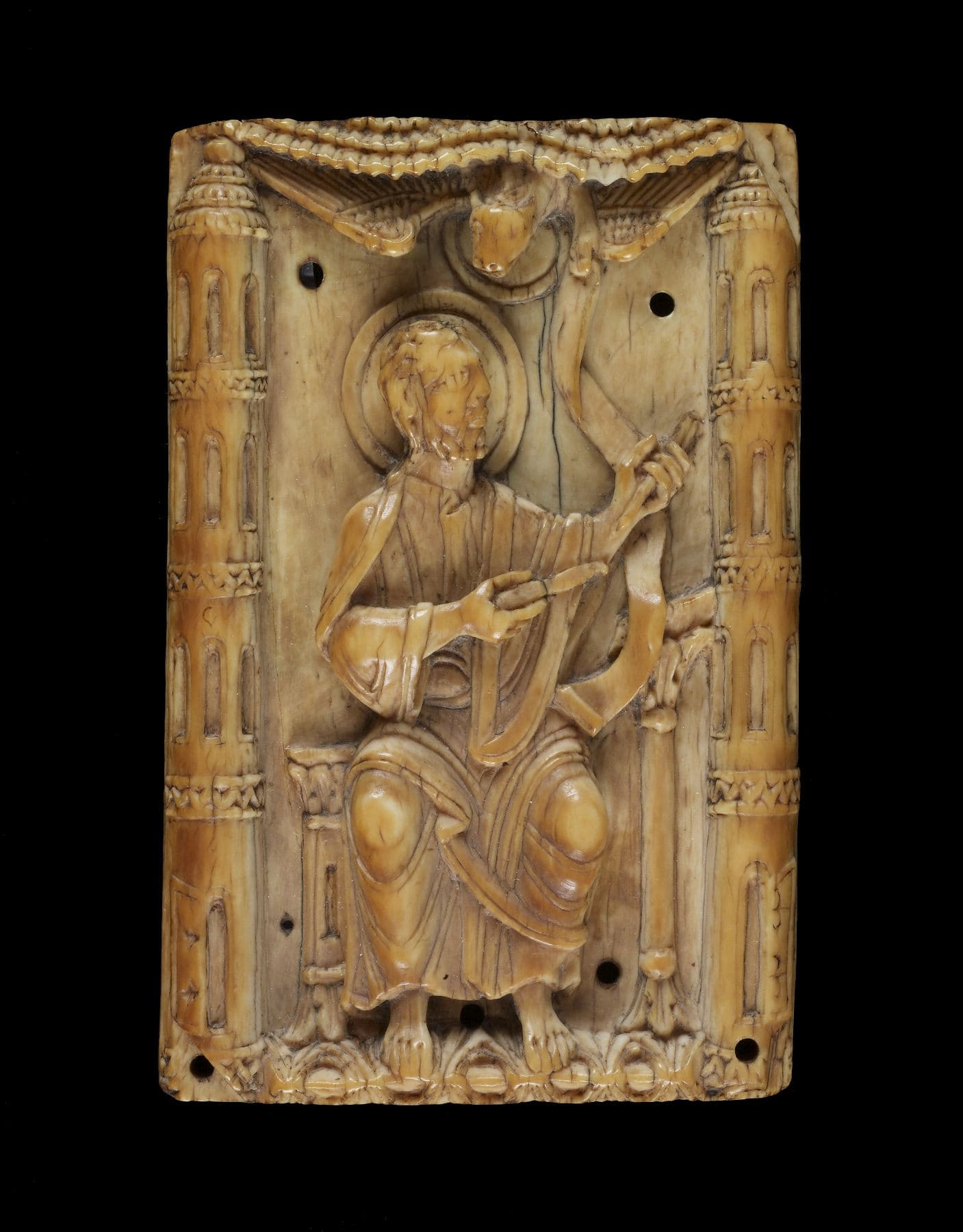
Saint Luke's symbol is an ox because Christian tradition connects his Gospel with priestly worship and sacrifice. His narrative opens with the priest Zechariah serving in the Jerusalem temple. The winged ox belongs to a larger tradition of representing the four evangelists through the living creatures described in Scripture. The Byzantine Catholic Eparchy of Phoenix explains these connections.
If you have noticed an ox beside a saint writing in a book, you may have found Luke. Understanding the symbol can turn a puzzling detail in a church window or manuscript into an invitation to read his Gospel more closely.
Why an ox rather than another animal?
The animal points toward sacrifice and the priestly dimension of Christ's work. The Diocese of Salford's introduction to Luke identifies sacrifice and salvation as themes expressed by the winged ox.
This interpretation has ancient roots. In The Harmony of the Gospels, Book I, chapter 6, Saint Augustine discusses different assignments of the creatures to the evangelists. He notes agreement about Luke's association with the calf and relates it to priesthood and sacrifice, beginning with Zechariah.
That gives us a useful distinction: the ox is a theological symbol used by Christian interpreters and artists. It is not evidence that Luke kept an ox, traveled with one, or chose an animal emblem for himself.
What actually happens at the beginning of Luke?
After the prologue, Luke 1:5–25 introduces Zechariah and Elizabeth. Zechariah is serving as a priest when an angel announces the coming birth of their son, John. The people are praying outside while Zechariah offers incense inside the sanctuary.
Notice the detail: Zechariah offers incense. This scene does not describe him slaughtering an ox. The traditional animal symbol draws on the wider association of oxen with sacrifice and on the temple setting; it should not be inserted into the biblical narrative as though it were part of the scene.
Read the passage slowly and imagine how it begins the Gospel. There is a place of worship, a praying community, an unexpected announcement, and a family whose future is about to change. The temple setting gives the artistic symbol a concrete point of connection with the text.
These descriptions summarize the passage; they are not direct Scripture quotations.
Why does the ox have wings?
The wings belong to the biblical imagery behind the evangelist symbols. In Ezekiel 1:5–11, the prophet describes four living creatures with wings and faces associated with a human being, lion, ox, and eagle. Each creature has four faces. Revelation 4 presents another vision of living creatures around God's throne.
The Eparchy of Phoenix's explanation connects the evangelist emblems with these visions. It gives the familiar artistic arrangement: Matthew with the human figure, Mark with the lion, Luke with the ox, and John with the eagle.
The biblical visions themselves do not name Matthew, Mark, Luke, and John as those creatures. Their use as evangelist symbols is a Christian interpretation of the imagery. Augustine's discussion also reminds us that historical interpreters did not all assign every creature in exactly the same way.
When you look at a winged ox, then, think of an image shaped by Scripture and Christian interpretation rather than a picture of an ordinary farm animal.
How can I recognize Luke in sacred art?
Look for the relationship between the figure, the book, and the animal. The cover image offers a clear example: Luke sits at a lectern while a winged ox appears above him. The Walters Art Museum's description, reproduced with the image on Wikimedia Commons, identifies the carving as a Gospel book-cover plaque made between 1050 and 1075.

Try describing what you see before interpreting it. Where is Luke looking? How is the book positioned? Where does the artist place the ox? Then use the museum's description to check your observations.
With a child or a Confirmation student, turn this into a small exercise. Ask them to find the writer first, then the book, then the animal. Explain one connection with Luke's Gospel and read a few verses together. The purpose is to let the image lead toward the text.
Is this the same as Luke's connection with artists?
They are separate associations. The ox helps identify Luke as an evangelist and expresses a traditional reading of his Gospel. His patronage of artists is connected with a different tradition about painting Mary.
Our article on Saint Luke as patron saint of artists explains that tradition and its historical limits. For his wider story, visit the biography of Saint Luke the Evangelist.
Keeping the associations distinct helps you read an artwork carefully. A painting of Luke at an easel and a carving of Luke with an ox can communicate different aspects of the Church's memory of the same saint.
A way to learn from the symbol this October
Luke's usual feast date is October 18, as reflected in Vatican News' saint entry. In 2026, however, the USCCB calendar lists October 18 as the Twenty-Ninth Sunday in Ordinary Time. Do not assume that your parish's Sunday Mass will use Luke's feast readings.
You can still make this a week for learning about him. Look for his symbol in a church or illustrated Bible, read the opening of his Gospel, and write down one question the passage raises. Our guide to the four Gospels can help place that reading alongside Matthew, Mark, and John.
Artwork: Saint Luke the Evangelist, anonymous German artist, 1050–1075, Walters Art Museum, Baltimore, 71.139. Photograph © Walters Art Museum via Wikimedia Commons, CC BY-SA 3.0. No editorial alterations; any cover-display crop is shared under the same license.