Catholic saint biography
St. Lioba
- Commemoration:
- September 28
- Lived:
- Eighth century; died c. 782 — Anglo-Saxon England
Local commemoration September 28.
Why dates and liturgical observances can differ
Read the sources for this biography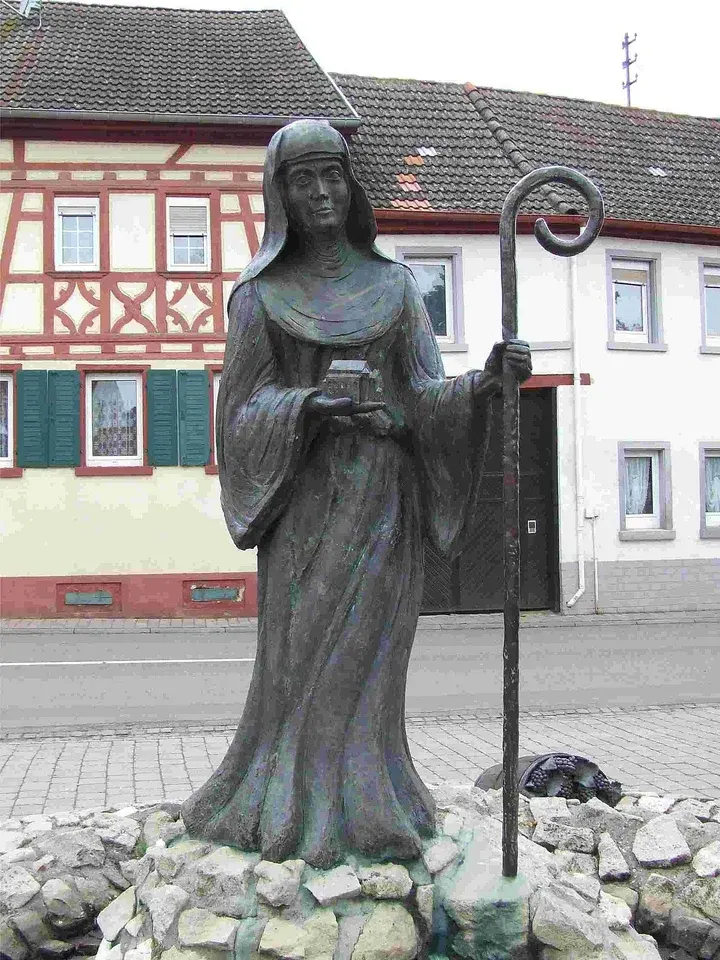
Biography
Lioba, also known as Leoba, was an English religious woman who joined the missionary work of her relative Boniface in German-speaking lands. He entrusted her with leadership of a women's monastery in the Tauber region. Her role demonstrates that the development of these Christian communities depended on women's teaching and monastic leadership as well as on traveling bishops and priests.
Her crossing from England to the continent belonged to a wider movement of monastic cooperation. A stable community could sustain teaching and religious practice in ways that an itinerant missionary alone could not. As abbess, she exercised authority through the daily formation of women living a shared rule.
She guided her community through instruction and example and became respected beyond its walls. Tradition associates her with the esteem of Charlemagne and the confidence of his wife Hildegard. In later life she withdrew to Schornsheim, near Mainz, where she died around 782. Her commemoration preserves the memory of a cross-cultural vocation rooted in learning, community, and sustained spiritual formation.
Later accounts preserve her contact with rulers, but her central vocation was the governance of a religious community. Courtly esteem was a consequence of that reputation rather than the defining purpose of her life. The surviving outline is limited, so a detailed itinerary or set of personal speeches would go beyond the evidence.
Context & contribution
Her own letter reveals a student and a poet
A surviving letter to Boniface, dated approximately 732 in Columbia University's Epistolae collection, gives unusually direct access to Lioba's voice. She asks prayers for her deceased father and ill mother, recalls family ties, and sends a small gift. Personal concern and religious correspondence are intertwined rather than separated into distinct spheres.
She also includes Latin verses, names Eadburga as her teacher in poetic composition, and asks Boniface to correct her style. This is concrete evidence of women's literary education within the monastic network. The letter's modest self-presentation should not obscure its achievement: Lioba communicates in learned Latin and participates actively in an exchange of writing, instruction, and prayer.
Explore the sources for this section
AI-assisted source comparison updated 2026-09-26. Editorial approach
From the Saint Discovery blog
Keep exploring your faith
Practical guides to prayer, the saints, and living the Catholic faith.
What Is the Domestic Church? John Paul II on Faith at Home
What Catholics mean by the domestic church, how John Paul II explained family life, and practical ways to begin with prayer, forgiveness and welcome.
Bring reflection into prayerRead the article Prayer & reflectionHow to Make a Spiritual Communion When You Cannot Receive
Learn how to make a spiritual communion, with a short original prayer and clear guidance on Mass, Confession, and times when you cannot receive.
Bring reflection into prayerRead the articleFrom reading to reflection
What will you carry with you?
After reading about St. Lioba, take a moment to consider:
- Read Lioba's letter and mark references to family, learning, and prayer; discuss what her request for correction reveals about how literary skill was cultivated.
These are reflection prompts from Saint Discovery, not quotations from the saint.
Sources and further reading
Biography source comparison recorded on . This is an AI-assisted comparison, not independent human or ecclesiastical approval.
What the recorded review covers
AI-assisted expansion of the existing source-reviewed biography with comparison to retrieved cited sources; not ecclesiastical approval
A source list helps you check an account; it does not establish that every claim is certain. Follow the biography’s qualifications about historical evidence, traditions and feast calendars.
Suggest a correction to this biography
How we research these pages and handle corrections · Directory corrections log
More lives to explore
Suggestions based on the site’s quiz themes, not a historical relationship or a measure of holiness.