Catholic saint biography
St. Martin I
- Commemoration:
- April 13
- Lived:
- Died 655 — Todi, Italy; Rome and Crimea
Current Roman memorial; older Western calendars used November 12.
Why dates and liturgical observances can differ
Read the sources for this biography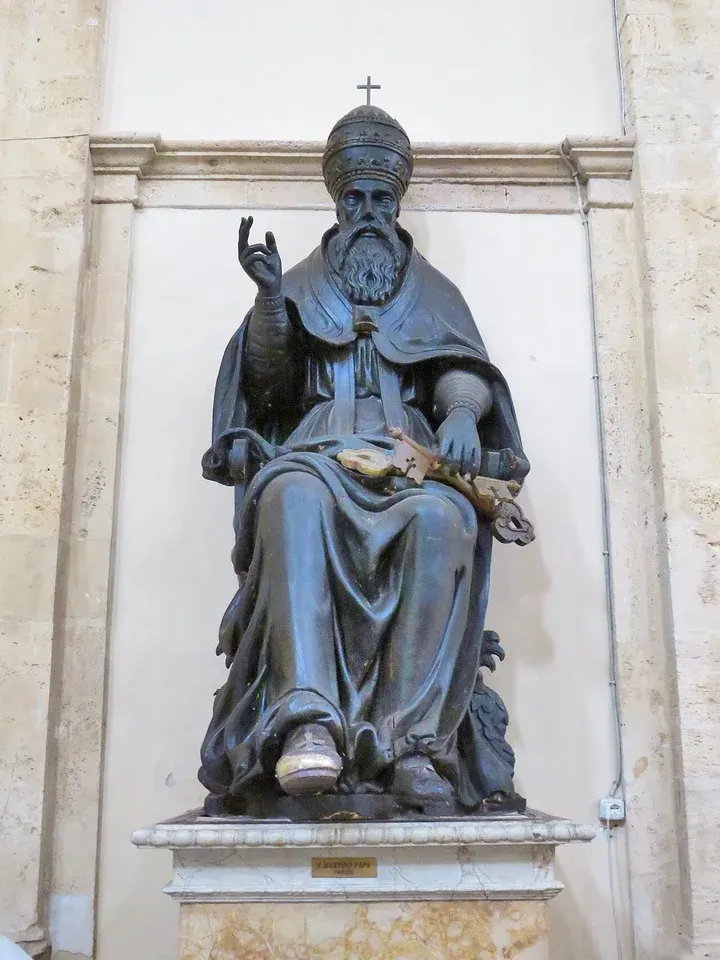
Biography
Martin I became pope in 649 during a major controversy about Christ's human and divine wills. He convened a Lateran council that opposed Monothelitism and rejected imperial attempts to silence the debate. His defense of church teaching brought him into conflict with Emperor Constans II.
The theological question concerned whether Christ's genuine humanity included a human will, not merely a human appearance. Imperial efforts to suppress discussion sought religious stability, while Martin and the Lateran council judged silence inadequate. A doctrinal disagreement thus became a struggle over the limits of imperial control of church teaching.
Imperial officials arrested him in Rome and took him to Constantinople, where he suffered imprisonment and trial. He was ultimately exiled to Cherson in Crimea and died there in 655. Surviving letters convey the deprivation and isolation of his final period. The Church honors him as a martyr for the suffering and death resulting from his witness; his current Roman memorial is April 13.
His surviving correspondence makes the final exile unusually personal: it preserves need and isolation rather than only the formal record of a council. Cherson was far from the Roman community he had governed. His martyr title recognizes the consequences of persecution even though his death came through prolonged deprivation rather than immediate execution.
Context & contribution
Making a council's decisions travel
The Lateran council of 649 involved 105 bishops and issued twenty canons. Martin circulated its decisions with an accompanying letter, making their reception beyond Rome part of the council's work. Rejecting the imperial Ecthesis and Typos was therefore followed by the practical task of communicating a theological judgment to other churches.
Martin also appointed John of Philadelphia as his representative in the East. These actions show the administrative side of a crisis often narrated only through arrest and exile. The dispute depended on documents, delegated authority, and networks of bishops as well as imperial coercion. His earlier service as a papal envoy in Constantinople had already brought him into that diplomatic world.
Explore the sources for this section
AI-assisted source comparison updated 2026-09-26. Editorial approach
From the Saint Discovery blog
Keep exploring your faith
Practical guides to prayer, the saints, and living the Catholic faith.
Why Do Catholics Pray to Saints? Intercession Explained
Why do Catholics pray to saints? Learn how intercession differs from worship, how it relates to Jesus, and a simple way to ask a saint to pray for you.
A next step with your saintRead the article Living the seasonsHow to Celebrate Your Patron Saint's Feast Day at Home
Celebrate your patron saint's feast day with prayer, a short biography, and an act of kindness. A practical plan for families, sponsors, and individuals.
A next step with your saintRead the articleFrom reading to reflection
What will you carry with you?
After reading about St. Martin I, take a moment to consider:
- Trace how a decision of the 649 council could reach a distant bishop, identifying the roles of a signed canon, an explanatory letter, and an authorized representative.
These are reflection prompts from Saint Discovery, not quotations from the saint.
Sources and further reading
Biography source comparison recorded on . This is an AI-assisted comparison, not independent human or ecclesiastical approval.
What the recorded review covers
AI-assisted expansion of the existing source-reviewed biography with comparison to retrieved cited sources; not ecclesiastical approval
A source list helps you check an account; it does not establish that every claim is certain. Follow the biography’s qualifications about historical evidence, traditions and feast calendars.
Suggest a correction to this biography
How we research these pages and handle corrections · Directory corrections log
More lives to explore
Suggestions based on the site’s quiz themes, not a historical relationship or a measure of holiness.