Catholic saint biography
St. Dymphna
- Commemoration:
- May 15
- Patron Saint of:
- People with mental illness
- Lived:
- Dates uncertain; traditionally seventh century — Traditionally Ireland; cult centered at Geel, Belgium
Why dates and liturgical observances can differ
Read the sources for this biography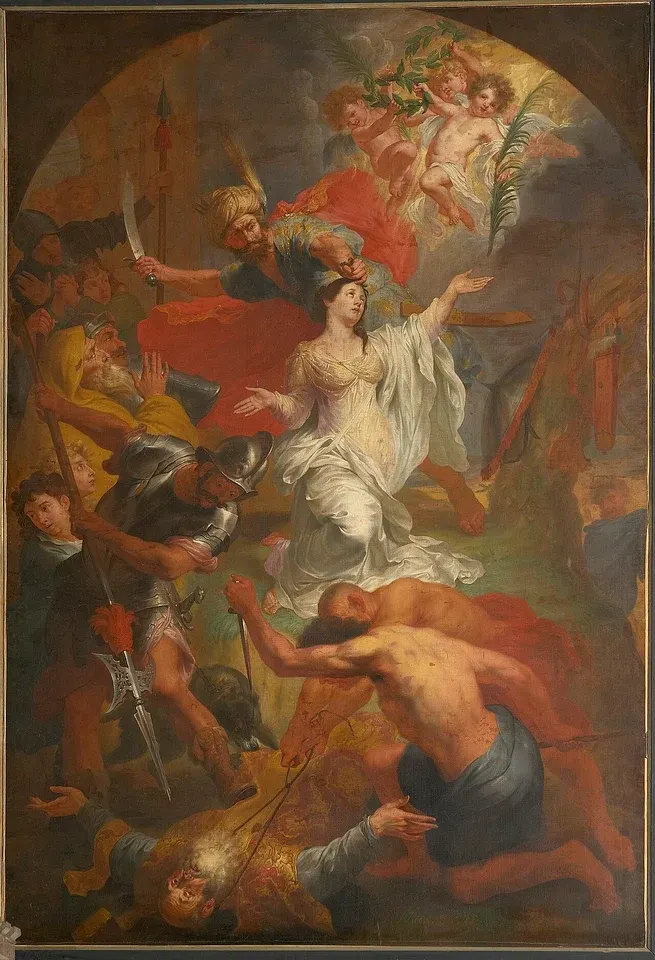
Biography
Dymphna is honored as a virgin martyr and a patron of people living with mental illness. Her devotion is centered on Geel in Belgium, where a tradition of welcoming people with psychiatric difficulties developed around her shrine.
The surviving account of her life was written in the thirteenth century by Pierre, a canon at Cambrai, who explicitly drew on oral tradition. It describes an Irish princess fleeing her father's abusive demands with a priest named Gerebernus. According to the story, her father pursued them and killed them at Geel.
That narrative was recorded many centuries after the events it claims to describe. Its family history, chronology, and journey cannot be established as contemporary fact. Even the connection between Dymphna and similarly named Irish saints remains uncertain.
The better documented history concerns her cult and the community's response to people seeking help. Care extended beyond the shrine into local households, giving Geel a distinctive place in the history of mental health support. Her May 15 remembrance therefore encompasses both a martyr tradition and a tangible legacy of hospitality. The sword in her artwork refers to the traditional account of her death.
Context & contribution
A shrine and the limits of material evidence
The early twentieth-century Catholic Encyclopedia describes fragments of two ancient sarcophagi and a brick bearing letters read as Dymphna's name. Such objects help explain why a particular place became associated with devotion, but they cannot establish the family relationships or journey narrated in the later Life.
The same source records the destruction of Geel's old church by fire in 1489 and the consecration of its replacement in 1532. These dated events offer a firmer chronology for the shrine than for the saint herself. Distinguishing the two chronologies lets the history of care and pilgrimage remain visible without turning an object into proof of every legend.
Explore the sources for this section
AI-assisted source comparison updated 2026-09-26. Editorial approach
From the Saint Discovery blog
Keep exploring your faith
Practical guides to prayer, the saints, and living the Catholic faith.
St. Josephine Bakhita: Hope Without Denying Suffering
Learn what St. Josephine Bakhita teaches about Christian hope, dignity, and freedom, with practical reflection prompts and an original prayer.
Faith in difficult timesRead the article Prayer & reflectionWhat Is Redemptive Suffering? A Catholic Guide
What is redemptive suffering? Learn what Catholics mean by offering it up, how to unite suffering to Christ, and why seeking help belongs with faith.
Faith in difficult timesRead the articleFrom reading to reflection
What will you carry with you?
After reading about St. Dymphna, take a moment to consider:
- Make two exhibit labels: one for a sarcophagus fragment and one for the later Life. Explain what each can and cannot tell a visitor.
These are reflection prompts from Saint Discovery, not quotations from the saint.
Sources and further reading
Biography source comparison recorded on . This is an AI-assisted comparison, not independent human or ecclesiastical approval.
What the recorded review covers
AI-assisted expansion checked against cited sources; historical traditions distinguished from documented evidence; not ecclesiastical approval
A source list helps you check an account; it does not establish that every claim is certain. Follow the biography’s qualifications about historical evidence, traditions and feast calendars.
Suggest a correction to this biography
How we research these pages and handle corrections · Directory corrections log
More lives to explore
Suggestions based on the site’s quiz themes, not a historical relationship or a measure of holiness.