Catholic saint biography
St. Juan Diego Cuauhtlatoatzin
- Commemoration:
- December 9
- Lived:
- Traditionally 1474–1548 — Cuautitlán, Mexico
Roman optional memorial on December 9.
Why dates and liturgical observances can differ
Read the sources for this biography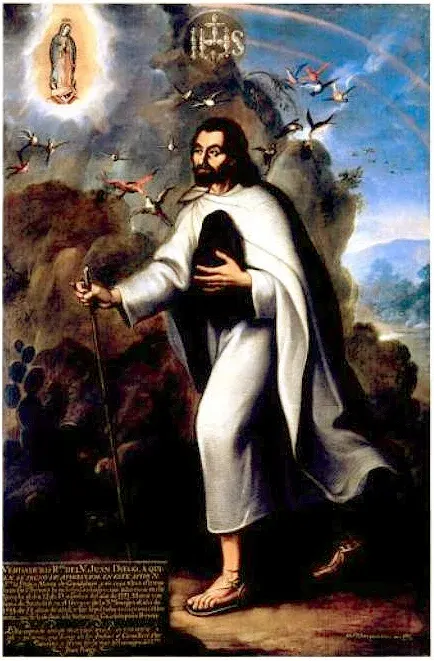
Biography
Juan Diego was an Indigenous Mexican Christian whose memory is inseparable from Our Lady of Guadalupe. According to the received Guadalupe narrative, he encountered Mary at Tepeyac in December 1531 and carried her request for a shrine to Bishop Juan de Zumárraga. The narrative recounts flowers gathered out of season and an image appearing on his tilma as the confirming sign.
The received account places him among adult Indigenous converts in the years after the arrival of Franciscan missionaries. It remembers his wife, María Lucía, as a fellow Christian and describes him as a widower by the period associated with the shrine. These details belong to the same traditional narrative as the apparitions.
These apparition details should be identified as Catholic devotional tradition rather than an independently documented modern biography. The same tradition remembers him living near the shrine and receiving pilgrims after his wife's death. John Paul II canonized him in Mexico City in 2002. His celebration particularly recognizes Indigenous participation in the history and life of the Church.
The story's significance includes the choice of an Indigenous messenger to address a colonial bishop. The shrine and image became central to Mexican Catholic devotion, but that later importance does not independently verify every biographical detail. Keeping tradition and documentary history distinct allows readers to understand both his veneration and the evidence's limits.
Context & contribution
An Indigenous-language account and its reception
The Holy See's canonization biography identifies the Nican Mopohua as a major Indigenous-language source for the Guadalupe narrative. Written in Nahuatl using Latin characters, it makes the transmission of the story part of the encounter between Indigenous expression and colonial forms of writing.
That source is not a modern interview with Juan Diego or a surviving personal diary. Its importance lies in preserving the received narrative in an Indigenous literary setting. Reading the account with attention to who speaks, how the bishop responds, and how the messenger is addressed gives a more precise approach to its cultural meaning than merely repeating the apparition sequence.
Explore the sources for this section
AI-assisted source comparison updated 2026-09-26. Editorial approach
From the Saint Discovery blog
Keep exploring your faith
Practical guides to prayer, the saints, and living the Catholic faith.
Why Do Catholics Pray to Saints? Intercession Explained
Why do Catholics pray to saints? Learn how intercession differs from worship, how it relates to Jesus, and a simple way to ask a saint to pray for you.
A next step with your saintRead the article Living the seasonsHow to Celebrate Your Patron Saint's Feast Day at Home
Celebrate your patron saint's feast day with prayer, a short biography, and an act of kindness. A practical plan for families, sponsors, and individuals.
A next step with your saintRead the articleFrom reading to reflection
What will you carry with you?
After reading about St. Juan Diego Cuauhtlatoatzin, take a moment to consider:
- Read a translated passage of the Nican Mopohua and mark who has authority to speak, question, and carry a message; discuss how the narrative distributes dignity.
These are reflection prompts from Saint Discovery, not quotations from the saint.
Sources and further reading
Biography source comparison recorded on . This is an AI-assisted comparison, not independent human or ecclesiastical approval.
What the recorded review covers
AI-assisted expansion of the existing source-reviewed biography with comparison to retrieved cited sources; not ecclesiastical approval
A source list helps you check an account; it does not establish that every claim is certain. Follow the biography’s qualifications about historical evidence, traditions and feast calendars.
Suggest a correction to this biography
How we research these pages and handle corrections · Directory corrections log
More lives to explore
Suggestions based on the site’s quiz themes, not a historical relationship or a measure of holiness.