Catholic saint biography
St. John of Capistrano
- Commemoration:
- October 23
- Patron Saint of:
- Military chaplains
- Lived:
- 1385–1456 — Capestrano, Italy
Roman optional memorial.
Why dates and liturgical observances can differ
Read the sources for this biography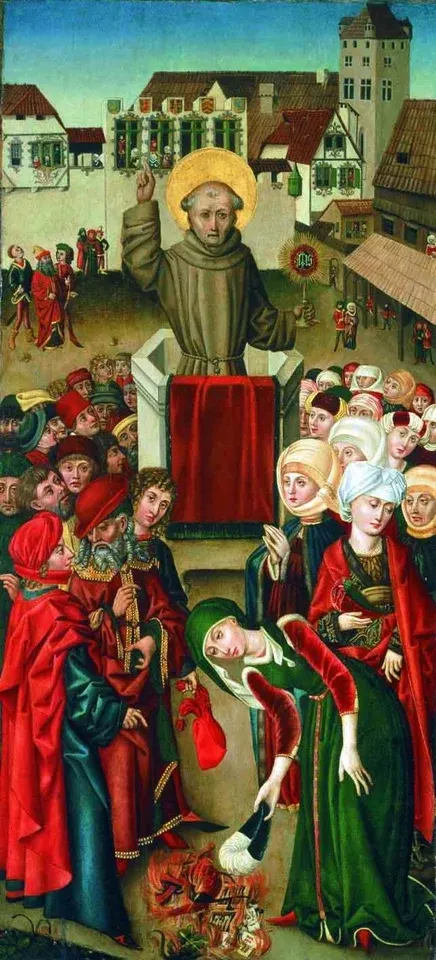
Biography
John of Capistrano studied law and served in the government of Perugia before imprisonment during a regional conflict prompted a change of life. He entered the Franciscans in 1416 and became a prominent preacher associated with the Observant reform and with Bernardino of Siena.
Legal training remained relevant after his change of vocation: he defended the Observant Franciscans and undertook diplomatic assignments for the papacy. His association with Bernardino included promoting devotion to the name of Jesus. Large public preaching missions made him an influential figure far beyond a single friary.
His later ministry took him across central Europe, where preaching, church politics, and campaigns against religious opponents were closely connected. He also helped rally resistance to the Ottoman siege of Belgrade in 1456 and died later that year. His history belongs to a conflict-ridden age and should not be reduced to a generic story of peaceful charity. Catholic tradition honors him as patron of military chaplains.
His legacy also includes coercive religious controversy and participation in warfare, features that require their medieval political setting rather than romantic treatment. At Belgrade he encouraged forces resisting the Ottoman advance. His connection with chaplains comes from that military ministry, not from a career as a modern professional army chaplain.
Context & contribution
Reform and the limits of institutional agreement
Capistrano's Franciscan work included an attempt to reconcile Observant and Conventual friars at Assisi in 1430. The agreement did not endure. That episode gives his reforming career a useful institutional dimension: persuasive preaching could not by itself settle disagreements about how a religious order should be governed and live its rule.
He also supported Colette's reform among the Poor Clares. These relationships place him within a wider movement involving different branches of Franciscan life. The older Catholic Encyclopedia describes crowds and triumphs enthusiastically; its enormous audience estimates are better treated cautiously than repeated as verified attendance figures. Reform history is clearest where identifiable meetings, people, and enduring disagreements can be examined.
Explore the sources for this section
AI-assisted source comparison updated 2026-09-26. Editorial approach
From the Saint Discovery blog
Keep exploring your faith
Practical guides to prayer, the saints, and living the Catholic faith.
Why Do Catholics Pray to Saints? Intercession Explained
Why do Catholics pray to saints? Learn how intercession differs from worship, how it relates to Jesus, and a simple way to ask a saint to pray for you.
A next step with your saintRead the article Living the seasonsHow to Celebrate Your Patron Saint's Feast Day at Home
Celebrate your patron saint's feast day with prayer, a short biography, and an act of kindness. A practical plan for families, sponsors, and individuals.
A next step with your saintRead the articleFrom reading to reflection
What will you carry with you?
After reading about St. John of Capistrano, take a moment to consider:
- Compare a temporary institutional agreement with a lasting reform; use the failed 1430 union to identify what negotiations require after the public meeting ends.
These are reflection prompts from Saint Discovery, not quotations from the saint.
Sources and further reading
Biography source comparison recorded on . This is an AI-assisted comparison, not independent human or ecclesiastical approval.
What the recorded review covers
AI-assisted expansion of the existing source-reviewed biography with comparison to retrieved cited sources; not ecclesiastical approval
A source list helps you check an account; it does not establish that every claim is certain. Follow the biography’s qualifications about historical evidence, traditions and feast calendars.
Suggest a correction to this biography
How we research these pages and handle corrections · Directory corrections log
More lives to explore
Suggestions based on the site’s quiz themes, not a historical relationship or a measure of holiness.