Catholic saint biography
St. Fidelis of Sigmaringen
- Commemoration:
- April 24
- Lived:
- 1577–1622 — Sigmaringen, present-day Germany
Optional memorial on April 24.
Why dates and liturgical observances can differ
Read the sources for this biography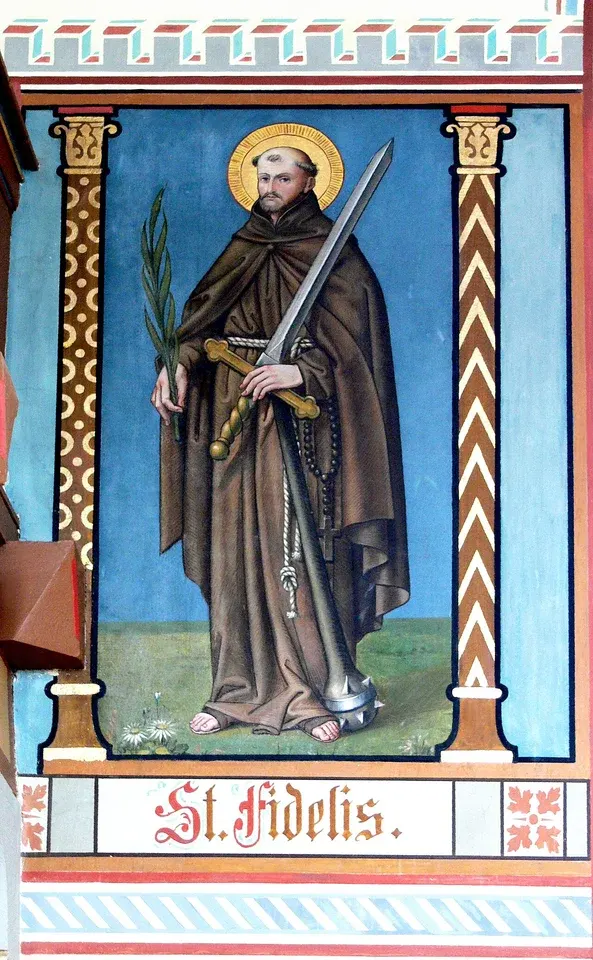
Biography
Fidelis of Sigmaringen was a lawyer who became a Capuchin priest and missionary preacher. His death in the Grisons in 1622 occurred where religious divisions and struggles over political control were closely entangled.
He studied at Freiburg and traveled as a tutor before completing advanced legal studies. Dissatisfaction with practices he encountered in the courts helped move him toward religious life. Ordained in 1612, he entered the Capuchins and took the name Fidelis.
He continued theological study and served as superior in several communities. Preaching and written controversy formed part of his ministry. His personal spiritual exercises also survive, providing evidence for his formation beyond the later accounts of his death.
His mission to the Grisons sought to restore Catholic adherence in a largely Protestant area. Opponents associated that mission with Austrian ambitions, making preaching politically charged. On April 24, 1622, he was killed at Seewis after speaking in the church. Canonized in 1745, he is honored as a martyr. Remembering the surrounding conflict allows his religious witness to be described without erasing the fears and pressures of the communities involved.
Context & contribution
The different survival of a writer's work
Fidelis's private spiritual exercises survived and were republished in the nineteenth century, while the controversial pamphlets he issued anonymously were reported lost. This uneven survival shapes the portrait available to readers: inward formation can be examined through a text that outward public argument cannot always match.
His teaching at Zizers also included extended conversations with magistrates and prominent townspeople. The mission depended on local relationships and civic authority, not only sermons. These details help explain why opponents perceived political implications even when the missionary understood his purpose in religious terms.
Explore the sources for this section
AI-assisted source comparison updated 2026-09-26. Editorial approach
From the Saint Discovery blog
Keep exploring your faith
Practical guides to prayer, the saints, and living the Catholic faith.
Why Is St. Thérèse the Patron Saint of Missions?
Why is St. Thérèse patron saint of missions? Discover her support for missionaries and practical ways to participate in the Church's mission from home.
Sharing the faithRead the article Everyday faithWhat Is Evangelization? A Catholic Guide to Sharing the Faith
What is evangelization? Learn the Catholic meaning, the new evangelization, and practical ways to share your faith with respect, confidence, and love.
Sharing the faithRead the articleFrom reading to reflection
What will you carry with you?
After reading about St. Fidelis of Sigmaringen, take a moment to consider:
- Contrast what a private exercise book and a lost anonymous pamphlet could tell a historian about Fidelis. Which questions remain open because only one survives?
These are reflection prompts from Saint Discovery, not quotations from the saint.
Sources and further reading
Biography source comparison recorded on . This is an AI-assisted comparison, not independent human or ecclesiastical approval.
What the recorded review covers
AI-assisted expansion checked against cited sources; historical traditions distinguished from documented evidence; not ecclesiastical approval
A source list helps you check an account; it does not establish that every claim is certain. Follow the biography’s qualifications about historical evidence, traditions and feast calendars.
Suggest a correction to this biography
How we research these pages and handle corrections · Directory corrections log
More lives to explore
Suggestions based on the site’s quiz themes, not a historical relationship or a measure of holiness.