Catholic saint biography
St. Jacinta Marto
- Commemoration:
- February 20
- Lived:
- 1910–1920 — Aljustrel, Fatima, Portugal
Commemorated with Francisco in the Fatima tradition.
Why dates and liturgical observances can differ
Read the sources for this biography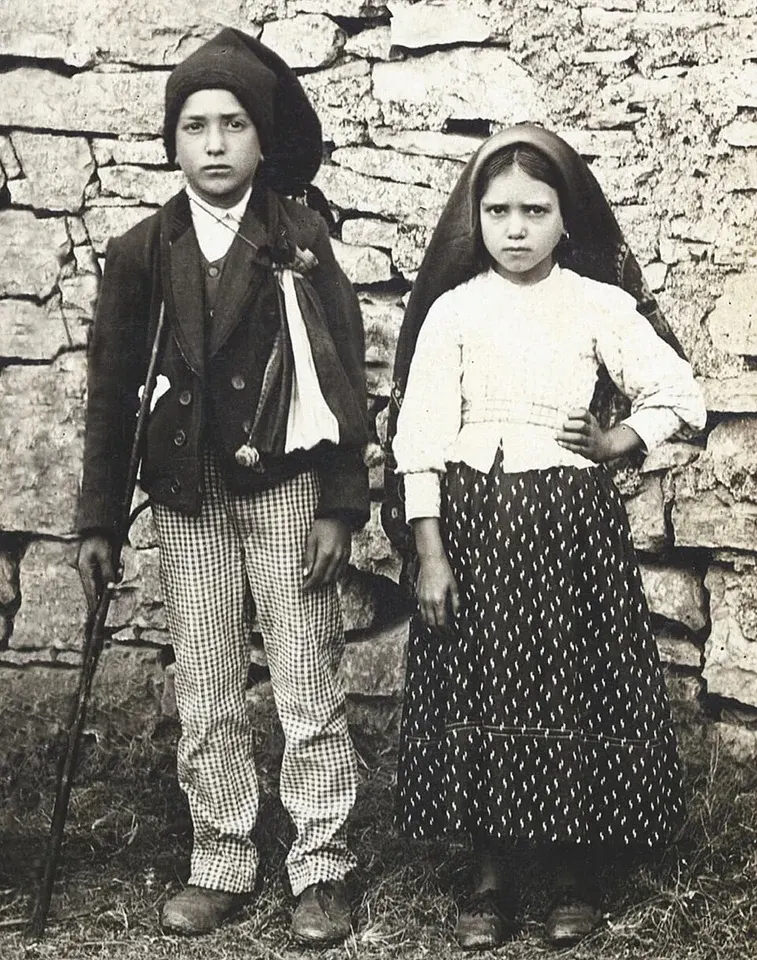
Biography
Saint Jacinta Marto was the youngest of the three children associated with the reported Marian apparitions at Fatima in 1917. Her short life is remembered especially for prayer and compassion toward people who were suffering.
Jacinta grew up in rural Portugal with her brother Francisco and their cousin Lucia. The Fatima accounts describe a lively, affectionate child whose concern for others deepened through the experiences the children reported. She became particularly attentive to the poor, the sick, and the pope.
During the influenza pandemic she became seriously ill. Treatment eventually took her to Lisbon, away from her family, where she died in February 1920 before her tenth birthday. Her final illness is part of a child's real history of vulnerability and separation, not simply a decorative ending to an apparition narrative.
Jacinta and Francisco were beatified in 2000 and canonized in 2017. The Church's recognition concerns their holiness of life. Fatima belongs to the category of private revelation, which does not add to the Gospel. Her memory is therefore best approached through the concrete qualities of prayer, generosity, and concern for others that those who knew her recorded.
Context & contribution
The route of her burial and remembrance
Jacinta's first resting place was in Ourém, where her remains stayed for fifteen years. The Shrine of Fátima records their transfer to Fátima's cemetery on September 12, 1935, and later to the basilica on April 30, 1951. These dates belong to the history of her public remembrance, distinct from the events of 1917.
A memorial at the Ourém cemetery was planned to mark that earlier burial place for local residents and pilgrims. Such a marker preserves a location that a visitor concentrating only on the present shrine could overlook. It makes the development of devotion visible as a sequence of places, decisions, and acts of remembrance rather than a single timeless setting.
Explore the sources for this section
AI-assisted source comparison updated 2026-09-26. Editorial approach
From the Saint Discovery blog
Keep exploring your faith
Practical guides to prayer, the saints, and living the Catholic faith.
St. Josephine Bakhita: Hope Without Denying Suffering
Learn what St. Josephine Bakhita teaches about Christian hope, dignity, and freedom, with practical reflection prompts and an original prayer.
Faith in difficult timesRead the article Living the seasonsWhy Is October the Month of the Rosary? History & Prayer
October’s Rosary devotion connects the October 7 memorial, Lepanto in 1571 and papal encouragement. Understand the history and start a manageable prayer…
Bring reflection into prayerRead the articleFrom reading to reflection
What will you carry with you?
After reading about St. Jacinta Marto, take a moment to consider:
- Draw Jacinta's burial itinerary from Ourém to the Fátima cemetery and basilica. Discuss why a community might preserve a memorial after the remains have moved.
These are reflection prompts from Saint Discovery, not quotations from the saint.
Sources and further reading
Biography source comparison recorded on . This is an AI-assisted comparison, not independent human or ecclesiastical approval.
What the recorded review covers
AI-assisted expansion checked against cited sources; historical traditions distinguished from documented evidence; not ecclesiastical approval
A source list helps you check an account; it does not establish that every claim is certain. Follow the biography’s qualifications about historical evidence, traditions and feast calendars.
Suggest a correction to this biography
How we research these pages and handle corrections · Directory corrections log
More lives to explore
Suggestions based on the site’s quiz themes, not a historical relationship or a measure of holiness.