Saint Josephine Bakhita shows how Christian hope can grow from knowing that God loves us, even when our history contains deep wounds. Her life joins faith with freedom, courage, and care for others. Reading it thoughtfully means taking both her suffering and her choices seriously, without turning an injustice into something admirable.
If you have wondered how a saint can speak about hope after experiencing cruelty, Bakhita offers a particularly important example. This guide explores what the Church draws from her witness and suggests ways to reflect on it in daily life. For the wider story, begin with our Josephine Bakhita biography.
Begin with the person behind the familiar story
Bakhita was born around 1869 in what is now Sudan. Kidnapped as a child and sold into slavery, she eventually reached Italy. Her exact birth date was not known, and accounts differ about her age at kidnapping; an exact number is unnecessary to understand the wrong done to her.
In Venice, the Canossian Sisters introduced her to the Christian faith. When the family she served wanted her to leave, she asserted her wish to remain. She received Baptism, Confirmation, and first Communion on January 9, 1890, and professed religious vows in 1896. These events are recorded in the Vatican biography prepared for her canonization.
Her later life included cooking, sewing, and welcoming people at the convent in Schio. She died in 1947 and was canonized by John Paul II on October 1, 2000. The ordinary work matters: her story continued well beyond the dramatic account of her enslavement and freedom.
Why Benedict XVI used Bakhita to explain hope
In Spe Salvi, paragraph 3, Benedict XVI describes the change that came when Bakhita encountered the God of Jesus Christ. People had treated her as property. She came to understand herself as known and loved by God, whose relationship with her was entirely different from the domination she had experienced.
Benedict's account connects that discovery with her refusal to be taken away from the sisters and her desire to share her faith. Hope gave her a future beyond the judgments of people who had mistreated her. It also shaped the way she lived with others.
That is a useful question to bring to her biography: what changed in her understanding of her own worth? Start there before trying to extract a quick lesson about being cheerful or enduring difficulties.
Christian hope reaches beyond a better mood
The Catechism, paragraphs 1817–1821, describes hope as trust in Christ's promises and desire for eternal life, sustained by the Holy Spirit's grace. Its foundation extends beyond our ability to predict the outcome of a particular problem.
You can hope for a job, a reconciliation, or relief from a difficult situation. Christian hope allows you to bring those desires to God while recognizing that you cannot guarantee how events will unfold. Bakhita's witness should never be used to promise that faith will make every painful memory disappear.
For personal reflection, separate a worry from a verdict about yourself. A setback at work is a real problem to address; it does not establish that you are worthless. A prayer might begin by naming the difficulty honestly, followed by asking for help with the next decision you can actually make.
Her freedom calls us to oppose injustice
At Bakhita's canonization, John Paul II's homily explicitly connected her witness with efforts to free girls and women from oppression and violence and restore their rights. His interpretation calls for active work on behalf of human dignity.
This matters when discussing her with children, a parish group, or a Confirmation class. Avoid suggesting that her captors did her a favor because she later became a Christian. A fruitful discussion can hold together three facts: the abuse was wrong, she made courageous choices, and her life developed into sustained service.
Let the conversation move toward responsibility. Who is being treated as disposable in a situation your group understands? What would listening, fair treatment, or practical support require? These are original discussion prompts, rather than words attributed to Bakhita.
Why February 8 connects her with people affected by trafficking
February 8, Bakhita's feast day, also marks the International Day of Prayer and Awareness Against Human Trafficking. The USCCB explains the connection and points readers toward the Church's work against exploitation.
You can remember her throughout the year. Ask your parish whether it supports a reputable organization working with people affected by trafficking, and learn what that organization actually needs. Follow its guidance instead of assuming that an unrequested donation or a dramatic personal intervention will help.
Our guide to the corporal works of mercy offers another starting point for moving from concern to concrete care. Begin with a need you can understand and a commitment you can sustain.
A small way to practice hope this week
Try a short reflection with Romans 12:12, NABRE: “Rejoice in hope, endure in affliction, persevere in prayer.” Read the surrounding passage as well; Paul's counsel belongs within a discussion of love, service, and life together.
Name one concern without explaining it away. Then name one person you can ask for support and one act of care you can offer. Keep the act specific: make the phone call, accompany someone to an appointment, or complete a task you promised to do. Return to prayer afterward without requiring an immediate feeling of peace.
If you are considering Bakhita as a Confirmation patron, discuss this distinction with your sponsor: which part of her witness would you like to learn from, and how could that become a lasting practice? Our Confirmation saint guide can help you compare saints thoughtfully and continue learning after choosing a name.
An original prayer inspired by Bakhita's witness
The following prayer was written for Saint Discovery for personal use; it is not a quotation from Bakhita or an official liturgical text.
Lord Jesus, help me trust your love without hiding the difficulties I face. Give me courage to ask for help and patience to receive it. Through Saint Josephine Bakhita's intercession, guide me to respect every person's dignity, oppose cruelty, and offer faithful care. Teach me to live this day with hope. Amen.
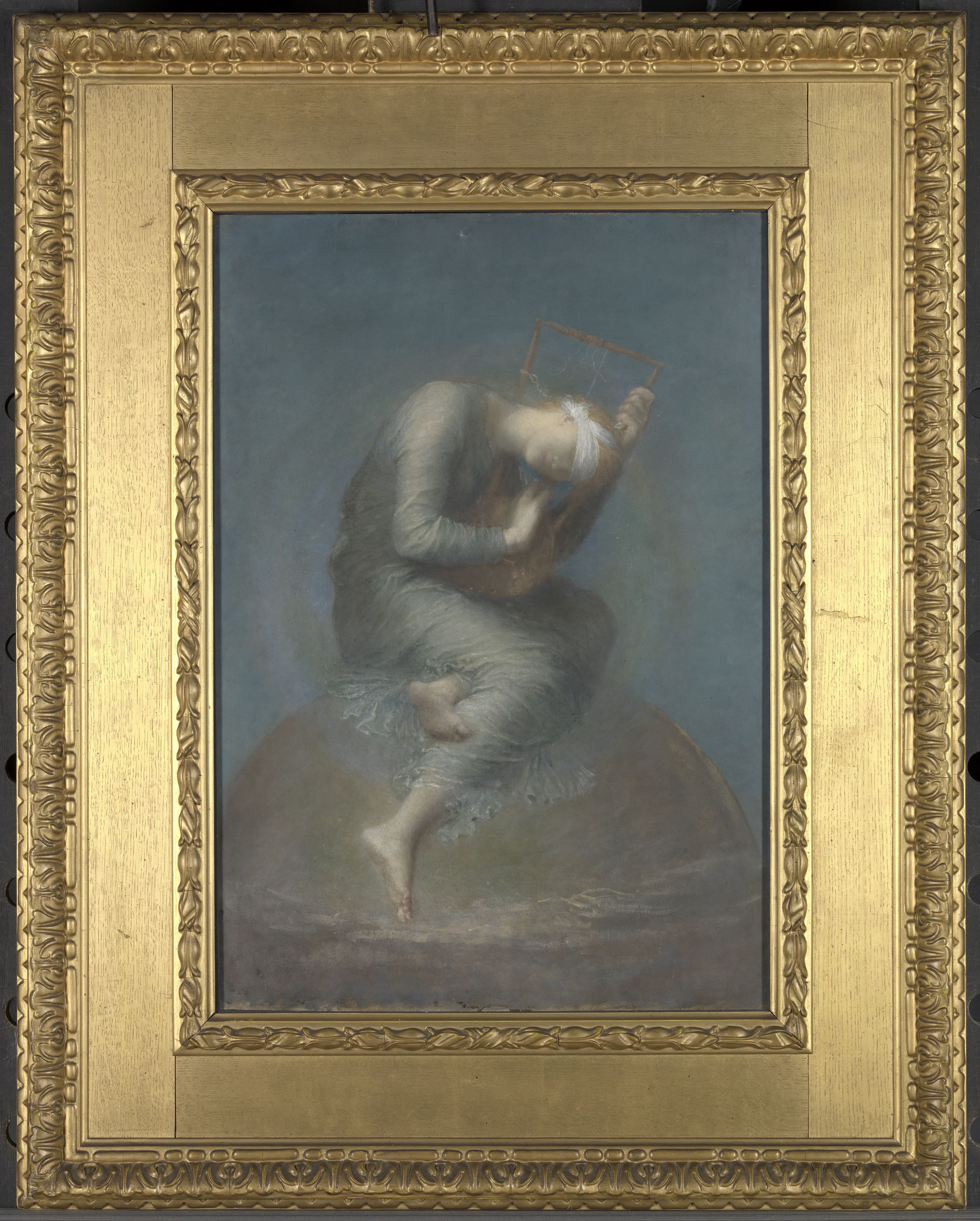
Cover artwork: George Frederic Watts, Hope, 1891, Yale Center for British Art. This is an allegorical painting, not a portrait of Josephine Bakhita. Public-domain reproduction via Wikimedia Commons.
