Catholic saint biography
St. Gleb
- Commemoration:
- July 24
- Lived:
- Died 1015 — Kyivan Rus'
July 24 in the Ukrainian Greek Catholic calendar; the 2025 UGCC report documents this celebration. This is not a claim of a General Roman Calendar memorial.
Why dates and liturgical observances can differ
Gleb (Hlib), brother of Borys, is celebrated by the Ukrainian Greek Catholic Church. Shared Orthodox veneration does not exclude Catholic recognition.
Read the sources for this biography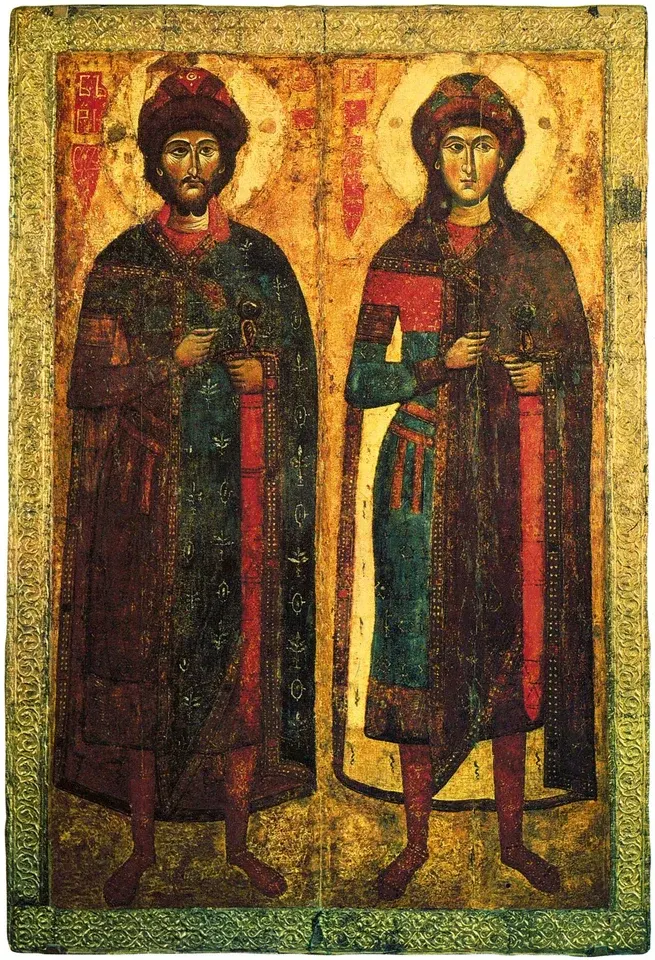
Biography
Gleb, baptized David, was a son of Vladimir of Kyiv and a brother of Boris. Orthodox tradition honors the brothers as passion-bearers, emphasizing their response to violence rather than political or military victory.
Their father's death in 1015 was followed by a struggle for succession. According to the medieval Christian account, Sviatopolk sought to remove his brothers as rivals. Boris was killed first after refusing to use force against his own family.
Gleb was then summoned with a message claiming that his father was ill. Traveling by boat, he learned instead of his father's death and Boris's murder. Assassins seized the boat, and the narrative identifies a member of his own household as the person who killed him.
The detailed speeches and dramatic sequence come through hagiography and should not be read as a contemporary transcript. The title passion-bearer expresses the Church's interpretation of their deaths as an imitation of Christ's nonretaliation. Their joint veneration became a major part of the Christian memory of Kyivan Rus'. Keeping that theological meaning visible also distinguishes their remembrance from a simple celebration of successful royal power.
Context & contribution
Kinship turned into a means of betrayal
The Orthodox Church in America's account deliberately pairs two different deceptions. Boris is approached with a false promise of reconciliation and greater territory; Gleb is summoned with a report that his father is ill. In Gleb's story, an obligation that should have expressed family care becomes the means of drawing him into danger.
That narrative setting gives the title passion-bearer its particular force. The account measures the brothers' response within a struggle for inheritance and political power, rather than portraying their deaths as a conventional trial for refusing another religion. Reading the two summonses together reveals how the tradition contrasts trust in kinship with the violence of dynastic competition.
Explore the sources for this section
AI-assisted source comparison updated 2026-09-26. Editorial approach
From the Saint Discovery blog
Keep exploring your faith
Practical guides to prayer, the saints, and living the Catholic faith.
Why Do Catholics Pray to Saints? Intercession Explained
Why do Catholics pray to saints? Learn how intercession differs from worship, how it relates to Jesus, and a simple way to ask a saint to pray for you.
A next step with your saintRead the article Living the seasonsHow to Celebrate Your Patron Saint's Feast Day at Home
Celebrate your patron saint's feast day with prayer, a short biography, and an act of kindness. A practical plan for families, sponsors, and individuals.
A next step with your saintRead the articleFrom reading to reflection
What will you carry with you?
After reading about St. Gleb, take a moment to consider:
- Compare the messages sent to Boris and Gleb in the OCA account. Discuss how each exploits a different family responsibility and why that matters to the story's moral meaning.
These are reflection prompts from Saint Discovery, not quotations from the saint.
Sources and further reading
- Orthodox Church in America: Boris and Gleb ↗
- Ukrainian Greek Catholic Church: Feast of Saints Borys and Hlib (2025) ↗
Biography source comparison recorded on . This is an AI-assisted comparison, not independent human or ecclesiastical approval.
What the recorded review covers
AI-assisted expansion checked against cited sources; historical traditions distinguished from documented evidence; not ecclesiastical approval
A source list helps you check an account; it does not establish that every claim is certain. Follow the biography’s qualifications about historical evidence, traditions and feast calendars.
Suggest a correction to this biography
How we research these pages and handle corrections · Directory corrections log
More lives to explore
Suggestions based on the site’s quiz themes, not a historical relationship or a measure of holiness.