Catholic saint biography
St. Hubert of Liège
- Commemoration:
- November 3
- Patron Saint of:
- hunters
- Lived:
- Seventh century–727/728 — Frankish territories; exact birthplace uncertain
Traditional feast associated with translation of relics, not his May death date.
Why dates and liturgical observances can differ
Read the sources for this biography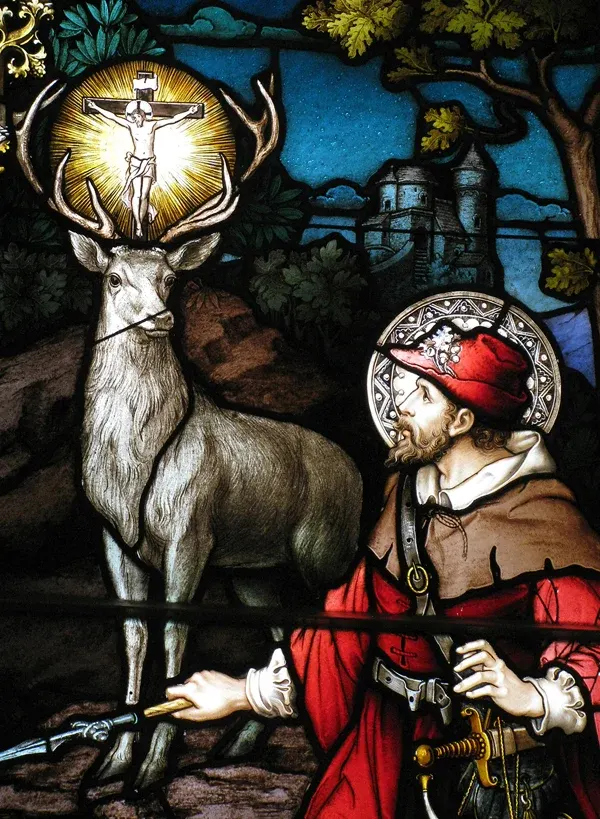
Biography
Hubert was a bishop of Maastricht whose ministry became closely connected with the rise of Liège. His later veneration also made him a familiar patron of hunters.
He succeeded Lambert and supported the transfer of Lambert's relics to Liège. Preaching in the Ardennes and neighboring areas formed part of his remembered episcopal work. These activities provide a firmer outline than the elaborate descriptions of his early court career.
The famous stag with a crucifix between its antlers belongs to later devotional legend. In that story, a hunting expedition becomes the occasion for a religious conversion. Its importance is chiefly explanatory: it accounts for the animal and cross in his artwork and for the development of his patronage.
Claims about noble ancestry, court appointments, and precise details of that conversion require caution. Hubert died at Tervuren in the early eighth century, and his relics and shrines helped spread his cult. His biography should therefore distinguish the bishop associated with Maastricht and Liège from the symbolic story through which many people now recognize him. Neither layer needs to be confused with the other.
Context & contribution
A shrine that changed a place-name
Hubert's posthumous history includes the transfer of his remains in 825 to the abbey of Andage, called Amdain in the Catholic Encyclopedia. The community became known as Saint-Hubert. The saint's name thus entered the geography of the Ardennes through an institution that received and promoted his cult.
The same source records the disappearance of the coffin in the sixteenth century. That break in the material history matters when discussing surviving shrines or relic traditions: continuous devotion does not necessarily mean every physical object has an unbroken documented history. Hubert's influence can be traced through names, institutions, and images even where the history of the original burial has become uncertain.
Explore the sources for this section
AI-assisted source comparison updated 2026-09-26. Editorial approach
From the Saint Discovery blog
Keep exploring your faith
Practical guides to prayer, the saints, and living the Catholic faith.
Why Do Catholics Pray to Saints? Intercession Explained
Why do Catholics pray to saints? Learn how intercession differs from worship, how it relates to Jesus, and a simple way to ask a saint to pray for you.
A next step with your saintRead the article Living the seasonsHow to Celebrate Your Patron Saint's Feast Day at Home
Celebrate your patron saint's feast day with prayer, a short biography, and an act of kindness. A practical plan for families, sponsors, and individuals.
A next step with your saintRead the articleFrom reading to reflection
What will you carry with you?
After reading about St. Hubert of Liège, take a moment to consider:
- Trace Maastricht, Liège, and Saint-Hubert on a map, distinguishing places in Hubert's ministry from the later destination of his remains.
These are reflection prompts from Saint Discovery, not quotations from the saint.
Sources and further reading
Biography source comparison recorded on . This is an AI-assisted comparison, not independent human or ecclesiastical approval.
What the recorded review covers
AI-assisted expansion checked against cited sources; historical traditions distinguished from documented evidence; not ecclesiastical approval
A source list helps you check an account; it does not establish that every claim is certain. Follow the biography’s qualifications about historical evidence, traditions and feast calendars.
Suggest a correction to this biography
How we research these pages and handle corrections · Directory corrections log
More lives to explore
Suggestions based on the site’s quiz themes, not a historical relationship or a measure of holiness.