Catholic saint biography
St. Hildegard of Bingen
- Commemoration:
- September 17
- Lived:
- 1098–1179 — Rhineland, present-day Germany
Roman optional memorial.
Why dates and liturgical observances can differ
Read the sources for this biography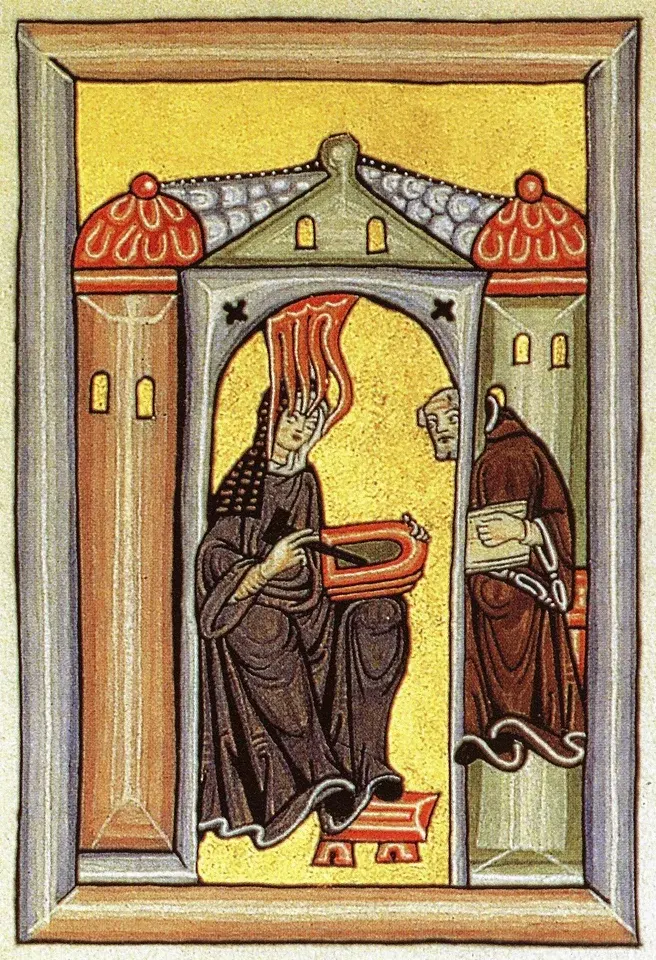
Biography
Hildegard of Bingen (1098–1179) was a Benedictine abbess whose work joined theology, music, community leadership, and the study of creation. Her surviving writings make it possible to encounter a medieval woman through more than later stories about her. They also require attention to the religious world in which she wrote.
Formed in religious life under Jutta at Disibodenberg, Hildegard became leader of the women’s community after Jutta’s death in 1136. When she began recording her visions, she sought advice rather than presenting them as beyond examination. Her correspondents included Bernard of Clairvaux. Pope Eugene III encountered her work at the Synod of Trier in 1147 and authorized her to write and speak about her experiences. Her writings were produced with assistance, including that of the monk Volmar. These relationships place her visionary accounts within a community of readers and religious authorities.
Her three major visionary works have different emphases. Scivias presents the story of salvation through symbolic visions. The Book of Life’s Merits explores the struggle between virtues and vices. The Book of Divine Works considers creation and humanity in relation to God, with Christ at its center. These are theological works shaped by Scripture and rich imagery. Hildegard also composed sacred songs. Her correspondence extended beyond the monastery: she challenged religious and political leaders, including Emperor Frederick Barbarossa, when she believed their conduct harmed the Church.
Leadership required buildings, journeys, and the daily care of sisters as well as writing. Around 1150, Hildegard moved her community to Rupertsberg near Bingen; in 1165 she established another house at Eibingen, while remaining responsible for both. She undertook preaching journeys and left letters, sermons, music, and writings on nature. The range is striking, but these works should be read in their historical setting. Her medieval accounts of health are not clinical evidence for using a remedy today.
Benedict XVI declared her a Doctor of the Church on October 7, 2012, recognizing the importance of her spiritual teaching. That recognition invites study of her understanding of God, humanity, and creation. It does not turn every medieval description of the natural world into a modern scientific conclusion. For a first encounter, her theological works and music provide a clearer starting point than claims that isolate a supposed cure or prediction from its original context.
Context & contribution
Music as a way of thinking about creation
Hildegard gathered hymns, antiphons, and songs into the collection known as Symphonia Harmoniae Caelestium Revelationum. Benedict XVI connects their use in her monasteries with her understanding of creation as a harmony animated by the Holy Spirit. Music was therefore part of her community's theological expression, as well as an artistic accomplishment.
Her imagery could also translate doctrine into relationships a listener could imagine. In Scivias, the union of Christ and the Church is presented through marriage, with the Cross central to that union. Reading such an image beside a song opens a path into her thought that does not depend on treating symbolic visions as straightforward descriptions of physical objects.
Explore the sources for this section
AI-assisted source comparison updated 2026-09-26. Editorial approach
Read, discuss, apply
Begin with Hildegard’s world of symbols
Start with Benedict XVI’s introduction to her writings below. It distinguishes her major books and places their images in a Christian account of creation and salvation. Then choose one work to explore in an annotated edition.
Read the introduction to Hildegard’s writings ↗
Try this with the text
For a class or reading group, make two columns: what an image describes, and what the author says it means. Keep your own interpretation separate. Compare your notes before looking for a modern application; a vivid image is not automatically a prediction.
An original study activity from Saint Discovery, for personal reading, a class, or a Confirmation group.
Find printable reflection resources →From the Saint Discovery blog
Keep exploring your faith
Practical guides to prayer, the saints, and living the Catholic faith.
Why Do Catholics Pray to Saints? Intercession Explained
Why do Catholics pray to saints? Learn how intercession differs from worship, how it relates to Jesus, and a simple way to ask a saint to pray for you.
A next step with your saintRead the article Living the seasonsHow to Celebrate Your Patron Saint's Feast Day at Home
Celebrate your patron saint's feast day with prayer, a short biography, and an act of kindness. A practical plan for families, sponsors, and individuals.
A next step with your saintRead the articleFrom reading to reflection
What will you carry with you?
After reading about St. Hildegard of Bingen, take a moment to consider:
- Which part of Hildegard’s work interests you most: theology, music, or community leadership? What would you need to learn to understand it in its own setting?
- Hildegard sought advice about her experiences. Who helps you examine an important conviction rather than simply affirming it?
- Choose one way to use a creative skill in service this week. Name the person or community it could help.
- Listen to one Hildegard antiphon while reading its translation. Identify an image of creation or relationship and compare it with her theological use of harmony.
These are reflection prompts from Saint Discovery, not quotations from the saint.
Frequently Asked Questions
- Why is Hildegard a Doctor of the Church?
- Benedict XVI recognized the significance of her spiritual teaching in 2012. The title concerns her contribution to Christian understanding; it is not a medical qualification or clinical endorsement of medieval remedies.
Sources and further reading
- Benedict XVI: Hildegard’s life and discernment, September 1, 2010 ↗
- Benedict XVI: Hildegard’s theology and music, September 8, 2010 ↗
- Benedict XVI: Hildegard declared Doctor of the Church, 2012 ↗
Biography source comparison recorded on . This is an AI-assisted comparison, not independent human or ecclesiastical approval.
What the recorded review covers
AI-assisted comparison with the cited primary Catholic sources; expanded with historical context and source-reading guidance. Not a human theological review or ecclesiastical approval.
A source list helps you check an account; it does not establish that every claim is certain. Follow the biography’s qualifications about historical evidence, traditions and feast calendars.
Suggest a correction to this biography
How we research these pages and handle corrections · Directory corrections log
More lives to explore
Suggestions based on the site’s quiz themes, not a historical relationship or a measure of holiness.