Catholic saint biography
St. Teresa of Ávila
- Commemoration:
- October 15
- Lived:
- 1515–1582 — Ávila, Spain
Why dates and liturgical observances can differ
Read the sources for this biography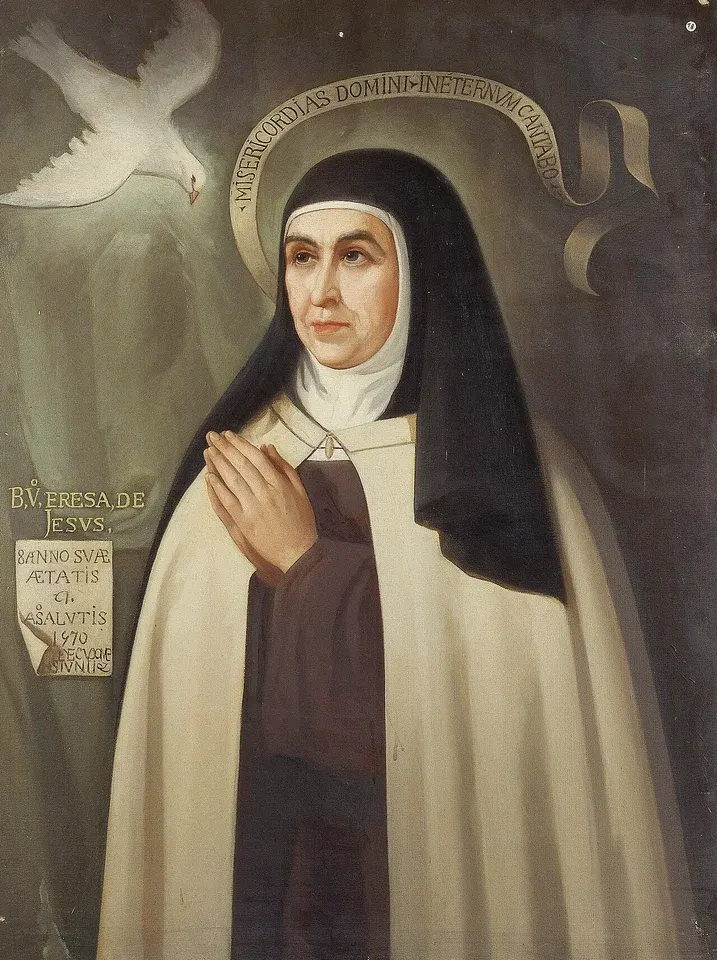
Biography
Teresa of Ávila (1515–1582), also known as Teresa of Jesus, was a Spanish Carmelite nun, founder, and teacher of prayer. Her books grew out of religious life rather than a university career. They address people who need help praying, living together, and recognizing whether spiritual enthusiasm is producing love.
Teresa entered Carmel at twenty. Serious illness and years of inner struggle preceded the deepening of her commitment to prayer. In 1562 she founded Saint Joseph’s in Ávila, beginning a reform centered on small communities, poverty, and recollection. John of the Cross became a collaborator in the reform of the friars. Founding communities involved travel, opposition, and practical decisions about resources as well as contemplation.
Her books serve different purposes. The Life recounts her experience and discernment. The Way of Perfection offers counsel to her sisters, including reflection on the Lord’s Prayer. The Interior Castle uses the image of a castle with successive dwellings to describe growth in relationship with God. The Foundations records the establishment of communities. Knowing which kind of book one is reading helps: autobiography, advice, and symbolic spiritual teaching are not interchangeable.
Pope Francis’s 2021 reflection on Teresa connects her prayer with her creative, demanding work as a reformer. He emphasizes that her extraordinary experiences are not a program every Christian must reproduce. The lasting question is whether prayer leads to charity. Teresa’s example of caring for a sick sister makes that test practical: interrupting a chosen devotion to meet another person’s need can itself express fidelity to God. A reader need not seek visions or unusual feelings to take her teaching seriously.
On September 27, 1970, Paul VI proclaimed Teresa a Doctor of the Church. His homily recognizes her as a teacher whose spiritual wisdom serves the wider Church. The declaration did not claim that she invented a new faith; it drew attention to her capacity to communicate Christian prayer and life. She had been canonized in 1622. Her importance as a woman teaching from lived religious experience is part of that public recognition.
Teresa’s legacy can therefore be approached through both her books and the communities she founded. Reading only accounts of mystical experiences misses the responsibilities surrounding them. Reading only her achievements misses the prayer that sustained them. Her work keeps those dimensions together and gives readers concrete questions about humility, friendship, perseverance, and service.
Context & contribution
Writing for particular readers
Teresa’s books were written for different immediate purposes. Benedict XVI notes that the Life submitted her experience for discernment, while the Way of Perfection addressed the novices of Saint Joseph’s convent. Knowing the intended reader changes how a passage is approached: testimony under examination and practical instruction are not identical genres.
Her writing also draws on experience while remaining in conversation with learned advisers and earlier Christian authors. She did not present interior conviction as eliminating the need for discernment. This relationship between experience, reading, and counsel helps explain the lasting usefulness of her work beyond the circumstances in which it was composed.
Explore the sources for this section
AI-assisted source comparison updated 2026-09-26. Editorial approach
Read, discuss, apply
Choose a Teresa book for your question
Use the overview below to choose a starting point: the Life for her experience, the Way of Perfection for counsel on prayer, or the Interior Castle for her extended image of spiritual growth. You do not need to read all three at once.
Read an introduction to Teresa’s books ↗
Try this with the text
With a short passage from your chosen book, ask: who is Teresa addressing, what difficulty is she naming, and what response does she propose? Write one sentence for each. If you are studying in a group, distinguish her advice to a Carmelite community from your own proposed application at home or work.
An original study activity from Saint Discovery, for personal reading, a class, or a Confirmation group.
Find printable reflection resources →From the Saint Discovery blog
Keep exploring your faith
Practical guides to prayer, the saints, and living the Catholic faith.
How to Read Saint Teresa's Interior Castle: A Beginner's Guide
Start Saint Teresa of Ávila's Interior Castle with a clear reading plan, help choosing an edition, and practical questions for prayer.
Connected to this saintRead the article Meet the saintsSaint Teresa of Ávila's Four Waters: A Guide to Prayer
Explore Saint Teresa of Ávila's four waters of prayer: the well, waterwheel, stream and rain, with practical guidance for reading her Life.
Connected to this saintRead the articleFrom reading to reflection
What will you carry with you?
After reading about St. Teresa of Ávila, take a moment to consider:
- Where might you be separating prayer from a practical responsibility that needs attention?
- How could you respond kindly when someone interrupts the time you hoped to keep for yourself?
- Choose a manageable time for prayer and one act of service. At the end of the week, reflect on how they affected each other.
- Compare a passage of autobiography with advice to her sisters. How does the intended audience change Teresa’s manner of teaching?
These are reflection prompts from Saint Discovery, not quotations from the saint.
Frequently Asked Questions
- Must I have mystical experiences to follow Teresa’s teaching?
- No. Pope Francis cautions against treating her extraordinary experiences as a pattern everyone must copy. Her teaching directs readers toward love of God expressed in concrete charity toward others.
Sources and further reading
- Benedict XVI: Teresa’s life and writings, February 2, 2011 ↗
- Francis: Teresa, prayer and service, April 15, 2021 ↗
- Paul VI: Proclamation of Teresa as Doctor of the Church, 1970 (Spanish) ↗
Biography source comparison recorded on . This is an AI-assisted comparison, not independent human or ecclesiastical approval.
What the recorded review covers
AI-assisted comparison with the cited primary Catholic sources; expanded with historical context and source-reading guidance. Not a human theological review or ecclesiastical approval.
A source list helps you check an account; it does not establish that every claim is certain. Follow the biography’s qualifications about historical evidence, traditions and feast calendars.
Suggest a correction to this biography
How we research these pages and handle corrections · Directory corrections log
More lives to explore
Suggestions based on the site’s quiz themes, not a historical relationship or a measure of holiness.