Catholic saint biography
St. Catherine of Siena
- Commemoration:
- April 29
- Patron Saint of:
- Europe
- Lived:
- 1347–1380 — Siena and Rome, Italy
Why dates and liturgical observances can differ
Read the sources for this biography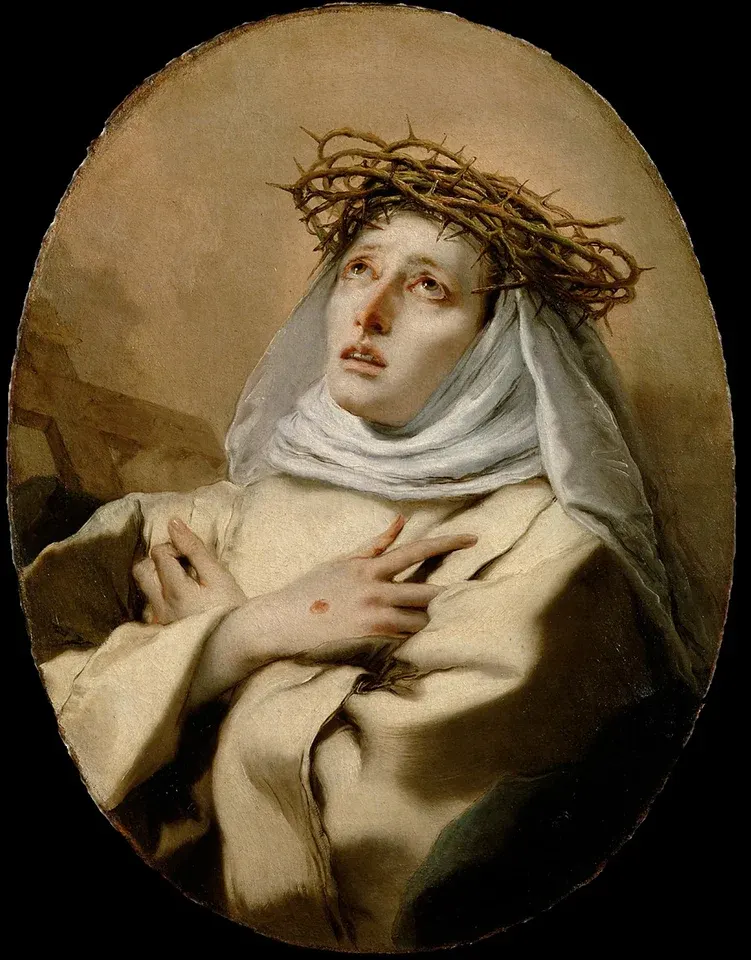
Biography
Catherine of Siena was a Dominican laywoman, spiritual writer, and influential advocate for reform and unity in the fourteenth-century Church. Born in Siena in 1347, she combined care for sick people with a demanding public ministry. Her letters and Dialogue preserve the teaching of a woman whose influence reached far beyond her hometown.
As a teenager she joined the Dominican women known as the Mantellate while continuing to live at home. Prayer and penance accompanied charitable service, especially to people who were ill. A circle of followers formed around her, including laypeople and clergy. They regarded her as a spiritual mother rather than merely as an unusual visionary.
Her public activity developed amid conflicts between Italian cities and the papacy’s residence at Avignon. She urged Gregory XI to return to Rome and traveled in the service of mediation and ecclesiastical reform. After the Western Schism began, she supported Urban VI. Her commitment to unity therefore took shape within a divided Church and difficult political circumstances, not outside them.
Catherine also encountered suspicion. Dominican authorities questioned her at Florence in 1374 and appointed Raymond of Capua as her spiritual guide. He later became an important witness to her life. His descriptions of visions and mystical experiences belong to the religious testimony through which her followers understood her vocation; they should be distinguished from independently recoverable public events.
Her Dialogue, letters, and prayers express an intense concentration on Christ. One memorable image presents Christ as a bridge between humanity and God. This theological imagination accompanies practical demands for repentance, charity, and responsible ministry. She could revere the Church’s sacramental life while addressing forceful criticism to the people entrusted with its leadership.
Catherine died in Rome in 1380, aged thirty-three. Canonized in 1461, she was declared a Doctor of the Church by Paul VI in 1970 and later a co-patron of Europe. Those honors recognize the enduring significance of her teaching as well as her courage. Her biography brings together contemplative experience, service, correspondence, and sustained involvement in the conflicts of her age.
Context & contribution
Reading the bridge in the Dialogue
Catherine's image of Christ as a bridge has an internal structure: three stages are associated with his feet, side, and mouth. These represent departure from sin, the practice of virtue through love, and union with God. The picture turns a theological claim about Christ's mediation into a map for spiritual growth, rather than a promise that maturity arrives in one dramatic experience.
Her discussion of tears gives emotional life a similarly serious place. As Benedict XVI explained, Catherine understood tears as expressions of the heart, recalling Jesus weeping at Lazarus's tomb. Her teaching therefore includes affection and vulnerability alongside the forceful public letters for which she is often remembered.
Explore the sources for this section
AI-assisted source comparison updated 2026-09-26. Editorial approach
Read, discuss, apply
Trace Catherine's image of a bridge
Near the end of the audience below, Benedict XVI explains Catherine's image of Christ as a bridge in the Dialogue. Read that explanation alongside the earlier account of her care for sick people and her work for peace.
Read an introduction to Catherine's life and teaching ↗
Try this with the text
Sketch the bridge and label its three stages using the explanation in the audience. Beside the sketch, write one question the image helps you ask and one point you still do not understand. Then find an example of practical service in the same reading. Discuss how that example might relate to the teaching without assuming your connection is Catherine's own explanation.
An original study activity from Saint Discovery, for personal reading, a class, or a Confirmation group.
Find printable reflection resources →From the Saint Discovery blog
Keep exploring your faith
Practical guides to prayer, the saints, and living the Catholic faith.
St. Josephine Bakhita: Hope Without Denying Suffering
Learn what St. Josephine Bakhita teaches about Christian hope, dignity, and freedom, with practical reflection prompts and an original prayer.
Faith in difficult timesRead the article Prayer & reflectionWhat Is Redemptive Suffering? A Catholic Guide
What is redemptive suffering? Learn what Catholics mean by offering it up, how to unite suffering to Christ, and why seeking help belongs with faith.
Faith in difficult timesRead the articleFrom reading to reflection
What will you carry with you?
After reading about St. Catherine of Siena, take a moment to consider:
- What is easier for you to notice in this reading: its vivid spiritual language or its practical demands?
- How could a firm request for change also show care for the person receiving it?
- Which of Catherine's writings would you investigate next, and what question would you bring to it?
- Draw Catherine's three-stage bridge and discuss why practicing love occupies a stage between turning away from sin and union with God.
These are reflection prompts from Saint Discovery, not quotations from the saint.
Frequently Asked Questions
- Did Catherine live in a cloistered convent?
- Benedict XVI describes her as a member of the Dominican Third Order's Mantellate who lived at home. Her vocation included prayer, service to sick people, spiritual guidance, and journeys for peace and Church reform.
Sources and further reading
Benedict XVI's 2010 audience introduces Catherine's teaching through her writings and Raymond of Capua's biography. It is a later papal catechesis, not a contemporary transcript of her life. The reported visions belong to that spiritual testimony and should not be treated as independently documented public events.
Biography source comparison recorded on . This is an AI-assisted comparison, not independent human or ecclesiastical approval.
What the recorded review covers
AI-assisted expansion checked against retrieved historical and institutional sources; traditions distinguished from documented history; not ecclesiastical approval
A source list helps you check an account; it does not establish that every claim is certain. Follow the biography’s qualifications about historical evidence, traditions and feast calendars.
Suggest a correction to this biography
How we research these pages and handle corrections · Directory corrections log
More lives to explore
Suggestions based on the site’s quiz themes, not a historical relationship or a measure of holiness.