Catholic saint biography
St. Egwin of Worcester
- Commemoration:
- December 30
- Lived:
- Seventh–early eighth century; died about 717 — Mercia, England
Usual commemoration December 30; older accounts disagree on the exact death date.
Why dates and liturgical observances can differ
Read the sources for this biography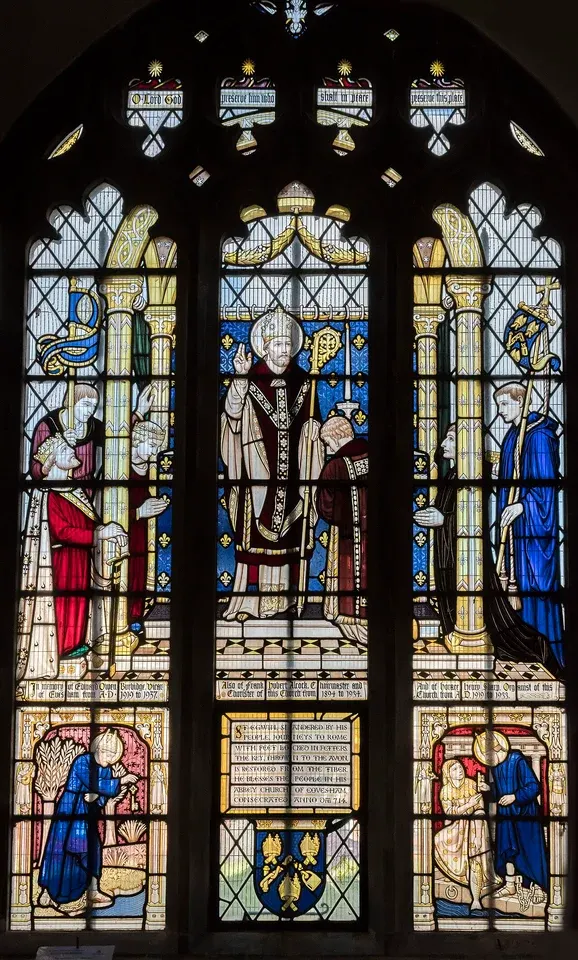
Biography
Egwin was an early bishop of Worcester and the founder associated with Evesham Abbey. His importance lies in the growth of English church institutions, although surviving biographies mix that history with much later miracle narratives.
He is remembered as Worcester's third bishop, working in a society where royal support and monastic foundations were closely connected. The tradition of Evesham's origin centers on a herdsman named Eoves who reported seeing Mary. Egwin's foundation gave the place a lasting religious identity.
A second famous story describes a journey to Rome undertaken with locked fetters as an act of penance. The key, supposedly thrown into water, was recovered from a fish. This episode expresses themes of accusation, repentance, and vindication, but it cannot serve as an independently verified itinerary.
Even the sequence of Egwin's offices and the assertion that he resigned his bishopric to become abbot are uncertain. His later shrine and the abbey's devotion are easier to establish than many personal details. December 30 is his usual commemoration. Keeping the institutional history distinct from the legends allows readers to understand both the remembered founder and the community that transmitted his story.
Context & contribution
A founder's story and an abbey's interests
The early account of Egwin's foundation links Evesham with a grant of land from King Ethelred. That connection draws attention to a condition underlying monastic life: a community required a recognized place and resources, not only a revered founder. Royal patronage also placed an abbey within political relationships.
The Catholic Encyclopedia notes disagreement between a later monastic foundation date of 714 and evidence suggesting an earlier beginning. This is a specific example of why apparently precise dates in a founder's story need evaluation. Institutional memory may preserve a real origin while arranging its chronology in ways later historians cannot fully reconcile.
Explore the sources for this section
AI-assisted source comparison updated 2026-09-26. Editorial approach
From the Saint Discovery blog
Keep exploring your faith
Practical guides to prayer, the saints, and living the Catholic faith.
Why Do Catholics Pray to Saints? Intercession Explained
Why do Catholics pray to saints? Learn how intercession differs from worship, how it relates to Jesus, and a simple way to ask a saint to pray for you.
A next step with your saintRead the article Living the seasonsHow to Celebrate Your Patron Saint's Feast Day at Home
Celebrate your patron saint's feast day with prayer, a short biography, and an act of kindness. A practical plan for families, sponsors, and individuals.
A next step with your saintRead the articleFrom reading to reflection
What will you carry with you?
After reading about St. Egwin of Worcester, take a moment to consider:
- Create a short historical note for Evesham that preserves the land grant tradition while presenting the disputed foundation date honestly.
These are reflection prompts from Saint Discovery, not quotations from the saint.
Sources and further reading
- Catholic Encyclopedia: Egwin ↗
- Catholic Encyclopedia: Evesham Abbey ↗
- Equestrian Order of the Holy Sepulchre: Egwin ↗
Biography source comparison recorded on . This is an AI-assisted comparison, not independent human or ecclesiastical approval.
What the recorded review covers
AI-assisted expansion checked against cited sources; historical traditions distinguished from documented evidence; not ecclesiastical approval
A source list helps you check an account; it does not establish that every claim is certain. Follow the biography’s qualifications about historical evidence, traditions and feast calendars.
Suggest a correction to this biography
How we research these pages and handle corrections · Directory corrections log
More lives to explore
Suggestions based on the site’s quiz themes, not a historical relationship or a measure of holiness.