Catholic saint biography
St. Edmund Campion
- Commemoration:
- December 1
- Lived:
- 1540–1581 — London, England
December 1 in Jesuit and English commemorations; also remembered with the English and Welsh martyrs.
Why dates and liturgical observances can differ
Read the sources for this biography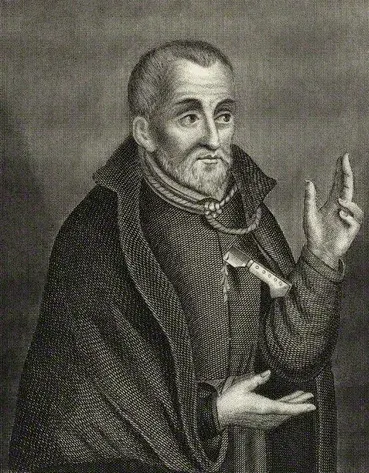
Biography
Edmund Campion was an English Jesuit priest, Oxford scholar, and martyr whose ministry joined intellectual argument with secret pastoral work. He returned to England in 1580, when Catholic priests faced grave danger under Elizabeth I.
His academic gifts had made him a prominent figure at Oxford. Religious convictions eventually led him abroad, where he studied at Douai and entered the Society of Jesus in 1573. Formation and teaching on the continent prepared him for his return mission.
In England he traveled between Catholic households, celebrating the sacraments and explaining the faith. His Decem Rationes, or Ten Reasons, set out a defense of Catholic belief and challenged learned opponents to consider his arguments. These writings show that his mission involved persuasion as well as clandestine worship.
Captured in 1581, he was interrogated and tortured before being tried for treason. Jesuit accounts distinguish his pastoral purpose from the political conspiracy alleged at trial. He was executed at Tyburn on December 1 with Ralph Sherwin and Alexander Briant. His surviving writings and the preservation of objects connected with his execution continue to shape his remembrance.
Context & contribution
Teaching, drama, and clandestine print
Campion's continental career included teaching in Prague and writing and directing plays for students. This supplies an often overlooked setting for his public speaking: his rhetorical gifts served education before they were deployed in the dangerous English mission.
The distribution of Ten Reasons made a university audience central to that mission. The Jesuit account describes copies placed on benches in Oxford's university church, where readers already knew his reputation. His earlier theatrical and academic work and his later printed arguments all depended on adapting a message to an audience; clandestine circulation added a new problem of access and risk.
Explore the sources for this section
AI-assisted source comparison updated 2026-09-26. Editorial approach
From the Saint Discovery blog
Keep exploring your faith
Practical guides to prayer, the saints, and living the Catholic faith.
Why Do Catholics Pray to Saints? Intercession Explained
Why do Catholics pray to saints? Learn how intercession differs from worship, how it relates to Jesus, and a simple way to ask a saint to pray for you.
A next step with your saintRead the article Living the seasonsHow to Celebrate Your Patron Saint's Feast Day at Home
Celebrate your patron saint's feast day with prayer, a short biography, and an act of kindness. A practical plan for families, sponsors, and individuals.
A next step with your saintRead the articleFrom reading to reflection
What will you carry with you?
After reading about St. Edmund Campion, take a moment to consider:
- Compare a student play in Prague with secretly distributed argument at Oxford. What changed about audience, access, and responsibility in Campion's communication?
These are reflection prompts from Saint Discovery, not quotations from the saint.
Sources and further reading
Biography source comparison recorded on . This is an AI-assisted comparison, not independent human or ecclesiastical approval.
What the recorded review covers
AI-assisted expansion checked against cited sources; historical traditions distinguished from documented evidence; not ecclesiastical approval
A source list helps you check an account; it does not establish that every claim is certain. Follow the biography’s qualifications about historical evidence, traditions and feast calendars.
Suggest a correction to this biography
How we research these pages and handle corrections · Directory corrections log
More lives to explore
Suggestions based on the site’s quiz themes, not a historical relationship or a measure of holiness.