Catholic saint biography
St. Daniel Comboni
- Commemoration:
- October 10
- Lived:
- 1831–1881 — Limone sul Garda, Italy
Why dates and liturgical observances can differ
Read the sources for this biography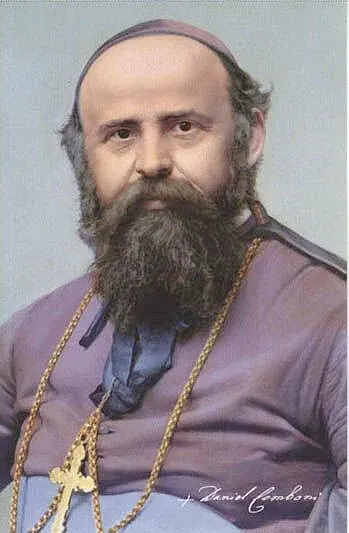
Biography
Daniel Comboni trained for missionary work in Verona and first traveled to central Africa in 1857. Disease and the deaths of colleagues forced a return to Europe, but he developed a new missionary plan emphasizing the formation of African Christians who could lead and sustain the work themselves.
Born at Limone sul Garda in 1831, Comboni was the only one of eight children to survive to adulthood. Limited family means led to his education at Nicola Mazza’s institute in Verona. Reports from returning missionaries helped shape the vocation that preceded his ordination in 1854.
His first journey to Khartoum took four months. The heavy losses suffered by the mission exposed the weakness of relying only on incoming European personnel. His 1864 plan consequently placed the education and participation of African Christians at the center of a more durable missionary organization.
He founded missionary institutes for men and women, raised support across Europe, and established training initiatives in Egypt. As a bishop responsible for central Africa, he opposed the slave trade and continued working through illness, shortages, and opposition. He died in Khartoum in 1881. His institutions continued after his death, and John Paul II canonized him in 2003.
Context & contribution
Making distant needs visible to church institutions
Comboni used communication and church assemblies to seek support for central Africa. At the First Vatican Council he served as theologian to the bishop of Verona and secured seventy bishops' signatures for a missionary petition. His work therefore included organized advocacy within an international gathering, not only journeys between Europe and Africa.
He also launched a missionary magazine to maintain interest and assistance beyond individual encounters. A periodical could reach readers repeatedly and connect scattered supporters with an ongoing undertaking. These efforts reveal the organizational side of his project: sustaining a mission required a public able to learn about it, institutions willing to accept responsibility, and support that continued after the departure of a persuasive visitor.
Explore the sources for this section
AI-assisted source comparison updated 2026-09-26. Editorial approach
From the Saint Discovery blog
Keep exploring your faith
Practical guides to prayer, the saints, and living the Catholic faith.
Why Is St. Thérèse the Patron Saint of Missions?
Why is St. Thérèse patron saint of missions? Discover her support for missionaries and practical ways to participate in the Church's mission from home.
Sharing the faithRead the article Everyday faithWhat Is Evangelization? A Catholic Guide to Sharing the Faith
What is evangelization? Learn the Catholic meaning, the new evangelization, and practical ways to share your faith with respect, confidence, and love.
Sharing the faithRead the articleFrom reading to reflection
What will you carry with you?
After reading about St. Daniel Comboni, take a moment to consider:
- Compare Comboni's magazine and his petition to seventy bishops: what different audiences, commitments, and kinds of continuity could each secure?
These are reflection prompts from Saint Discovery, not quotations from the saint.
Sources and further reading
Biography source comparison recorded on . This is an AI-assisted comparison, not independent human or ecclesiastical approval.
What the recorded review covers
AI-assisted expansion checked against retrieved historical and institutional sources; traditions distinguished from documented history; not ecclesiastical approval
A source list helps you check an account; it does not establish that every claim is certain. Follow the biography’s qualifications about historical evidence, traditions and feast calendars.
Suggest a correction to this biography
How we research these pages and handle corrections · Directory corrections log
More lives to explore
Suggestions based on the site’s quiz themes, not a historical relationship or a measure of holiness.