Catholic saint biography
St. Casimir
- Commemoration:
- March 4
- Patron Saint of:
- Lithuania
- Lived:
- 1458–1484 — Poland and Lithuania
Why dates and liturgical observances can differ
Read the sources for this biography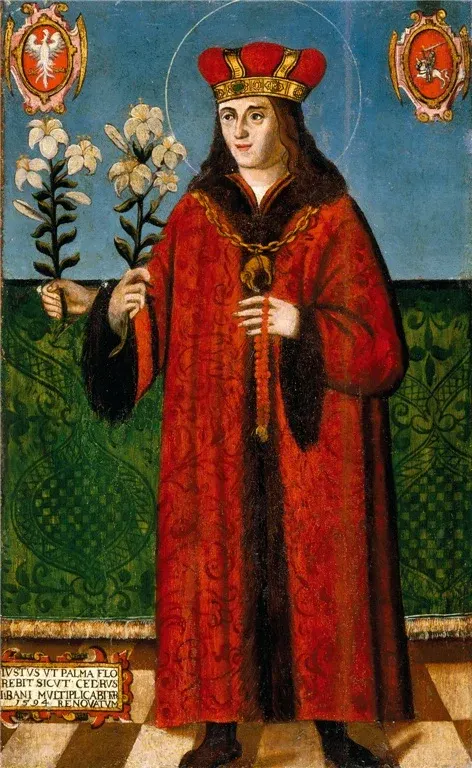
Biography
Casimir was a prince of the Polish-Lithuanian royal family. His position placed him within dynastic ambitions and plans for political marriages, but Catholic tradition remembers him particularly for his devotion and resistance to the attractions of status and luxury.
Born in 1458, Casimir belonged to a family whose children were involved in plans extending across several kingdoms. The prospect of the Hungarian crown was therefore part of a broader dynastic setting. The Vatican summary connects his withdrawal from that project with papal counsel.
His refusal of a politically advantageous marriage is remembered as another limit placed on the pursuit of power. The short record does not support a detailed account of every decision at court. His significance in devotion rests on his religious commitments within royal life, not on a lengthy list of conquests or legislation.
He declined an arranged marriage and did not take the Hungarian crown that had been sought for him. He died at only twenty-five, leaving a reputation for religious commitment rather than a long reign. The Church honors him as a patron of Lithuania and commemorates him on March 4.
Context & contribution
The education and public duties of a young prince
Casimir's preparation included study with Jan Długosz, the Polish historian, and Filippo Buonaccorsi, known as Callimachus. Their learning connected religious and literary formation with the political knowledge expected of a royal son. The educational setting helps explain why his biography concerns the responsible use of privilege as well as personal devotion.
He also exercised public responsibility during his father's absence, administering affairs in Poland in the early 1480s. Thus his short life should not be reduced to a refusal of power: it also included learning how to discharge duties already placed upon him. His reputation for justice belongs beside the better-known stories about prayer and chastity, giving a fuller account of holiness within a ruling household.
Explore the sources for this section
AI-assisted source comparison updated 2026-09-26. Editorial approach
From the Saint Discovery blog
Keep exploring your faith
Practical guides to prayer, the saints, and living the Catholic faith.
Why Do Catholics Pray to Saints? Intercession Explained
Why do Catholics pray to saints? Learn how intercession differs from worship, how it relates to Jesus, and a simple way to ask a saint to pray for you.
A next step with your saintRead the article Living the seasonsHow to Celebrate Your Patron Saint's Feast Day at Home
Celebrate your patron saint's feast day with prayer, a short biography, and an act of kindness. A practical plan for families, sponsors, and individuals.
A next step with your saintRead the articleFrom reading to reflection
What will you carry with you?
After reading about St. Casimir, take a moment to consider:
- Design a short curriculum for a prince like Casimir: how should historical study, religious formation, and responsibility for ordinary people's affairs inform one another?
These are reflection prompts from Saint Discovery, not quotations from the saint.
Sources and further reading
Biography source comparison recorded on . This is an AI-assisted comparison, not independent human or ecclesiastical approval.
What the recorded review covers
AI-assisted expansion checked against retrieved historical and institutional sources; traditions distinguished from documented history; not ecclesiastical approval
A source list helps you check an account; it does not establish that every claim is certain. Follow the biography’s qualifications about historical evidence, traditions and feast calendars.
Suggest a correction to this biography
How we research these pages and handle corrections · Directory corrections log
More lives to explore
Suggestions based on the site’s quiz themes, not a historical relationship or a measure of holiness.