Catholic saint biography
St. Willibrord
- Commemoration:
- November 7
- Lived:
- 658–739 — Northumbria; ministry in Frisia
Why dates and liturgical observances can differ
Read the sources for this biography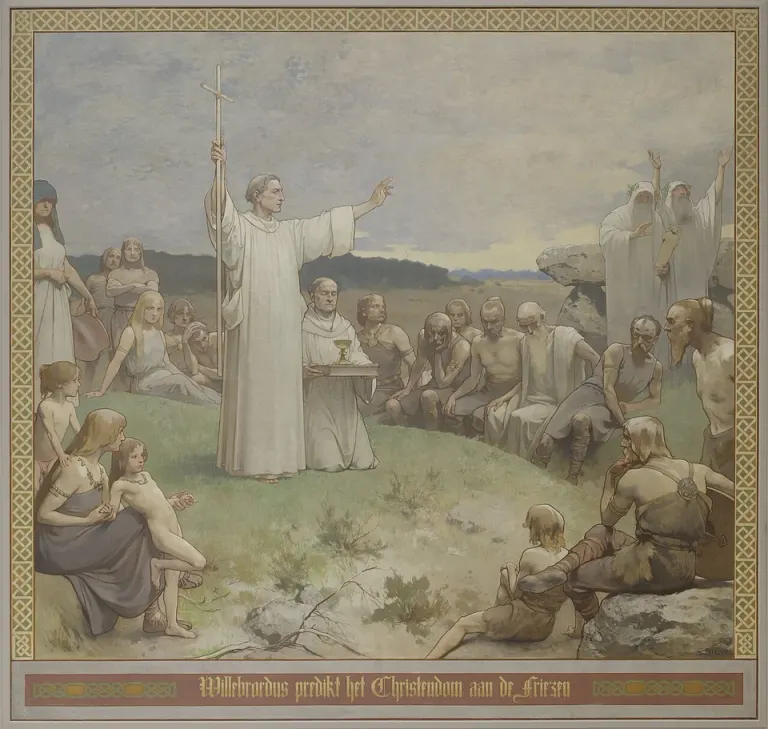
Biography
Willibrord was a Northumbrian monk who studied at Ripon and continued his formation in Ireland before undertaking mission work in Frisia. His work required cooperation with church and political authorities and perseverance through periods of opposition. He became bishop of Utrecht and is remembered for helping establish lasting Christian communities.
Visits to Rome secured authorization for his mission and episcopal consecration. At Utrecht he established a church and monastic community, giving the work a stable base and helping form future missionaries. The mission depended on such foundations as much as on the journeys of individual preachers.
Political reversal under Radbod forced withdrawal and brought destruction to churches. Willibrord later returned to rebuild, with assistance from Boniface. These setbacks prevent his life from being understood as an uninterrupted success: persistence and repair were important parts of establishing enduring communities.
The abbey of Echternach became an important center for his mission and his own life of prayer. He died there in 739, and his tomb became a place of pilgrimage. His biography belongs to the movement of monks who crossed regions and languages to teach the faith in early medieval Europe.
Context & contribution
A pilgrimage tradition carried in movement
Willibrord's remembrance at Echternach includes a hopping procession held on the Tuesday of Pentecost. UNESCO's account traces documentation of the procession to 1100 and describes a sequence beginning in the former abbey courtyard, continuing in organized groups with prayer and music, and ending with worship in the basilica.
Inscribed on UNESCO's intangible cultural heritage list in 2010, the procession preserves a practice transmitted through participation, not only through written lives or buildings. Its history includes opposition and prohibitions as well as later civic and religious support. These changing responses reveal how devotion to Willibrord became a shared regional custom whose continuity depended on generations of organizers, musicians, and pilgrims.
Explore the sources for this section
AI-assisted source comparison updated 2026-09-26. Editorial approach
From the Saint Discovery blog
Keep exploring your faith
Practical guides to prayer, the saints, and living the Catholic faith.
What Is the Domestic Church? John Paul II on Faith at Home
What Catholics mean by the domestic church, how John Paul II explained family life, and practical ways to begin with prayer, forgiveness and welcome.
Bring reflection into prayerRead the article Prayer & reflectionHow to Make a Spiritual Communion When You Cannot Receive
Learn how to make a spiritual communion, with a short original prayer and clear guidance on Mass, Confession, and times when you cannot receive.
Bring reflection into prayerRead the articleFrom reading to reflection
What will you carry with you?
After reading about St. Willibrord, take a moment to consider:
- Compare preserving Willibrord's tomb with preserving the hopping procession; identify what knowledge must be passed from person to person for the second to survive.
These are reflection prompts from Saint Discovery, not quotations from the saint.
Sources and further reading
Biography source comparison recorded on . This is an AI-assisted comparison, not independent human or ecclesiastical approval.
What the recorded review covers
AI-assisted expansion using the linked historical and ecclesiastical sources; devotional traditions distinguished from documented history.
A source list helps you check an account; it does not establish that every claim is certain. Follow the biography’s qualifications about historical evidence, traditions and feast calendars.
Suggest a correction to this biography
How we research these pages and handle corrections · Directory corrections log
More lives to explore
Suggestions based on the site’s quiz themes, not a historical relationship or a measure of holiness.