Catholic saint biography
St. Rose of Lima
- Commemoration:
- August 23
- Lived:
- 1586–1617 — Lima, Peru
Why dates and liturgical observances can differ
Read the sources for this biography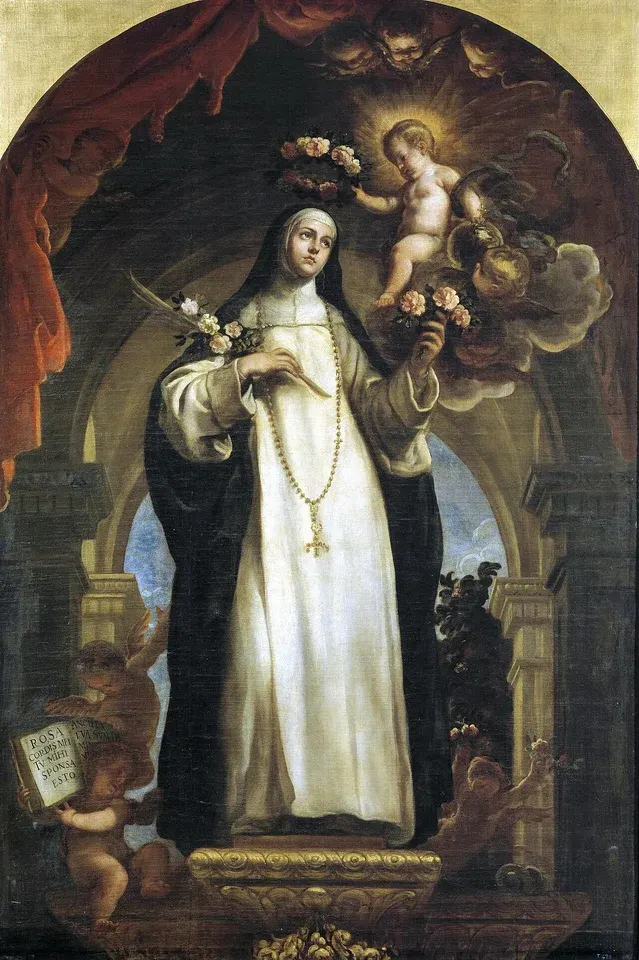
Biography
Rose of Lima, born Isabel Flores de Oliva, became a Dominican tertiary while continuing to live outside a convent. Inspired by Catherine of Siena, she devoted herself to prayer and helped support her family through gardening and embroidery. Her religious life developed amid the inequalities and difficulties of colonial Peru.
Family financial difficulty made her labor economically important. Her devotional life therefore existed alongside the need to earn income and maintain a household. Accounts also describe shelter and assistance for vulnerable people, particularly children and older adults.
A small retreat in the family garden became the setting for much of her prayer. Her Dominican affiliation connected this largely domestic life to a wider spiritual tradition. Stories of visions and extraordinary experiences should be read as devotional testimony alongside the more tangible record of work and service.
Accounts of her spirituality emphasize intense contemplation, care for people in need, and severe penitential practices. Those practices belong to her historical religious setting rather than a program readers should imitate. Canonized in 1671, she became the first canonized saint born in the Americas. Her general Roman-calendar memorial falls on August 23.
Context & contribution
The images and words Rose left behind
Rose’s spiritual legacy includes unusual visual documents: figures of hearts attached to paper, accompanied by handwritten explanations of the divine favors she believed she had experienced. A related diagram represents stages of spiritual ascent. Historian Teodoro Hampe Martínez discusses these materials as evidence that allows Rose’s own expression to be studied alongside later accounts of her life.
The annotations combine intense religious conviction with a request for correction. In the text reproduced in the Dominican study The Prayer of Love, Rose permits her spiritual adviser to destroy the heart images if they distract from God. These documents are testimony to how she understood and communicated her inner life; their survival does not require a reader to treat every reported experience as independently verified.
Explore the sources for this section
- Teodoro Hampe Martínez: El proceso de canonización de Santa Rosa (CEMHAL) ↗
- Julián de Cos, OP: The Prayer of Love, Works of Saint Rose ↗
AI-assisted source comparison updated 2026-09-26. Editorial approach
From the Saint Discovery blog
Keep exploring your faith
Practical guides to prayer, the saints, and living the Catholic faith.
What Is the Domestic Church? John Paul II on Faith at Home
What Catholics mean by the domestic church, how John Paul II explained family life, and practical ways to begin with prayer, forgiveness and welcome.
Bring reflection into prayerRead the article Prayer & reflectionHow to Make a Spiritual Communion When You Cannot Receive
Learn how to make a spiritual communion, with a short original prayer and clear guidance on Mass, Confession, and times when you cannot receive.
Bring reflection into prayerRead the articleFrom reading to reflection
What will you carry with you?
After reading about St. Rose of Lima, take a moment to consider:
- Compare a description of Rose’s paper hearts with an ordinary written spiritual autobiography. What can an image communicate that prose may not, and what does her request for correction add to the interpretation?
These are reflection prompts from Saint Discovery, not quotations from the saint.
Sources and further reading
Biography source comparison recorded on . This is an AI-assisted comparison, not independent human or ecclesiastical approval.
What the recorded review covers
AI-assisted expansion using the linked historical and ecclesiastical sources; devotional traditions distinguished from documented history.
A source list helps you check an account; it does not establish that every claim is certain. Follow the biography’s qualifications about historical evidence, traditions and feast calendars.
Suggest a correction to this biography
How we research these pages and handle corrections · Directory corrections log
More lives to explore
Suggestions based on the site’s quiz themes, not a historical relationship or a measure of holiness.