Catholic saint biography
St. Canute IV of Denmark
- Commemoration:
- January 19
- Lived:
- Died 1086 — Denmark
Why dates and liturgical observances can differ
Read the sources for this biography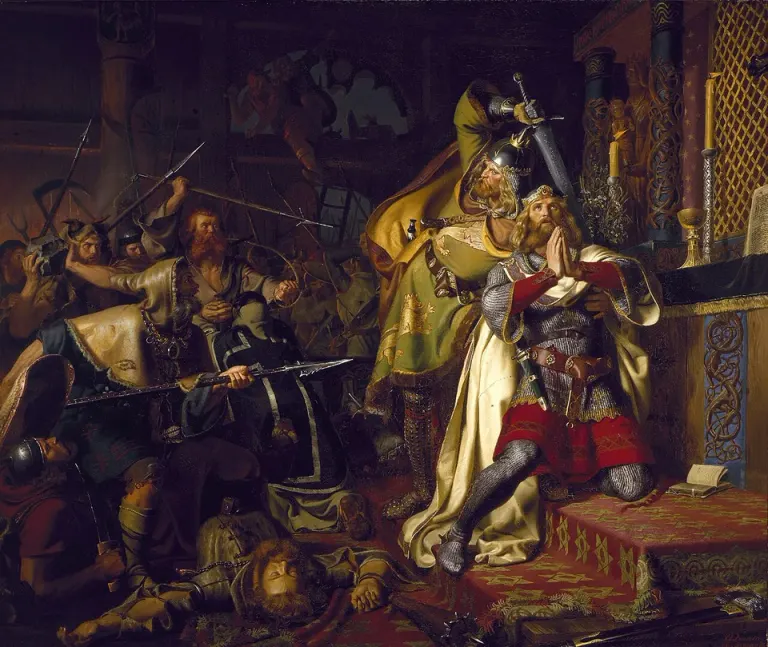
Biography
Canute IV, also called Cnut, became king of Denmark around 1080. His rule combined support for the Church with efforts to strengthen royal authority. Resistance to taxation and royal policy contributed to a revolt against him.
The political setting matters to his death. Church patronage, taxation, and royal ambitions affected different groups in the kingdom, and opposition cannot be reduced to a single private grudge. His intended expedition against England also belongs to the record of a ruler exercising military power.
The church where he sought refuge became the setting of his violent end. Later veneration interpreted that death through Christian martyrdom, while historians must also account for the revolt surrounding it. Keeping those perspectives visible produces a fuller portrait than either an idealized ruler or a purely political victim.
He was killed with his brother Benedict and other companions in the church of Saint Alban on Funen on July 10, 1086. The Church subsequently honored him as a martyr. January 19 is his commemoration in the older Roman calendar cited here, while July 10 is his death anniversary. He should not be confused with other Scandinavian rulers named Canute.
Context & contribution
What a royal shrine can tell researchers
Canute's shrine in Odense preserves material evidence of his later veneration as well as the memory of his death. Research reported by the University of Southern Denmark examined textiles associated with the shrines of Canute and his brother Benedict. The surviving silks make it possible to ask questions about dating, precious materials, and the changing arrangement of the relics.
The researchers' interpretation suggests that some textiles now associated with Canute originally belonged with his brother. That possibility illustrates why the contents of a shrine cannot automatically be treated as an untouched deposit from the saint's lifetime. Devotion, concealment, rediscovery, and display all form part of an object's history. Studying those changes adds a tangible dimension to the written accounts of a royal martyr.
Explore the sources for this section
AI-assisted source comparison updated 2026-09-26. Editorial approach
From the Saint Discovery blog
Keep exploring your faith
Practical guides to prayer, the saints, and living the Catholic faith.
Why Do Catholics Pray to Saints? Intercession Explained
Why do Catholics pray to saints? Learn how intercession differs from worship, how it relates to Jesus, and a simple way to ask a saint to pray for you.
A next step with your saintRead the article Living the seasonsHow to Celebrate Your Patron Saint's Feast Day at Home
Celebrate your patron saint's feast day with prayer, a short biography, and an act of kindness. A practical plan for families, sponsors, and individuals.
A next step with your saintRead the articleFrom reading to reflection
What will you carry with you?
After reading about St. Canute IV of Denmark, take a moment to consider:
- Explain how moving textiles between two shrines could change a historian's interpretation even when the objects themselves are authentic medieval materials.
These are reflection prompts from Saint Discovery, not quotations from the saint.
Sources and further reading
Biography source comparison recorded on . This is an AI-assisted comparison, not independent human or ecclesiastical approval.
What the recorded review covers
AI-assisted expansion checked against retrieved historical and institutional sources; traditions distinguished from documented history; not ecclesiastical approval
A source list helps you check an account; it does not establish that every claim is certain. Follow the biography’s qualifications about historical evidence, traditions and feast calendars.
Suggest a correction to this biography
How we research these pages and handle corrections · Directory corrections log
More lives to explore
Suggestions based on the site’s quiz themes, not a historical relationship or a measure of holiness.