Catholic saint biography
St. Blandina of Lyon
- Commemoration:
- June 2
- Lived:
- Died 177 — Lyon, Roman Gaul
Why dates and liturgical observances can differ
Read the sources for this biography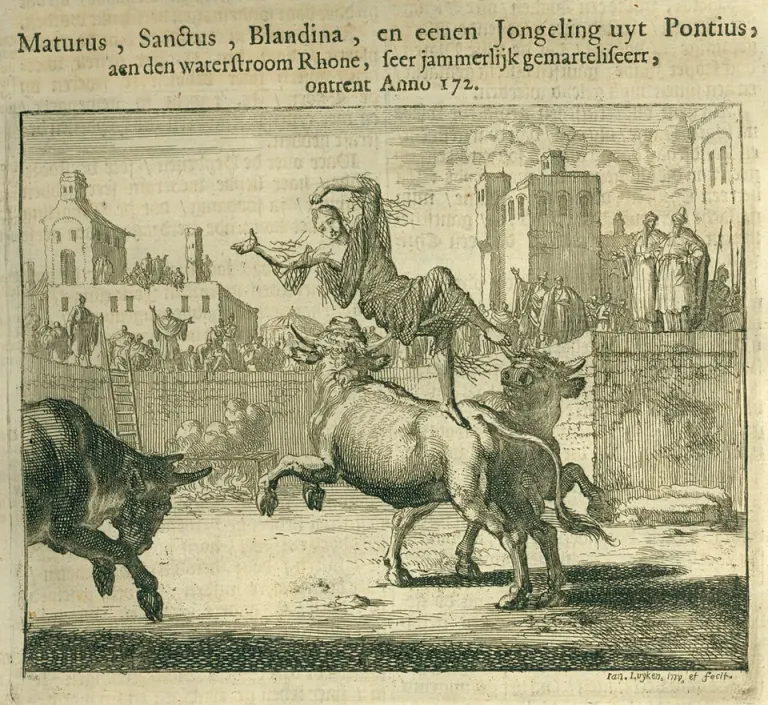
Biography
Blandina was an enslaved Christian among the martyrs of Lyon in 177. A letter from the local churches, preserved by Eusebius, records the persecution and describes how prisoners supported one another through interrogation and suffering.
The persecution involved public hostility, imprisonment, and accusations against Christian gatherings. Other prisoners initially feared that Blandina’s physical frailty would leave her unable to endure. The account deliberately overturns that expectation by making her steadfastness a source of encouragement to the others.
Her enslaved status is significant: the narrative grants religious authority and courage to someone with little social power. Her story is not simply about individual endurance, but about the way a vulnerable member of the community strengthened fellow believers during a shared ordeal.
The account emphasizes Blandina’s steadfastness despite her physical vulnerability. She was repeatedly brought into the arena before being killed. Her memory is therefore grounded in an early account of a particular persecuted community, rather than only in later legend. Her feast is June 2, together with the remembrance of the martyrs of Lyon.
Context & contribution
A testimony sent across the Mediterranean
The account of Blandina reached later readers through a letter from the churches of Lyon to Christian communities in Asia Minor. Its original purpose was communication between living communities, not the production of an isolated heroic portrait. The letter shared an ordeal with distant believers who could recognize the prisoners as members of the same faith.
One troubling feature of the persecution was testimony obtained under the threat of torture. The narrative describes enslaved people pressured into confirming accusations against Christians. Blandina's repeated denial of wrongdoing belongs to that setting of rumor and coerced evidence. Attending to the judicial circumstances helps readers understand why truthful speech mattered alongside endurance, and why an account of persecution must be read with care for the vulnerable people caught within it.
Explore the sources for this section
AI-assisted source comparison updated 2026-09-26. Editorial approach
From the Saint Discovery blog
Keep exploring your faith
Practical guides to prayer, the saints, and living the Catholic faith.
St. Josephine Bakhita: Hope Without Denying Suffering
Learn what St. Josephine Bakhita teaches about Christian hope, dignity, and freedom, with practical reflection prompts and an original prayer.
Faith in difficult timesRead the article Prayer & reflectionWhat Is Redemptive Suffering? A Catholic Guide
What is redemptive suffering? Learn what Catholics mean by offering it up, how to unite suffering to Christ, and why seeking help belongs with faith.
Faith in difficult timesRead the articleFrom reading to reflection
What will you carry with you?
After reading about St. Blandina of Lyon, take a moment to consider:
- Imagine receiving the Lyon community's letter far away in Asia Minor; what would you need to understand about coerced testimony before retelling Blandina's story?
These are reflection prompts from Saint Discovery, not quotations from the saint.
Sources and further reading
Biography source comparison recorded on . This is an AI-assisted comparison, not independent human or ecclesiastical approval.
What the recorded review covers
AI-assisted expansion checked against retrieved historical and institutional sources; traditions distinguished from documented history; not ecclesiastical approval
A source list helps you check an account; it does not establish that every claim is certain. Follow the biography’s qualifications about historical evidence, traditions and feast calendars.
Suggest a correction to this biography
How we research these pages and handle corrections · Directory corrections log
More lives to explore
Suggestions based on the site’s quiz themes, not a historical relationship or a measure of holiness.