Catholic saint biography
St. Brendan the Navigator
- Commemoration:
- May 16
- Lived:
- Sixth century — Ireland
Why dates and liturgical observances can differ
Read the sources for this biography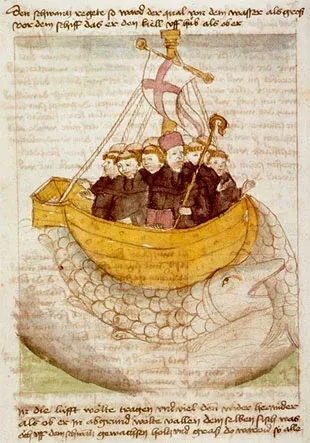
Biography
Brendan of Clonfert, also known as Brendan the Voyager, belonged to the early Irish monastic tradition. Accounts associate him with religious foundations in Ireland, especially Clonfert, and with travel undertaken for religious purposes.
Irish tradition connects his formation with Erc and Ita and remembers foundations in several regions. These relationships place him within a network of teachers, monasteries, and journeys. Clonfert became the most enduring institutional association of his name.
The voyage narrative casts travel as a spiritual search and includes events that cannot be treated as a navigator’s log. It may reflect a culture familiar with sea travel, but the destination of any historical voyage remains uncertain. Literary influence and geographic proof are different kinds of evidence.
His wider fame comes from the Navigatio, the medieval narrative of a voyage in search of a promised land. Its extraordinary islands and encounters belong to religious literature and legend. The story is important for medieval culture, but it does not prove that Brendan reached North America or establish a reliable route for such a voyage. His feast is May 16.
Context & contribution
A literary island that moved across maps
The island associated with Brendan's voyage had a long life in European cartography. Medieval and early modern maps placed it in different parts of the Atlantic; as geographic knowledge changed, its supposed location shifted. The Catholic Encyclopedia traces examples near Ireland and farther south, showing how a religious narrative could influence the representation of unknown space.
This is a legacy of imagination rather than proof of a particular landfall. A map can record inherited expectation as well as observation. Brendan's story helps readers ask what kinds of knowledge a map claims to contain and how unexplored regions invite stories. His cultural influence is substantial even when the extraordinary voyage cannot serve as evidence for an Irish discovery of America.
Explore the sources for this section
AI-assisted source comparison updated 2026-09-26. Editorial approach
From the Saint Discovery blog
Keep exploring your faith
Practical guides to prayer, the saints, and living the Catholic faith.
What Is the Domestic Church? John Paul II on Faith at Home
What Catholics mean by the domestic church, how John Paul II explained family life, and practical ways to begin with prayer, forgiveness and welcome.
Bring reflection into prayerRead the article Prayer & reflectionHow to Make a Spiritual Communion When You Cannot Receive
Learn how to make a spiritual communion, with a short original prayer and clear guidance on Mass, Confession, and times when you cannot receive.
Bring reflection into prayerRead the articleFrom reading to reflection
What will you carry with you?
After reading about St. Brendan the Navigator, take a moment to consider:
- Compare two historical placements of Brendan's island and explain what its movement reveals about the relationship between evidence, expectation, and mapmaking.
These are reflection prompts from Saint Discovery, not quotations from the saint.
Sources and further reading
Biography source comparison recorded on . This is an AI-assisted comparison, not independent human or ecclesiastical approval.
What the recorded review covers
AI-assisted expansion checked against retrieved historical and institutional sources; traditions distinguished from documented history; not ecclesiastical approval
A source list helps you check an account; it does not establish that every claim is certain. Follow the biography’s qualifications about historical evidence, traditions and feast calendars.
Suggest a correction to this biography
How we research these pages and handle corrections · Directory corrections log
More lives to explore
Suggestions based on the site’s quiz themes, not a historical relationship or a measure of holiness.