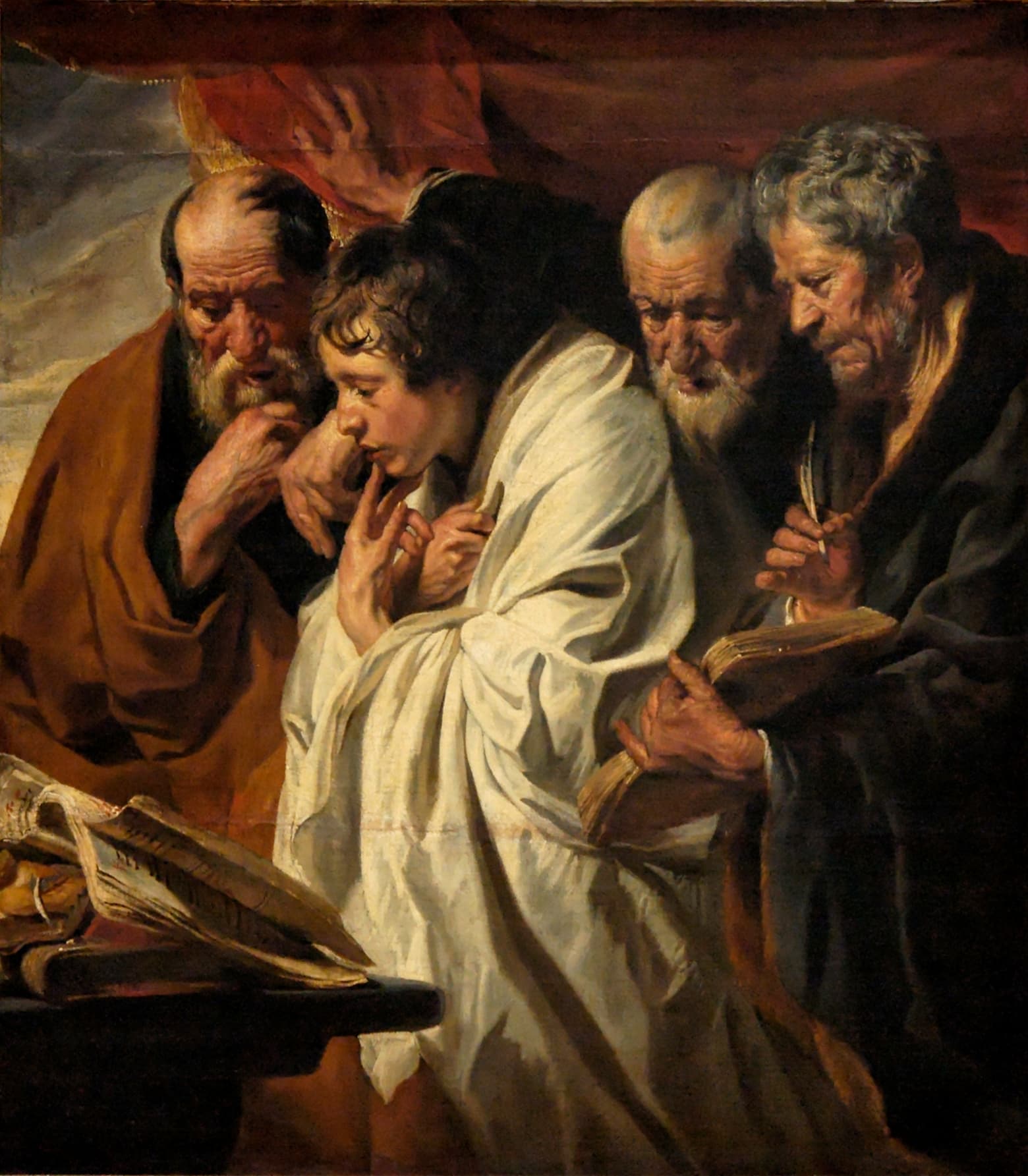
Why does the Bible tell the story of Jesus four times? Matthew, Mark, Luke, and John proclaim the same Lord, but each helps us notice something we might otherwise overlook. Matthew connects Jesus with Israel's Scriptures and teaches the life of discipleship. Mark presses us to understand the cross. Luke gives particular attention to mercy and the reach of salvation. John invites us to contemplate Jesus as the eternal Word made flesh.
These are starting points, not exclusive labels. All four Gospels teach, reveal Jesus' identity, and lead readers toward his death and Resurrection. Reading them together gives us a fuller understanding than treating one as a substitute for the others.
Why are there four Gospels instead of one?
Catholics receive the four Gospels as inspired testimony to Jesus' life and teaching. Vatican II explains that their authors selected and arranged material received through apostolic preaching and testimony, addressing the needs of their communities while faithfully communicating the truth about Jesus. They did not set out to produce four identical transcripts. See Dei Verbum, sections 18–19.
Matthew, Mark, and Luke are called the Synoptic Gospels because their many shared events and sayings can be studied side by side. John follows a more distinctive arrangement and includes extended conversations and discourses. The USCCB's introduction to John explains that difference.
For the broader question of how these books became part of Scripture, see our history of the Catholic Bible. Here, the question is what each Gospel helps us understand when we open it.
Matthew: Jesus fulfills Scripture and forms disciples
Matthew helps readers see continuity between Jesus and the Scriptures of Israel. In the Sermon on the Mount, Jesus explains his relationship to the Law and the Prophets in terms of fulfillment. His teaching reaches into anger, reconciliation, faithfulness, and love of enemies. The Beatitudes describe a life whose priorities challenge ordinary ideas of success. Read Matthew 5.
This Gospel contributes a sustained account of what belonging to Jesus means in practice. It asks us to move beyond admiration into obedience. A reader can pause over its teaching and ask: Which relationship needs reconciliation? Where am I choosing recognition over faithfulness?
Matthew ends with the risen Jesus sending his disciples to all nations, commanding baptism and teaching, and promising his continuing presence. That ending joins belief, worship, and mission. See Matthew 28:16–20.
For a closer look at the apostle associated with this Gospel in Christian tradition, explore why Jesus called Matthew the tax collector.
Mark: following Jesus means learning the way of the cross
Mark, the shortest Gospel, moves briskly through Jesus' ministry. Yet its pace does not make it a simple collection of miracles. Again and again, the disciples struggle to understand who Jesus is and what his mission requires.
The decisive question becomes whether they can follow a Messiah who suffers. Jesus' predictions of his Passion expose their mistaken expectations of greatness. His teaching about service, especially Mark 10:42–45, ties his mission to giving his life for others. The USCCB's introduction to Mark traces this connection between Jesus' identity, suffering, and discipleship.
Mark contributes an essential correction to a faith built only around success or comfort. The cross belongs at the center of the story. For a beginning reader, a useful question is: What do the disciples misunderstand here, and do I share that expectation? Their confusion makes this Gospel particularly searching for people who believe but still struggle to follow.
Luke: mercy reaches people who are easily overlooked
Luke draws our attention to Jesus' care for people who are poor, excluded, afflicted, or burdened by sin. The Good Samaritan and the father welcoming his lost son are among the memorable parables preserved in this Gospel. Luke also emphasizes prayer, the Holy Spirit, and women in Jesus' ministry.
Mercy here is more than a reassuring feeling. It challenges pride, indifference, and attachment to possessions. Luke asks readers to recognize their own need for God while responding to their neighbors' needs. These themes are explained in the USCCB's introduction to Luke.
Luke also contributes a bridge to the rest of the New Testament: his Gospel forms the first part of a work continued in Acts. Jesus' ministry and the Church's mission belong to a connected story of salvation extending to the nations.
As you read, notice who receives attention in a scene. Then ask whose needs you have learned to overlook. That question can turn a familiar account into an examination of your own habits.
John: the Word made flesh offers life with God
John opens with the eternal Word who becomes flesh. Its signs and conversations invite readers to consider both what Jesus does and what his actions reveal about him. The wedding at Cana, the encounter with the Samaritan woman, and the raising of Lazarus give this Gospel a distinctive shape.
John states its purpose in 20:30–31: the written signs are intended to lead readers to faith in Jesus as the Messiah and Son of God, and to life through him. Its contribution is a sustained invitation to recognize the Father revealed in the Son. See the USCCB's introduction to John.
John's emphasis does not mean the other Gospels lack theology, or that John abandons Jesus' humanity. Read slowly enough to follow a conversation rather than extracting a single sentence. Ask what Jesus is offering, how the other person responds, and what prevents understanding.
See the difference: one miracle in Mark and John
Compare the feeding of the five thousand in Mark 6:30–44 and John 6:1–15. Both describe Jesus feeding a crowd with five loaves and two fish, with twelve baskets remaining. Yet paying attention to their differences reveals more than collecting the details into a single account.
Mark begins with the apostles returning from their mission. Jesus recognizes their need for rest, then responds compassionately to the approaching crowd. He teaches the people and involves the disciples in distributing the food. Notice the tension between the disciples' limited resources and the responsibility Jesus gives them.
John identifies Philip and Andrew, mentions a boy with barley loaves, and places the event near Passover. The crowd wants to make Jesus king, but he withdraws. Continue into the bread-of-life discourse later in John 6: the question becomes what kind of life Jesus gives, and whether people will receive him on his own terms.
Try making two columns, one for each account. Record only details actually present in that passage, then write a sentence about the question it raises. This exercise helps you hear each evangelist before combining what you have learned.
How the Gospels contribute to the whole Bible
The Gospels bring us directly to Jesus' ministry, death, and Resurrection. They illuminate the promises and patterns of the Old Testament, while Acts and the apostolic letters show the Church proclaiming and living the faith. The Old Testament remains Scripture with enduring value; it is not discarded once we reach Matthew. Vatican II describes the unity of the Testaments and the contribution of the other New Testament writings in Dei Verbum, sections 15–20.
What should I do when Gospel accounts differ?
Begin by naming the difference precisely: wording, selected detail, sequence, or emphasis. Do not assume that an omission denies something another account includes. Equally, do not invent a missing conversation or event just to make every detail fit. Read the surrounding passage and consult a Catholic Bible's notes.
The Church's affirmation that the Gospels faithfully convey Jesus' real deeds and teaching goes together with attention to their authors' selection and arrangement. Dei Verbum 12 and 19 holds historical truth and literary form together. A difficult question may require further study; noticing it can begin a more careful reading rather than end it.
A simple way to start reading this week
Choose one short passage a day: Matthew 5:1–12, Mark 10:35–45, Luke 15:11–32, and John 20:24–31. After each reading, write one sentence about what you learned about Jesus and one question you want to revisit. On the fifth day, return to the passage that challenged you most.
Then choose a Gospel to read continuously. Mark is a manageable starting point because it is short; there is no need to rush through all four. Our beginner's guide to lectio divina offers a way to bring that reading into prayer. Let each Gospel speak in its own voice, and give its invitation time to shape your life.
Cover artwork: Jacob Jordaens, The Four Evangelists, circa 1625–1630, Louvre Museum. Public-domain reproduction, credited to Marie-Lan Nguyen on Wikimedia Commons.
