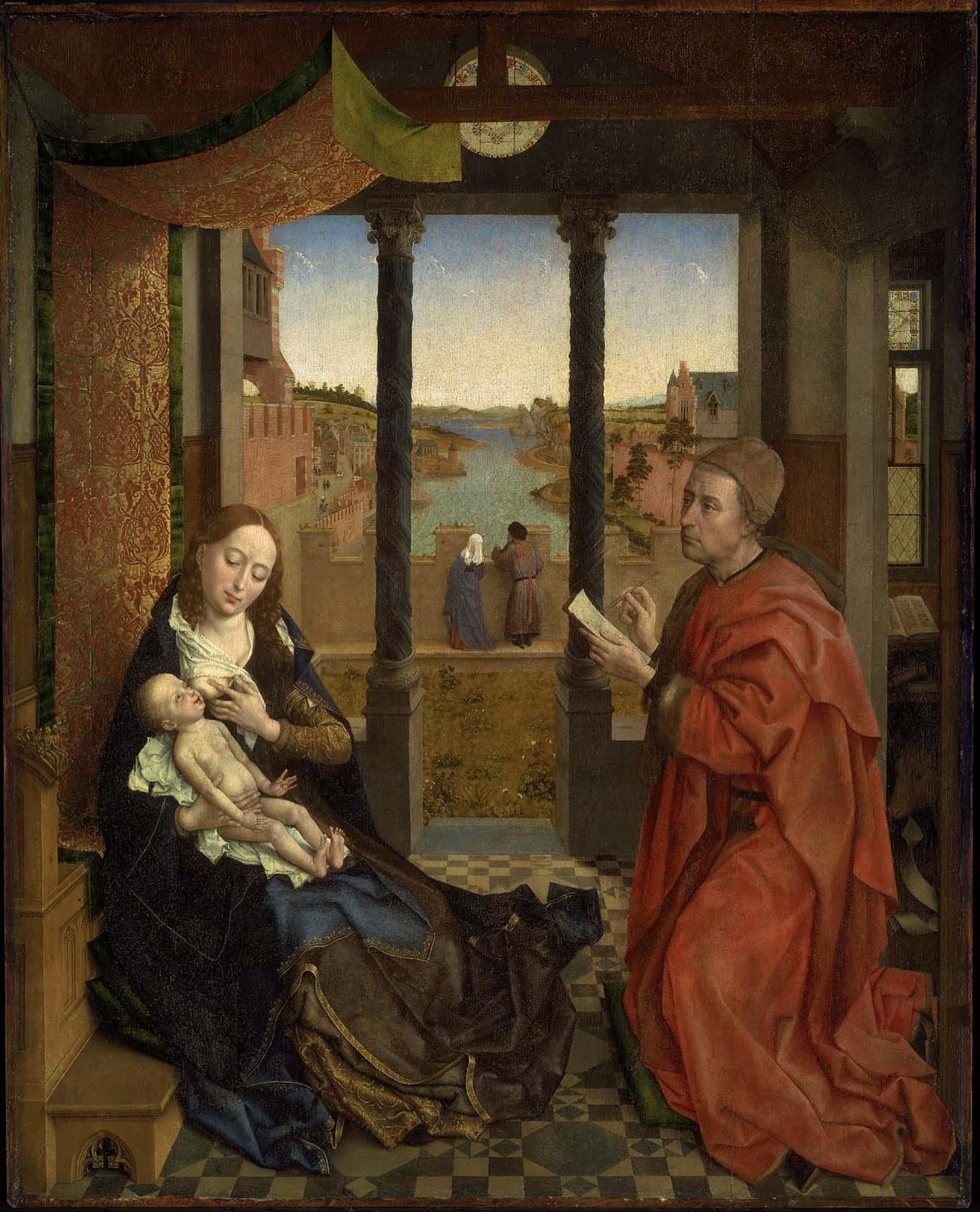
Saint Luke is honored as a patron saint of artists because of the tradition that he painted the Virgin Mary, and because his Gospel has inspired generations of people working in the arts. Vatican News identifies him as patron of artists. The association is meaningful, but it needs one important qualification: the account of Luke painting Mary is a devotional tradition, not an episode recorded in his Gospel.
For artists, parents, and catechists, that distinction opens a useful conversation. We can appreciate a sacred image while asking what it tells us about Scripture, what it expresses symbolically, and what remains uncertain in the historical record.
Did Saint Luke really paint the Virgin Mary?
In his message for the feast of Saint Luke, Saint John Paul II explicitly presents Luke's painting of Mary as a pious tradition. He then directs attention to the portrait of Mary conveyed through Luke's writing.
That gives us a careful way to speak. We can say that Christian tradition depicts Luke as an artist who painted Mary. We should not turn that statement into a claim that a particular surviving image has been proved to be his work.
A painting of Luke at an easel tells us that later Christians understood his relationship with Mary and the Gospel through the language of art. It does not, by itself, establish that the depicted meeting took place. Recognizing the difference preserves both the devotional meaning of the image and honesty about the evidence.
What do we know about Luke as a writer?
The New American Bible introduction to Luke's Gospel, published on the Holy See's website explains that early Christian tradition, from the late second century onward, identifies the author of the Gospel and Acts with Luke, a companion of Paul. It also notes that the Gospel's prologue describes dependence on testimony received from earlier witnesses.
This is firmer ground for exploring his contribution than a detailed reconstruction of his painting practice. The introduction highlights the Gospel's attention to mercy, prayer, the Holy Spirit, and Jesus' concern for women.
For more background, our biography of Saint Luke the Evangelist separates the literary evidence from later accounts of his life. This article focuses on the artistic association rather than repeating that biography.
Why has his Gospel inspired so much art?
John Paul II points to scenes associated with Mary's life, including the Annunciation, Visitation, Nativity, and Presentation in the Temple, as material that has inspired painters, sculptors, poets, and musicians.
An artist approaching these scenes has more to consider than costumes and architecture. There are relationships to notice: a visitor and her host, a parent and a child, someone receiving unexpected news. Looking closely at the Gospel can deepen the questions an image asks.
Try comparing a familiar artwork with the passage it interprets. Which details come from the text? Which appear to be the artist's choices? Does a gesture help you notice something you had overlooked? You need not settle every question before the exercise becomes worthwhile.
How can you read a painting of Luke and Mary?
The cover image is Rogier van der Weyden's Saint Luke Drawing the Virgin, in the Museum of Fine Arts, Boston. The Wikimedia Commons file record dates it to about 1435–1440 and identifies the reproduction as public domain.

Mary holds the infant Jesus on the left; Luke, dressed in red, draws on the right. Beyond them, a river landscape opens through the columns. These visible details invite slow looking before interpretation.
Ask what Luke's attention suggests about the task of an artist. Then ask how the setting shapes your attention to Mary and Jesus. Treat your answers as observations and interpretations, rather than as newly discovered facts about the first century.
With children, begin simply: what do you see, and what makes you say that? Let them point to a detail before supplying an explanation. This is an original discussion activity, not a required devotional practice.
What can artists learn from this patronage today?
In his Letter to Artists, sections 3–4, John Paul II connects artistic gifts with responsibility, work, and service to others. Talent calls for cultivation and a contribution to the common good.
One practical response is to choose a small, achievable act of artistic service. You might help a parish make a readable event poster, share a drawing with someone who is isolated, or offer patient encouragement to a beginning artist.
Give the work appropriate care: check a caption, obtain permission before using someone else's photograph, and credit borrowed material. Those ordinary decisions matter even when the project is modest.
You can also ask Saint Luke to pray for you as you work. Our guide to the intercession of saints explains this practice. His patronage is an invitation to prayer and faithful work; it offers no guarantee of artistic success.
When is Saint Luke's feast day in 2026?
Saint Luke's usual feast date is October 18. In 2026, that date falls on Sunday, and the USCCB's 2026 calendar lists the Twenty-Ninth Sunday in Ordinary Time. The standard U.S. calendar therefore does not list a separate Luke feast celebration that day.
Check your parish schedule for local observances. You can still learn about Luke and reflect on sacred art at home. Choose one image, read about its source, and spend a few unhurried minutes noticing what it invites you to see.