Catholics pray for someone who has died by entrusting that person to God's mercy and asking for forgiveness, purification, and eternal life with him. You can begin with a short prayer at home, pray with your parish, or request a Mass intention. Remembering the deceased and caring for those who mourn can become parts of the same act of love.
You may be grieving a recent loss or remembering someone who died years ago. Perhaps you want to pray but feel unsure what to say. A simple beginning is enough: name the person before God, ask him to receive your prayer, and stay for a moment in his presence.
Why do Catholics pray for the dead?
The Catechism, paragraphs 1030–1032, explains that those who die in God's friendship but still need purification undergo that purification before entering heaven. The Church calls this purgatory. It concerns people assured of salvation and is distinct from the punishment of the damned.
The Catechism connects this teaching with the Church's longstanding practice of praying for the dead, especially through the Eucharistic sacrifice. Catholics are asking God to help the deceased, rather than merely preserving a memory.
In Spe Salvi, paragraph 48, Pope Benedict XVI reflects on the bonds between people and the value of prayer beyond death. Our relationship with someone does not become spiritually irrelevant when that person dies. Prayer can give continuing love a concrete expression.
Start with a prayer you can actually say
If words are difficult, use a familiar prayer or read a prayer for the deceased slowly. The U.S. bishops' Prayers for Death and Dying includes prayers after death, for mourners, and at the graveside. Choose the section that fits your situation; you do not need to read the whole collection at once.
You can also speak to God in your own words. Ask for mercy for the person who died, give thanks for something you received through their life, and pray for those left behind. If the relationship was painful or complicated, you can bring that honestly into prayer too. Gratitude does not require pretending that everything was easy.
An original prayer for someone who has died
Merciful Father, I bring [name] before you. Forgive their sins, complete your work of healing and purification, and welcome them into the joy of your presence. Comfort everyone who misses them. Help us carry our memories with honesty and love, and teach us to place our hope in Christ. Amen.
This is an original prayer written for Saint Discovery for personal use. It is not a quotation from Scripture or an official liturgical text.
Request a Mass intention through your parish
The USCCB names prayer for the living and the dead among the spiritual works of mercy and specifically suggests requesting a Mass intention for someone who has died.
Contact a parish office and ask how to arrange one. Have the person's name ready, and explain whether you hope for a particular date, such as an anniversary. Ask what dates are available rather than assuming your preferred day can be scheduled. If you are unfamiliar with the process, say so; a short conversation can clarify what to do.
If possible, attend and join your prayer to the Church's worship. A funeral Mass has its own place in the Church's care for the deceased: the USCCB's explanation of funeral rites describes both prayer for the person who died and consolation for mourners. A later Mass intention can continue that remembrance.
Make room for grief as you pray
John's account of Lazarus includes the brief sentence, “And Jesus wept.” (John 11:35, NABRE). Christian hope does not require you to act as though a death has caused no pain.
On a difficult day, try a small practice: sit quietly, say the person's name, and pray once. Another day, you might read a passage of Scripture or pray with a friend. Our Catholic prayer guide for beginners offers ways to begin when prayer feels unfamiliar.
If you are supporting a grieving person, ask before leading a prayer. Listen to what they need today. A shared silence, a meal, or help with an ordinary task may be a welcome companion to your prayer. Avoid assigning a timetable to their grief or insisting that they feel comforted immediately.
Remember them beyond the funeral
Choose one sustainable way to continue. You might keep a name in your prayer journal, mark an anniversary, or visit the grave and pray. These are suggestions for personal devotion, not a checklist for proving how much you loved someone.
The Church's Commemoration of All the Faithful Departed on November 2, 2026, commonly called All Souls' Day, provides another occasion to join this prayer with the wider Church. Ask your parish about its observance. You can pray for the deceased throughout the year as well.
The Catechism also commends almsgiving on behalf of the dead. You might support a work of mercy while praying for your loved one. Our guide to the corporal works of mercy offers practical starting points. Choose a real need and a commitment you can fulfill.
Questions people often bring to this prayer
Can I pray for someone who was not Catholic?
Yes. You can entrust that person to God's mercy. Canon 901 also allows a priest to apply the Mass for anyone, living or dead. Questions about eligibility for particular Catholic funeral rites are separate; discuss those with a priest when arranging a funeral.
Is it too late if the death happened years ago?
You can begin now. Benedict XVI's reflection in Spe Salvi explains why prayer for another remains meaningful beyond death without treating God's action as bound by our earthly timetable. An anniversary or an unexpected memory can be an invitation to pray today.
Must I know where the person is before praying?
No. You are commending the person to God, not announcing a verdict about their eternal state. The Church's funeral prayers ask for mercy and express hope in Christ. You can share that hope while acknowledging what you do not know.
Begin with one name and one prayer. Then consider one act of care for someone who is still carrying the loss.
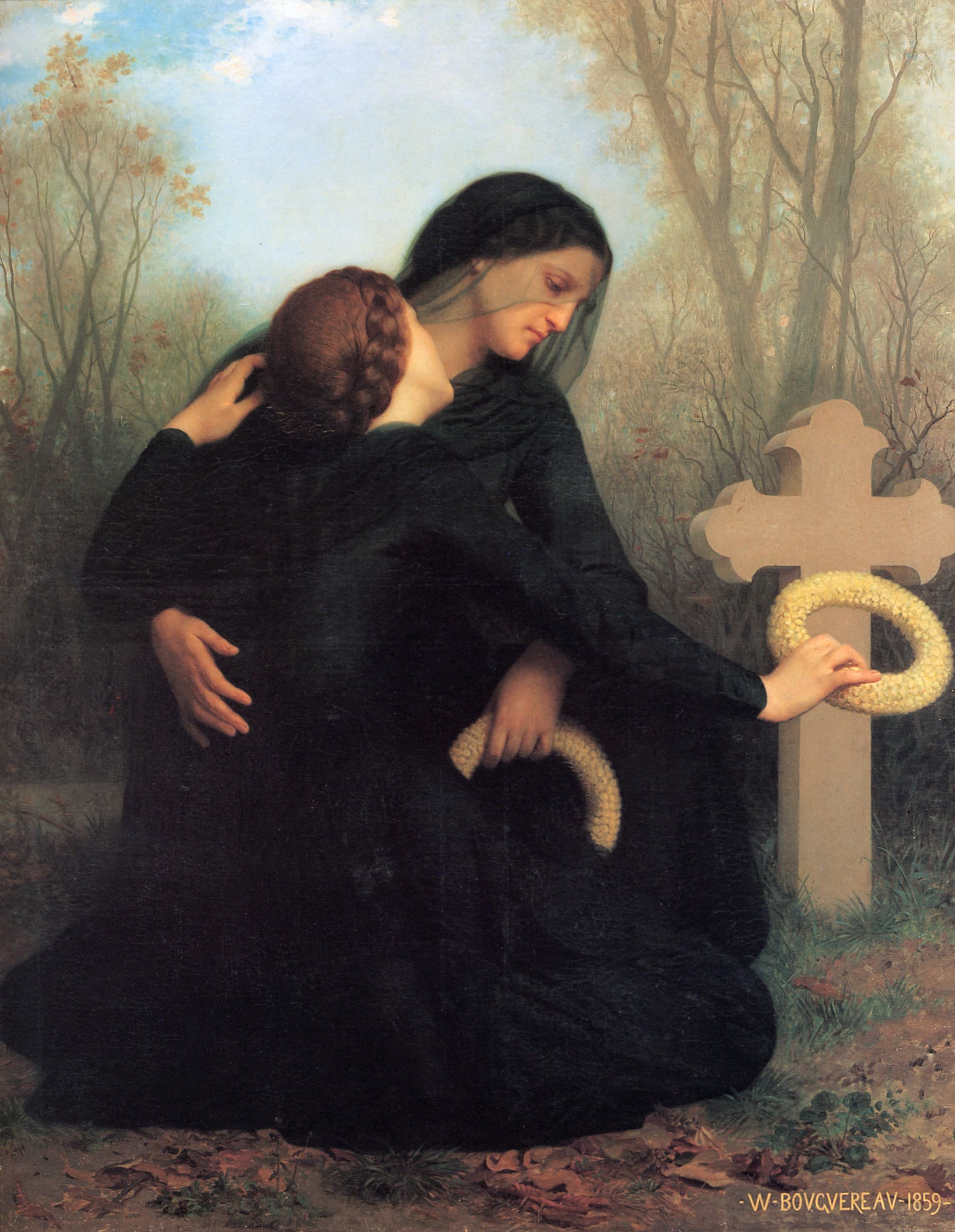
Cover artwork: William-Adolphe Bouguereau, The Day of the Dead, 1859, Musée des Beaux-Arts de Bordeaux. Public-domain reproduction via Wikimedia Commons.
