The Rosary is a Catholic devotion that combines spoken prayers with meditation on the mysteries of Jesus' life and the role of Mary in God's saving work. Catholics pray it to grow closer to Christ, ask for Mary's intercession, and bring their needs and the needs of others before God. Saint John Paul II describes its central purpose as contemplating Christ with Mary. Read Rosarium Virginis Mariae.
If you have seen someone moving a string of beads through their fingers, you have seen the practical aid often used for this prayer. Understanding what happens beyond the beads makes the Rosary much less mysterious to a beginner.
What are rosary beads for?
The beads help you keep your place. A common rosary has a crucifix, introductory beads, and five groups of ten beads. Each group is used for a decade: ten Hail Marys prayed while reflecting on one mystery, with an Our Father before them and a Glory Be afterward. A usual five-decade Rosary meditates on five mysteries. See the USCCB prayer guide.
You can begin learning before you own a rosary. Keep a written guide beside you and count on your fingers if that helps. The point of a counting aid is to free your attention for prayer; losing your place need not turn a quiet moment into a test.
Why do Catholics pray the Rosary?
To spend time with the life of Jesus
The Rosary invites a person to linger over the Gospel rather than rush past familiar events. In Rosarium Virginis Mariae, John Paul II explains that remembering Christ's mysteries in faith helps them shape a person's life. He also warns against reducing the devotion to mechanical recitation. See sections 12–13.
For a beginner, try choosing one detail to notice. At the Nativity, you might reflect on God's humility in coming as a child. During the Carrying of the Cross, you might bring someone who is suffering into your prayer. These are suggested starting points for reflection, not additional formulas you must master.
To ask Mary to pray with and for us
Catholics distinguish the veneration of Mary from the adoration owed to God alone. Asking for her intercession means asking her to pray for us. Her role depends entirely on Christ and leads to him. The USCCB explains this distinction in its guide to devotional practices, questions 7–8.
The Hail Mary makes that request explicit with the words “pray for us sinners.” The Catechism connects the prayer's opening to Gabriel's greeting and Elizabeth's blessing, and explains its closing appeal for Mary's prayers now and at death. Catechism, paragraphs 2676–2677.
If this is new to you, our explanation of why Catholics pray to saints explores intercession more fully. You can also read why Catholics believe Mary was sinless for another common question about Marian devotion.
What are the mysteries of the Rosary?
Here, a mystery is a truth or event of faith to contemplate. The Rosary's twenty mysteries are arranged in four groups of five. These groups guide the meditation rather than add twenty separate spoken prayers. Rosary Center and Confraternity guide.
Joyful Mysteries
These concern the beginning of Jesus' earthly life: the Annunciation, Visitation, Nativity, Presentation in the Temple, and Finding of Jesus in the Temple.
Luminous Mysteries
These focus on Jesus' public ministry: his Baptism, the wedding at Cana, the proclamation of the Kingdom with the call to conversion, the Transfiguration, and the institution of the Eucharist.
Sorrowful Mysteries
These contemplate his Passion: the Agony in the Garden, Scourging at the Pillar, Crowning with Thorns, Carrying of the Cross, and Crucifixion.
Glorious Mysteries
These concern resurrection and glory: the Resurrection, Ascension, Descent of the Holy Spirit, Assumption of Mary, and Coronation of Mary. The Dominican Confraternity of the Most Holy Rosary's mystery guides provide material for each group.
How to pray the Rosary: a beginner's sequence
One common sequence follows the USCCB's instructions, which also link the full prayer texts:
1. Begin with the introductory prayers
Make the Sign of the Cross. Pray the Apostles' Creed, one Our Father, three Hail Marys, and the Glory Be.
2. Pray the first decade
Name the mystery. Pray one Our Father, ten Hail Marys while meditating, then the Glory Be. Many add the optional Fatima prayer, beginning “O my Jesus.”
3. Continue through the other four mysteries
Repeat the decade pattern for each remaining mystery in your chosen group.
4. Close the prayer
Pray the Hail Holy Queen and concluding Rosary prayer, then make the Sign of the Cross.
Keep the guide open while learning. You do not need to memorize every prayer before joining a family or parish group. Listening to others and following along is a reasonable first step.
Which mysteries should I pray today?
A common weekly pattern is Joyful on Monday and Saturday, Sorrowful on Tuesday and Friday, Glorious on Wednesday and Sunday, and Luminous on Thursday. John Paul II proposed this arrangement when introducing the Luminous Mysteries, while expressly allowing freedom for pastoral needs and particular celebrations. See Rosarium Virginis Mariae, section 38.
Treat the pattern as a helpful rhythm. Some communities adapt the Sunday mysteries to the liturgical season. If you join a group, follow its announced mysteries; if you pray privately, a particular feast or need may lead you to another set. Choosing a different mystery does not make your prayer invalid.
A worked example: praying one decade of the Visitation
Begin by reading Luke 1:39–45. Mary visits Elizabeth, whose greeting recognizes the child Mary carries as her Lord. Notice that this mystery includes both a human encounter and recognition of God's action. This suggested exercise is an original aid to meditation, not an additional set of required prayers.
Name the Visitation, the second Joyful Mystery. You might offer the decade for someone isolated by illness. That person is your prayer intention; the Visitation is the mystery you are contemplating. Keeping those distinct can help when you wonder whether to think about Jesus' life or the person you are praying for: you can bring the person into your meditation on the mystery.
Pray the Our Father, then the ten Hail Marys and Glory Be. As the words continue, gently return to one detail: Mary's arrival, Elizabeth's welcome, or the joy of recognizing the Lord. You do not need to invent a different insight for every bead. Afterward, consider whether a call, visit, or message would be welcome to the person you remembered. Ask rather than assume. The practical response need not be dramatic for the prayer to influence your day.
Why repeat the Hail Mary so many times?
The intended rhythm supports loving attention to Christ. It is not a technique for forcing God to grant a request. John Paul II's discussion of repetition emphasizes love and contemplation, while explicitly taking seriously Jesus' warning against empty words. Rosarium Virginis Mariae, sections 12 and 26.
If your attention wanders, pause briefly and return to the mystery. Try reading its Scripture passage before the decade or choosing a single image from the scene. A slower pace may help more than restarting whenever a distracting thought appears.
Does the Rosary replace Mass or reading the Bible?
No. Catholic devotions should support the Church's liturgical life and lead people toward it. The USCCB also explains that the Rosary should encourage prayerful Scripture reading. It complements the sacraments and the Bible rather than replacing them. USCCB, Popular Devotional Practices.
How can I start without feeling overwhelmed?
Set aside a short, quiet window and choose one mystery. Read about it, name a person or concern you want to bring to God, and pray one decade attentively. That is a manageable beginning toward learning the five-decade prayer.
If a group moves too quickly for you, try praying alone with a guide first. If silence makes it harder to stay attentive, ask someone you trust to pray with you. Experiment with a time you can return to, using our simple daily prayer routine for ideas.
Afterward, consider one small response to what you contemplated: offer help, thank someone, seek reconciliation, or spend a little more time with the Gospel passage. Let the prayer have a place in the rest of your day.
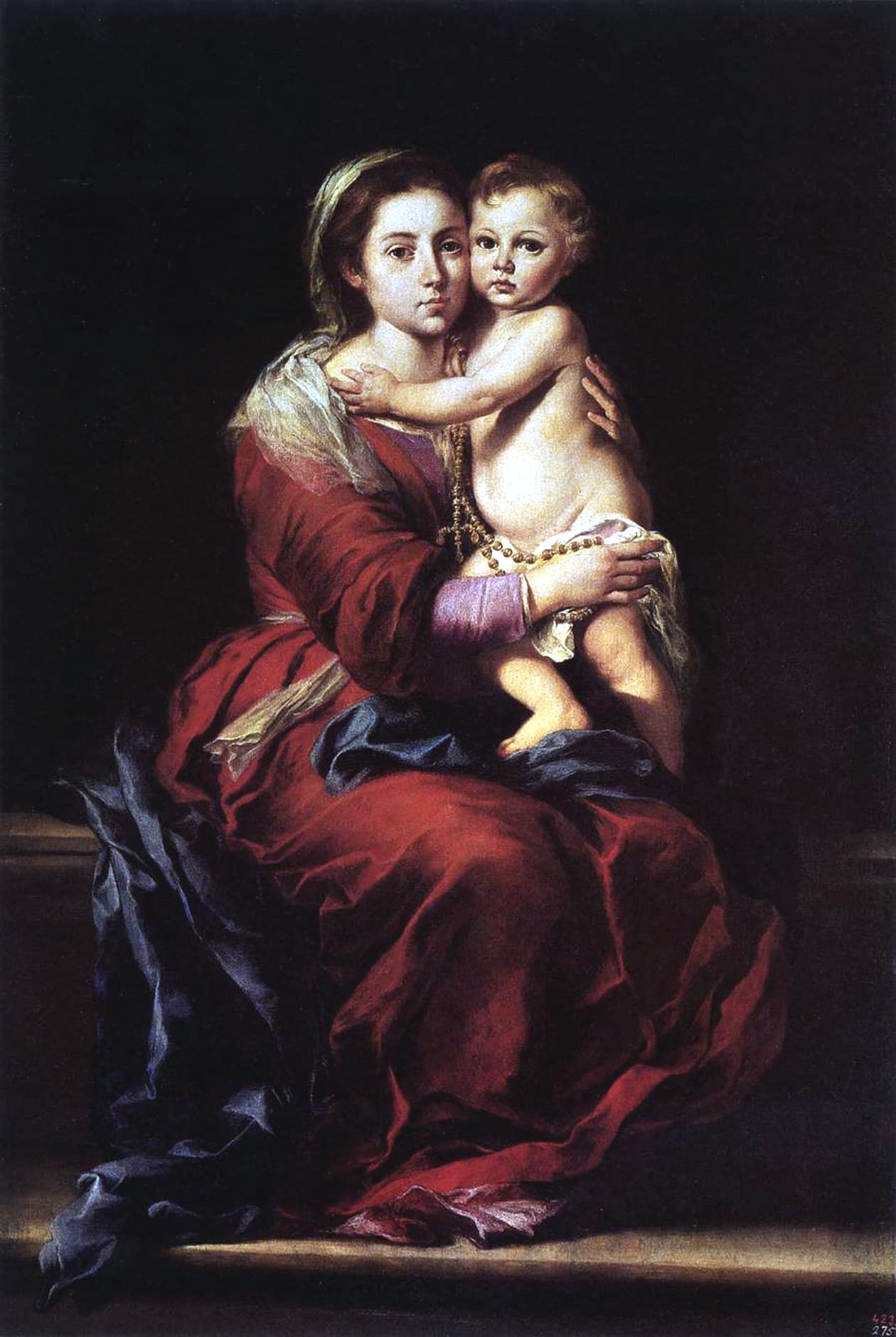
Cover artwork: Bartolomé Esteban Murillo, Virgin and Child with a Rosary. Public-domain reproduction from Wikimedia Commons.
