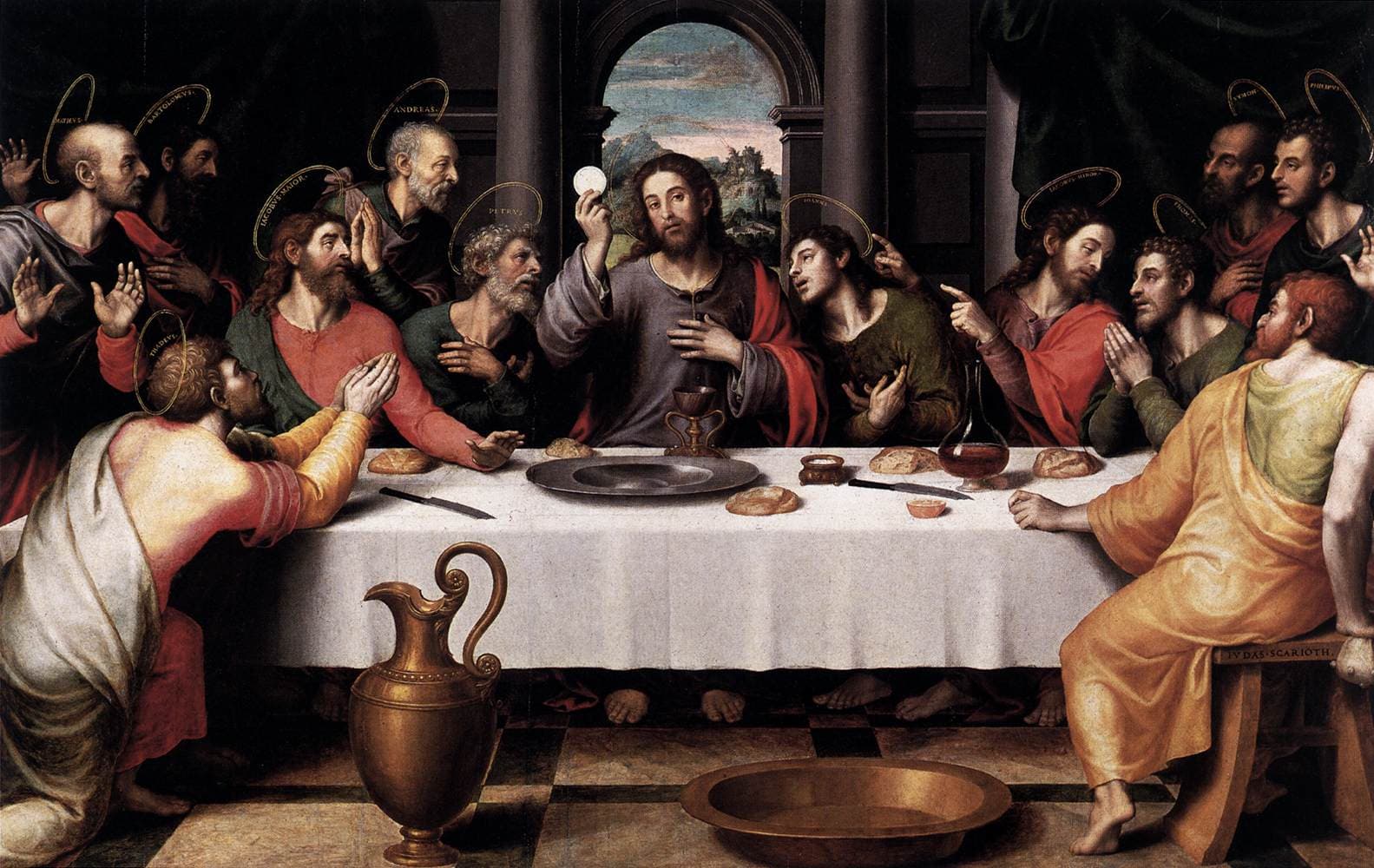
Eucharistic miracles are extraordinary events connected with the Eucharist that Catholics understand as signs pointing to Jesus Christ's presence in the sacrament. Familiar accounts describe a consecrated Host appearing to bleed or the Eucharistic elements taking on the appearance of flesh and blood. A newly reported event, however, is a claim to be examined, not automatically an established miracle.
These stories often raise two questions at once: What do Catholics believe happens at every Mass? And how should someone evaluate an unusual event associated with Communion? Keeping those questions distinct makes the subject easier to understand.
The Real Presence comes first
Catholics believe that, through the consecration at Mass, the bread and wine become Christ's Body and Blood while their appearances remain. The whole Christ is present: body, blood, soul, and divinity. This is the Real Presence. The Church calls the change in the underlying reality of bread and wine transubstantiation. See the USCCB's explanation of the Eucharist.
That teaching does not depend on anyone seeing blood, experiencing strong emotions, or witnessing something extraordinary. A consecrated Host does not become more fully Christ's Body because an unusual sign is reported. The distinction is between the sacrament itself and an extraordinary event connected with it.
Someone may therefore describe every Mass as miraculous while also using the phrase “Eucharistic miracle” more narrowly for an unusual, observable sign. Understanding which meaning a speaker intends helps prevent confusion.
For example, someone attending an ordinary parish Mass is not receiving a lesser Christ than someone visiting a famous shrine. A reported sign can prompt renewed attention, but the enduring focus is Christ and the sacramental life of the Church. Our guide to the seven sacraments offers a starting point for that wider understanding.
Two well-known Eucharistic miracle accounts
Lanciano, Italy
The tradition associated with Lanciano places the event in the eighth century. It tells of a monk troubled by doubt about the Eucharist who, while celebrating Mass, witnessed the bread and wine change into flesh and blood. Vatican News recounts the tradition of Lanciano, alongside the story of Bolsena.
Readers should distinguish the historical tradition, later examinations of preserved material, and claims made by modern commentators. They are different kinds of evidence. A detailed assertion about a laboratory result needs the actual report and its context; the existence of a famous shrine does not verify every scientific claim attached to it online.
Bolsena and Orvieto, Italy
In a 2010 audience, Pope Benedict XVI recalled the 1263 event at Bolsena: a priest doubting the Real Presence saw blood appear from the consecrated Host. Benedict also described the preservation in Orvieto of the corporal, the altar cloth associated with the event. Read his audience on Saint Juliana of Cornillon.
That audience places the event within a wider history of Eucharistic devotion, including Saint Juliana's promotion of the feast of Corpus Christi and Saint Thomas Aquinas's liturgical writing. These connections help explain why Catholics encounter miracle accounts through pilgrimage, sacred art, hymns, and the Church calendar.
How does the Church examine a reported miracle?
The Vatican's 2024 norms for discerning alleged supernatural phenomena place the local bishop in dialogue with the Dicastery for the Doctrine of the Faith. The process examines testimony, relevant objects, doctrinal concerns, and spiritual fruits, alongside potential deception or abuse.
Article 11 calls for appropriate experts to examine objects and organic material, with special reverence when the Eucharistic species are involved.
The norms distinguish several possible conclusions. A nihil obstat can acknowledge positive spiritual fruits and permit devotion without certifying supernatural origin. As a rule, the process does not culminate in a declaration that a phenomenon is supernatural; an exceptional procedure can be authorized by the pope. Read the actual decision in any particular case rather than treating every form of permission as interchangeable.
Can science prove a Eucharistic miracle?
Scientific testing can address specific questions about a sample: its composition, possible contamination, or whether a proposed natural explanation fits the findings. The strength of a result depends on the methods, documentation, sample handling, and limits of the examination.
Finding something unexplained is not the same as scientifically identifying God as its cause. Nor does identifying human tissue, by itself, establish whose tissue it is or how it arrived there. Those are separate claims that require separate support.
When reading a headline, ask whether it links to an original laboratory report, identifies the investigators, explains how the sample was preserved, and distinguishes observations from interpretation. A compelling presentation can be a starting point for learning, but it cannot substitute for those details.
A worked example: separating a claim from its evidence
Imagine an online post says, “Scientists proved this Host became heart tissue.” This is a hypothetical headline, not a report about a particular shrine. There are several separate questions inside it. What was the object? Who obtained the sample? What exactly did the examination identify? Does the report document an uninterrupted connection between the sample and the claimed event? What has the responsible Church authority actually concluded?
Write down the evidence for each question separately. A photograph may establish appearance. A witness account may describe what a person remembers. A laboratory report may characterize the submitted material. An ecclesiastical statement may permit a devotion or give another judgment. None of these documents automatically supplies everything missing from the others.
If an article links only to another article, keep following its references until you reach the original statement or report. If you cannot reach it, say that the claim remains unverified in your reading. This is a practical source-checking method, not a declaration that an unexplained event must be false.
Must Catholics believe every Eucharistic miracle story?
Catholic belief in the Eucharist is part of the Church's sacramental faith. An individual extraordinary account has a different role. The Compendium of the Catechism, question 10, explains that private revelations do not belong to the deposit of faith and may help people live the faith insofar as they lead to Christ. They cannot replace or correct his definitive revelation.
A favorable nihil obstat does not oblige Catholics to believe the phenomenon has a supernatural origin. Accepting every circulated story is not a test of devotion.
What about emotional experiences during Mass?
A person can be deeply moved at Mass without reporting any visible change in the Eucharistic elements. The distinction became relevant in September 2026 when Father Brent Bowman clarified his experience in Hopkins, Minnesota. His statement on the archdiocese's website described a private spiritual experience and explicitly denied seeing physical blood or flesh.
Our Minnesota Eucharistic miracle report explains the clarification. It is a useful example of why a witness's own account should accompany a widely shared video.
Let curiosity lead to a deeper understanding
If these accounts have caught your attention, begin with the Church's teaching about the Eucharist. Bring questions to a parish priest or OCIA catechist, read a full source before sharing a short clip, and make space for quiet prayer.
You might also explore Saint Thomas Aquinas, whose writing connects careful thought with Eucharistic devotion, or start a simple daily prayer routine. The next step can be small: a question asked honestly, a source read carefully, or a few attentive minutes at church.
Artwork credit
Cover: The Last Supper by Juan de Juanes, public domain, via Wikimedia Commons. This is illustrative sacred art, not a depiction of a reported Eucharistic miracle.
